
TL;DR

Get kitchen gear delivered free with Prime
- Fast, free delivery on millions of items
- Prime Video, Amazon Music and more included
- Member-only deals all year
Hand sharpening offers precision and control but requires skill, while pull-through sharpeners are quick and easy but less customizable. Your choice depends on your experience and knife care goals.
Choosing how to sharpen your knives isn’t just about convenience. It’s about preserving your tools, safety, and the joy of cooking with a razor-sharp edge. Whether you’re a seasoned chef or a weekend cook, understanding the difference between traditional hand sharpening and pull-through sharpeners makes a real difference. One method demands skill, the other offers speed. But which truly works best for your knives?
This guide will walk you through the strengths and weaknesses of each. Expect real-world examples, practical tips, and clear comparisons. By the end, you’ll know which approach keeps your blades slicing smoothly and lasting longer in your off-grid kitchen.
Hand Sharpening vs Pull-Through Sharpeners
Hand sharpening rewards practice with precision, customization, and a refined edge. Pull-through tools exchange that control for speed and simplicity. The right choice depends on your knife, your experience, and how carefully you want to preserve the blade.
Maximum control over angle, pressure, and grit progression.
A guided, repeatable option for quick maintenance.
Coarse slots and heavy pressure can shorten blade life.
One method follows the blade. The other asks the blade to follow the tool.
A stone lets you choose the geometry. A pull-through slot supplies geometry for you. That distinction shapes sharpness, speed, consistency, and long-term wear.
Hand sharpening
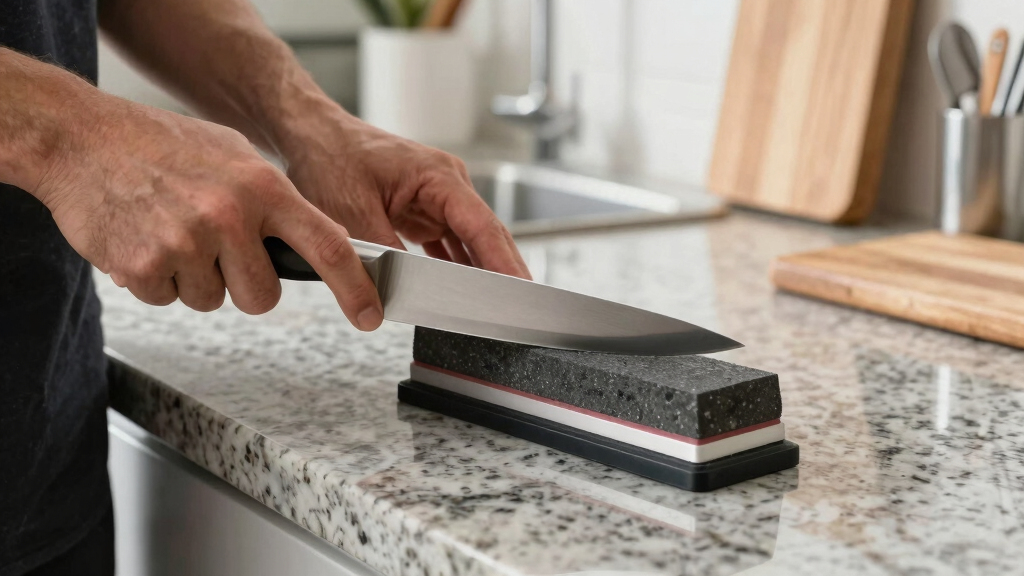
The sharpener controls angle, pressure, abrasive grit, and finishing. This makes the method suitable for delicate Japanese edges, robust Western blades, and unusual bevels.
- +Tailors the edge to each knife
- +Can remove very little metal
- +Produces a highly refined finish
- ~Requires patience and muscle memory
Pull-through sharpening
Preset slots stabilize the sharpening angle and simplify the motion. It is approachable for beginners and useful when speed matters more than a custom edge.
- +Fast, portable, and easy to repeat
- +Minimal technique required
- ~Limited angle and grit options
- −Heavy use may remove excess steel
Precision and blade care, compared
These ratings describe typical tools and correct use. Guided systems with adjustable angles can narrow the gap, while poor hand technique can erase the advantages of a stone.
| Decision factor | Hand sharpening | Pull-through sharpening |
|---|---|---|
| Angle control | ✓Fully adjustable for blade geometry | ~Usually fixed by the slot |
| Grit choice | ✓Coarse-to-fine progression available | ~Often limited to one or two stages |
| Speed | ~Slower setup and execution | ✓Quick passes and immediate results |
| Beginner access | ~Technique must be learned | ✓Guided and easy to understand |
| Metal removal | ✓Low when pressure and grit are correct | ✗Can be aggressive, especially when coarse |
| Delicate blades | ✓Excellent with careful technique | ✗Fixed geometry may chip or over-grind |
| Consistency | ~Depends on the operator | ✓Preset guides support repeatable passes |
| Long-term value | ✓Quality stones can last for years | ~Inserts or the unit may need replacement |
Control rises with skill. Convenience works immediately.
Illustrative ratings summarize the practical differences described in the guide; they are decision aids, not laboratory measurements.
A well-executed hand sharpening can create a sharper edge while preserving more of the blade’s original steel.
Restore only what the edge needs
Sharpening removes metal to rebuild a dull edge. Honing simply realigns an edge that still exists. Checking first prevents unnecessary grinding.
Read the edge
Look for rolling, reflection, chips, and dull sections.
Match the method
Choose honing, stones, or a compatible guided slot.
Use light pressure
Work evenly; progress from coarse only when necessary.
Test and stop
Check the full edge and avoid extra passes after sharpness returns.
Choose for the knife in front of you
For valuable or specialized blades
Best when you want custom geometry, a refined finish, and careful metal removal. Ideal for thin Japanese knives and enthusiasts willing to practice.
For fast working sharpness
Useful for durable everyday knives, beginners, and off-grid kitchens where speed and portability matter more than edge customization.
Hone often, sharpen less
Realign the edge regularly, sharpen only when dull, and reserve coarse abrasives for actual repair. With a pull-through, use light, even passes.
Why Hand Sharpening Gives You More Control (And Why That Matters)
Hand sharpening involves manually grinding your knife against abrasive stones or honing rods. It sounds simple, but the real magic lies in control. You decide the angle, the pressure, and the grit. This means you can tailor the process to your specific knife—be it a delicate fillet or a heavy chef’s knife.
Why does this control matter? Because different knives have different requirements. A delicate Japanese santoku, for example, needs a precise, gentle touch to preserve its thin edge. Over-aggressive sharpening or incorrect angles can chip or dull such blades quickly, reducing their lifespan and performance. Conversely, a robust Western chef’s knife can handle more aggressive sharpening, allowing you to restore a dull edge more efficiently. The tradeoff is that mastering hand sharpening requires practice—improper technique can lead to uneven edges or unnecessary metal removal, which shortens blade life over time. Therefore, understanding your knife’s material and edge geometry helps you choose the right approach, balancing care and efficiency.
professional knife sharpening stone
As an affiliate, we earn on qualifying purchases.
As an affiliate, we earn on qualifying purchases.
Pull-Through Sharpeners: Fast, Foolproof, and Perfect for Beginners
Pull-through sharpeners are designed for convenience, but their appeal goes beyond ease. They lock your knife into a fixed angle, ensuring consistent sharpening every time. This consistency is crucial because uneven angles or inconsistent pressure are common pitfalls for beginners. By guiding your blade, these tools reduce the learning curve, making it easier to maintain a reasonably sharp edge without specialized skills.
However, this fixed-angle approach also means less customization. Some knives, especially those with unique bevels or delicate edges, may not benefit from a one-size-fits-all angle. Additionally, because the abrasive surfaces are often coarse or medium grit, frequent use can remove more metal than necessary, leading to faster dulling if not used carefully. For routine touch-ups, pull-throughs are excellent—they keep blades reasonably sharp and save time. But over-reliance on them without understanding their limitations can result in uneven edges or even damage to high-end knives. The key is to use them as part of a balanced maintenance routine, not as a substitute for more precise methods when needed.
manual knife sharpener for precision
As an affiliate, we earn on qualifying purchases.
As an affiliate, we earn on qualifying purchases.
The Big Tradeoff: Precision and Blade Care
| Hand Sharpening | Pull-Through Sharpening |
|---|---|
| Offers precise control over angle and grit. Can be customized for different knives. | Limited control due to fixed angles. Usually only one or two grit options. |
| Removes less metal when done correctly, extending blade life. | Potential to remove too much metal if used aggressively, risking shorter blade lifespan. |
Why does this matter? Because removing too much metal too quickly can compromise the integrity of your blade, making it less durable over time. Hand sharpening allows you to work slowly and deliberately, adjusting your technique to preserve the knife’s original geometry and temper. This results in a sharper, longer-lasting edge and reduces the risk of chipping or dulling prematurely. In contrast, pull-through sharpeners often rely on coarse abrasives that can strip away layers of metal rapidly, especially if used with excessive force or repeatedly on the same spot. This can lead to a weaker edge, increased susceptibility to damage, and a shorter overall lifespan of your blades. Thus, while pull-throughs are convenient, they require careful use to prevent unintended damage. Proper technique, whether hand sharpening or using a pull-through, is essential to maintaining blade integrity and performance over the long haul.
pull-through kitchen knife sharpener
As an affiliate, we earn on qualifying purchases.
As an affiliate, we earn on qualifying purchases.
electric knife sharpener for home use
As an affiliate, we earn on qualifying purchases.
As an affiliate, we earn on qualifying purchases.
Halloween Picks
halloween
As an affiliate, we earn on qualifying purchases.