TL;DR

Get kitchen gear delivered free with Prime
- Fast, free delivery on millions of items
- Prime Video, Amazon Music and more included
- Member-only deals all year
Using the correct grip and proper technique makes knives safer and more effective. Sharp knives require less force, and focusing on hand position reduces injuries. Staying informed on safety tools and methods boosts confidence in the kitchen.
Imagine slicing through a tough squash with a dull blade. You push harder, losing control. Now picture a sharp knife gliding effortlessly, your fingers protected by a perfect grip. It’s not just about sharpness—your technique and handling matter just as much.
In this guide, you’ll learn how to hold your knife safely, use effective cutting techniques, and stay aware during food prep. These skills can turn dangerous moments into confident, efficient cooking—no matter if you’re in a tiny off-grid cabin or your well-equipped kitchen.
Use the pinch grip combined with the claw technique to maximize control and safety.
A sharp knife requires less force and is less likely to slip, making it safer than dull blades.
Always cut away from your body and keep your work area stable to avoid accidents.
Invest in safety accessories like cut-resistant gloves and proper storage solutions.
Regularly hone and sharpen knives to maintain their safety and effectiveness.
Knife Safety & Proper Cutting Grip
Control starts before the first cut. A sharp blade, a stable board and deliberate hand placement turn risky force into smooth, confident movement—from a compact off-grid cabin to a fully equipped kitchen.
Two grips. One controlled system.
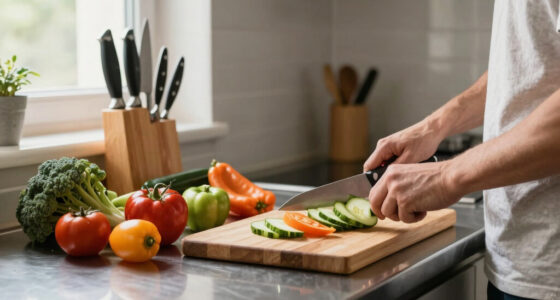
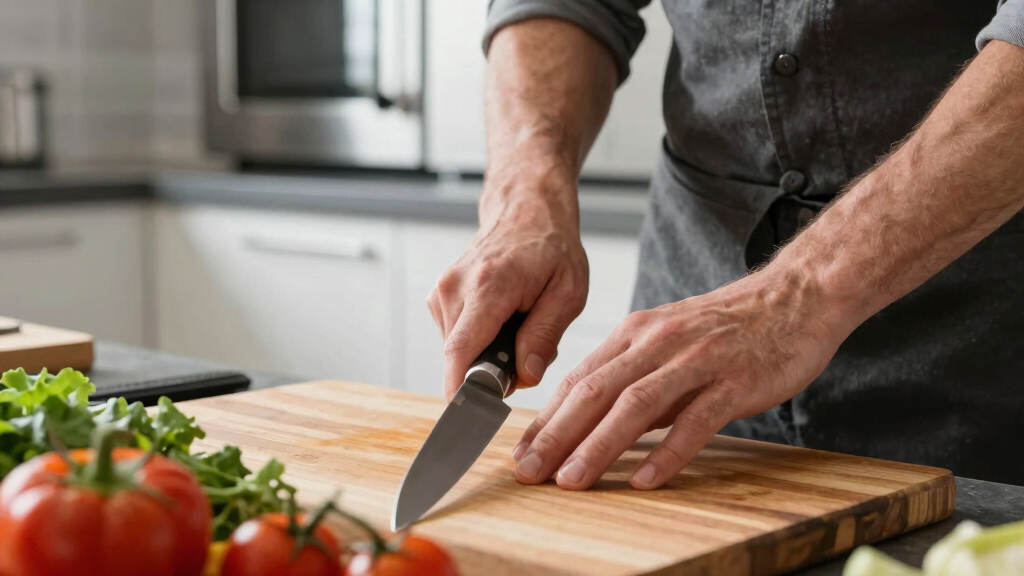
The knife hand controls the blade through a pinch grip. The guide hand forms a claw, keeping fingertips behind the knuckles. Together they improve precision and build safer muscle memory.
The Pinch Grip
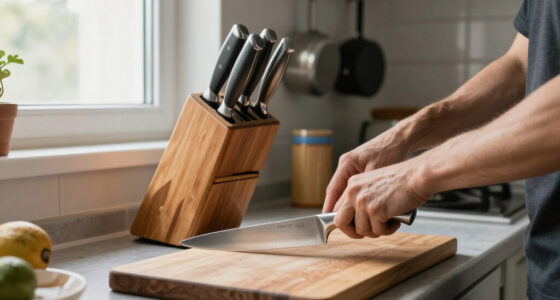
Pinch the blade just ahead of the handle between thumb and forefinger. Wrap the remaining fingers around the handle firmly but comfortably—secure, never tense.
The Claw Technique
Curl fingertips inward and place the knuckles toward the blade. The flat side of the knife can glide beside the knuckles while the fingertips stay safely recessed.
Grip the blade just below the handle.
Close three fingers around the handle.
Tuck guide-hand fingertips inward.
Keep knuckles beside the blade.
Move smoothly with the tip near the board.
Sharp beats force.
When an edge cannot bite cleanly, the cook compensates with pressure. That extra force increases fatigue and makes a slip harder to stop.
The tomato test
A sharp knife starts through tomato skin with light pressure. A dull knife crushes the surface before cutting, encouraging a forceful push and increasing the chance of sideways movement.
Rule of thumb: if the blade skids, crushes or needs heavy pressure, stop and service the edge.
Build a safer cutting zone.
Good knife safety is a system. Direction, stability, storage, attention and maintenance work together so one small mistake does not become an injury.
Cut away
Direct the blade away from your body and other people.
Stop the slide
Use a non-slip board or place a damp towel beneath it.
Store securely
Choose a block, magnetic strip or fitted protective sheath.
Stay present
Pause cutting when distracted, rushed or looking away.
Maintain the edge
Hone regularly and sharpen before extra force is needed.
| Safety factor | Preferred practice | Risky practice | Effect on control |
|---|---|---|---|
| Knife hand | ✓ Pinch grip | ✗ Loose handle-only grip | ✓ Precise blade guidance |
| Guide hand | ✓ Curled claw | ✗ Flat exposed fingers | ✓ Knuckle barrier |
| Blade edge | ✓ Honed and sharp | ✗ Dull or damaged | ✓ Less force required |
| Board | ✓ Level and non-slip | ✗ Loose or unstable | ✓ Predictable movement |
| Cutting motion | ✓ Smooth rocking action | ~ Forceful chopping | ✓ Reduced lateral stress |
Protection beyond technique.
Accessories cannot replace attention or correct grip, but they add useful protection for beginners, repetitive prep and difficult ingredients.
Cut-resistant gloves
Kevlar or Dyneema-style fibers add protection while preserving dexterity. Especially useful around frozen, bony or slippery foods.
Finger & blade guards
Simple shields reduce exposed contact during repetitive work and protect the edge during storage or transport.
Balanced handles
Stable, comfortable handles reduce strain and help cooks maintain a consistent grip through longer prep sessions.
Blocks, strips & sheaths
Secure storage prevents accidental drawer contact and protects the edge from damage that can make cutting less predictable.
Smart feedback
Developing sensor concepts may flag excessive force or poor grip, bringing real-time coaching into the kitchen.
Lower-impact design
Recycled and biodegradable handle or accessory materials are expanding the options for safety-minded kitchens.
Know what to do next.
Preparation includes maintenance, choosing appropriate tools and responding calmly if an injury occurs.
If you cut yourself
Stop, apply firm pressure and clean the wound. Seek medical attention for deep wounds, heavy bleeding, loss of sensation or bleeding that does not stop.
For beginners or children
Use age-appropriate safety knives with rounded tips, guarded designs or reduced cutting edges, always with close supervision.
For home sharpening
Use a honing steel for routine alignment. Restore a worn edge with a whetstone or a reputable professional sharpening service.
When choosing a knife
Select a sharp blade suited to the task with a balanced weight and a handle that remains comfortable and secure in your hand.
How to Hold a Knife for Safety and Control
The way you grip your knife directly impacts safety. The most recommended method is the pinch grip, where you clamp the blade just below the handle with your thumb and forefinger. This grip offers superior control because it allows you to manipulate the knife with more precision and less fatigue, especially during prolonged chopping sessions. When your grip is secure, your movements are more fluid, reducing the risk of slips that could lead to cuts.
Pair this with the claw technique for your other hand: curl your fingertips inward, holding food with your knuckles facing the blade. This creates a natural barrier—your knuckles guide the knife and protect your fingers from accidental cuts. Understanding and practicing these techniques means you’re not just holding a knife; you’re actively controlling it to enhance safety and efficiency in your food prep. Proper grip and technique are about developing muscle memory, which ultimately reduces hesitation and mistakes during cutting tasks.
As an affiliate, we earn on qualifying purchases.
Step-by-Step: Mastering the Claw and Pinch Grip
- Hold the knife with the pinch grip, gripping the blade just below the handle with your thumb and forefinger. This positioning gives you more control and less fatigue, especially during detailed cuts.
- Wrap your remaining fingers around the handle firmly but comfortably, ensuring a secure hold without tension.
- Form the claw shape with your other hand: curl fingers inward, knuckles facing the blade, so they serve as a guide and barrier.
- Place the food on the cutting board, pressing it gently with your knuckles as a guide for your knife. This keeps your fingers safe while maintaining control over the cut.
- Use a gentle rocking motion, keeping the tip of the knife in contact with the board, to make precise, controlled cuts. This technique minimizes lateral stress on the blade and enhances safety.
Practicing this sequence helps develop muscle memory, making your cuts more consistent and safe. Start with softer vegetables like bell peppers, then gradually progress to denser items like carrots or onions. Over time, these habits become second nature, greatly reducing the risk of accidents.
As an affiliate, we earn on qualifying purchases.
Why a Sharp Knife Is Safer Than a Dull One
It might seem counterintuitive, but a sharp knife is actually safer because it requires less force to cut through food. When a blade is dull, you tend to press harder, which increases the chance of your hand slipping and causing an injury. Sharp knives, on the other hand, glide through ingredients with minimal effort, giving you better control and reducing fatigue during repetitive tasks.
For example, trying to cut a stubborn tomato with a dull knife often results in applying excessive pressure, which can cause the knife to slip or the food to squish, leading to uneven cuts or accidents. Conversely, a sharp knife slices effortlessly, allowing you to focus on your technique rather than brute force. Regular honing realigns the edge, while periodic sharpening maintains a keen cutting surface. Think of it as maintaining your tools—dull blades are not just inefficient but dangerous because they demand more force and increase the risk of slips. Investing time in sharpening not only makes your prep faster but also significantly enhances safety by reducing the likelihood of accidental cuts.
As an affiliate, we earn on qualifying purchases.
Top 5 Safety Tips to Keep in Mind When Cutting
- Always cut away from your body. This fundamental rule prevents injuries if your hand slips or the knife suddenly jerks. Cutting away ensures that any slips result in the knife moving outward, not toward you or others nearby. Consistently practicing this habit builds muscle memory, making it second nature and reducing hesitation or accidental injuries during high-pressure situations.
- Use a non-slip cutting board. Rubber or silicone bases grip the counter surface, preventing the board from sliding during vigorous chopping. This stability is crucial in off-grid environments where surfaces might be uneven or less secure, as a shifting board can cause loss of control and injuries. Ensuring your workspace is stable minimizes the risk of accidents and makes your cutting more precise.
- Store knives properly. Use a knife block, magnetic strip, or sheaths to keep blades protected and prevent accidental contact. Proper storage not only prolongs blade sharpness but also creates a safer environment by preventing accidental cuts when reaching into drawers. In small or cluttered kitchens, organized storage is especially important to avoid rummaging and potential injuries.
- Stay focused. Distractions like rushing, multitasking, or using your phone can divert your attention from your task, increasing the risk of slips and cuts. Developing mindfulness while cutting—focusing solely on your food—significantly reduces accidents. In off-grid settings, where distractions may be fewer, this habit becomes even more crucial to safety.
- Keep knives sharp. Dull blades require more force, which compromises control and increases the chance of slipping. Regular honing and sharpening are essential maintenance steps that keep your knives performing optimally. A sharp knife not only makes prep easier but also ensures safer, more controlled cuts, especially when working with dense or slippery foods.
As an affiliate, we earn on qualifying purchases.
The Latest in Knife Safety Gear and Tech
Modern safety tools are making a difference. Cut-resistant gloves are a game-changer, especially for beginners or when handling tricky bones or frozen foods. These gloves are made from materials like Kevlar or Dyneema, which provide a high level of protection against cuts while maintaining dexterity. They allow you to focus on technique without the constant fear of slipping and cutting yourself, making them invaluable in high-risk situations.
Similarly, finger guards that clip onto knives or fit over fingers add an extra layer of protection during intensive prep. These simple devices are especially useful when working with small or slippery ingredients, or when performing repetitive cuts that can lead to fatigue-induced slips. Ergonomic knife handles designed to reduce strain and improve grip stability are also gaining popularity, as they help maintain proper hand positioning and reduce fatigue, which is a common cause of accidents. Additionally, safety devices like blade guards and magnetic strips keep knives secure and accessible, preventing clutter and accidental contact in busy kitchens.
Emerging tech includes smart knives with sensors that monitor grip pressure or force applied, alerting you if you’re holding the knife improperly. While still niche, these advancements aim to make kitchen safety more intuitive and accessible, especially for those new to knife skills or working in challenging environments. Integrating these tools into your routine can significantly reduce injury risks and build confidence in your food prep skills.
How to Sharpen and Hone Your Knives at Home
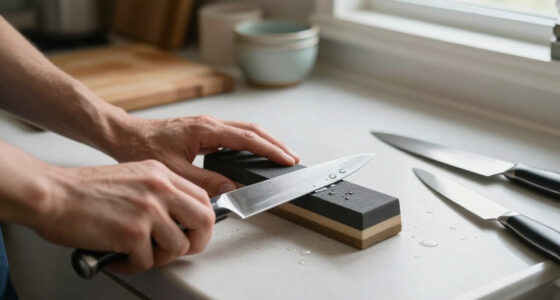
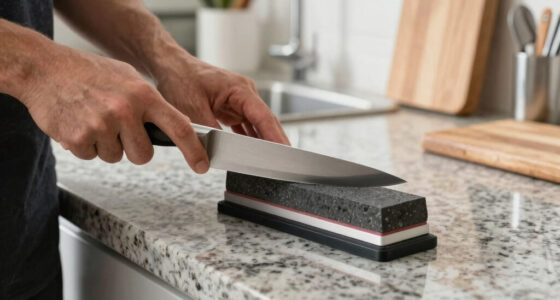
Keeping your knives sharp isn’t complicated, but it’s essential. Use a honing steel after every few uses to realign the edge. Honing doesn’t remove material but instead straightens the microscopic teeth on the blade, restoring smoothness and control. For a more thorough sharpening, a whetstone is your best option. Soak the stone in water, then slide the blade at a 15-20 degree angle across its surface, maintaining a consistent angle for even sharpening. Proper technique ensures an even edge, which is crucial for safety and performance.
Practice slow, controlled strokes, alternating sides to prevent uneven wear. If you’re unsure about your technique, professional sharpening services can quickly restore your blades to optimal condition. Regular maintenance not only prolongs the lifespan of your knives but also keeps them performing at their best, reducing the effort needed and minimizing safety risks during food prep. Remember, a well-maintained knife is a safer knife—less force is needed, and control is improved, especially when working with dense or slippery foods.
Frequently Asked Questions
How do I hold a knife safely for precise cuts?
Use the pinch grip, gripping the blade just below the handle with your thumb and forefinger. Curl your remaining fingers into a claw shape, with knuckles facing the blade. This combo gives you control and finger protection during slicing or dicing.
What should I do if I accidentally cut myself?
Immediately apply firm pressure to stop bleeding. Clean the wound with soap and water. For deep cuts, seek medical attention promptly. Keep the cut elevated and covered with a sterile bandage until professional help is available.
How often should I sharpen my knives at home?
Hone your knives with a steel after every few uses to keep the edge aligned. Sharpen with a whetstone or professional service every 6-12 months, depending on use. Regular maintenance prevents dullness and enhances safety.
Are safety knives good for beginners or children?
Yes, safety knives with rounded tips or dull blades are ideal for beginners or kids, helping them learn proper handling without the risk of serious cuts. Always supervise young cooks and choose age-appropriate tools.
What’s the best way to store knives safely?
Use a knife block, magnetic strip, or protective sheaths. These prevent accidental contact and keep blades sharp longer. Avoid tossing knives loosely into drawers, which increases the risk of injury and dulling.
Conclusion
Good knife handling isn’t just about technique—it’s about habits. Mastering the correct grip, staying attentive, and keeping your blades sharp can turn dangerous moments into confident, efficient food prep.
Remember, safety in the kitchen is a skill, not a chance occurrence. Keep these tips in mind, and your knives will serve you safely for years to come. After all, a well-handled knife is a trusted tool in any self-reliant kitchen.
Halloween Picks
halloween
As an affiliate, we earn on qualifying purchases.