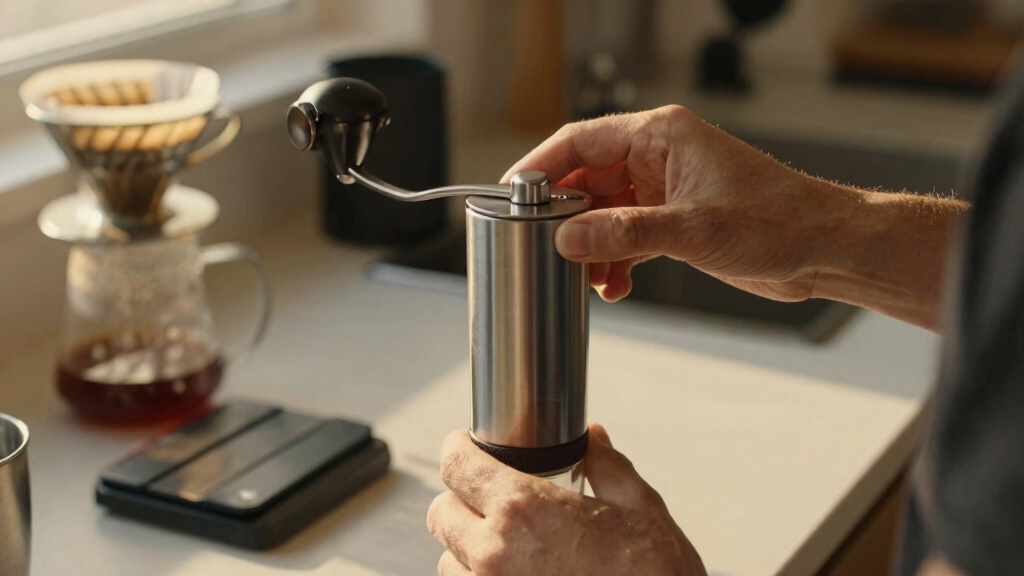

TL;DR
Open a free Amazon Business account
Business pricing, bulk buying and tax-exempt orders.
Create a free accountAs an affiliate, we earn on qualifying purchases.
Dialing in your grind size for pour-over coffee involves starting with a medium grind, brewing, tasting, and tweaking until the flavor and brew time align. Consistency and small adjustments make all the difference in achieving a clean, balanced cup.
When it comes to pour-over coffee, grind size is the secret sauce. It’s the difference between a bright, balanced cup and a muddy, bitter mess. Yet, many home brewers stick with a default setting, never fine-tuning to match their beans or equipment.
Mastering how to dial in your grind size isn’t just about precision; it’s about unlocking a world of flavor. This guide will give you a clear, practical approach to find that sweet spot, with tips you can implement right away.
Start with a medium grind, then tweak based on brew time and flavor.
Small adjustments (a quarter turn) make big differences—be patient.
Consistent grind size from a quality burr grinder is essential for reproducibility.
Brew time of 2.5–4 minutes is your best guide for proper extraction.
Notes help refine your technique and replicate your best brews.
Why Your Grind Size Changes Everything
Grind size controls how quickly water extracts flavor from your coffee. Finer grinds increase surface area, speeding up extraction. Coarser grinds slow it down. Think of it like adjusting the flow of a river—too fast, and it splashes; too slow, and it stagnates.
For pour-over, a grind like sea salt usually works well. But even that needs tweaking based on your beans, filter, and pouring style. A slightly finer grind can boost brightness, while a coarser one can smooth out harshness.
Understanding why this matters is crucial: a proper grind ensures optimal extraction, balancing the solubles dissolved in your brew. If your grind is too fine, over-extraction occurs, leading to bitterness and astringency. Too coarse, and under-extraction results in sourness and weak flavor. The tradeoff is timing—finer grinds extract faster but risk overdoing it, while coarser grinds require longer brew times to reach full extraction.
For example, if your brew takes more than 4 minutes, you’re probably using too fine a grind, risking over-extraction and bitterness. If it’s under 2 minutes, it’s likely too coarse, leading to underdeveloped flavors. Adjusting grind size carefully fine-tunes this balance, allowing you to craft a cup that’s both flavorful and well-rounded.

Pro Manual Coffee Grinder Stainless Steel Conical Burr With Adjustable Settings.Portable For Espresso, French press, Pour-over. All-metal, Plastic-free, Perfect For Travel camping
- Consistent Stainless Steel Burr: Ensures uniform grind for various brewing methods
- Portable and Lightweight: Ideal for travel, camping, and on-the-go use
- Adjustable Grind Settings: Customize grind size for espresso, French press, and more
As an affiliate, we earn on qualifying purchases.
As an affiliate, we earn on qualifying purchases.
How to Start Dialing in Your Grind for Perfect Flavor
- Begin with a medium grind—think sand or sea salt. This provides a balanced starting point as it generally offers a good compromise between extraction speed and control.
- Brew a batch following your usual method, timing it to around 3 minutes. Use this as your baseline to observe how the flavor and timing align with your expectations.
- Taste the coffee. Is it balanced? Too bitter or sour? Consider what the flavor profile indicates about your grind—over-extraction or under-extraction.
- If the coffee tastes bitter, harsh, or over-extracted, go coarser by a small step. If it’s sour, weak, or under-extracted, go finer. This is about understanding how small changes influence the overall extraction process.
- Repeat the process, adjusting in small increments—no more than a quarter turn on your grinder—until the flavor is clean and the brew time hits 2.5–4 minutes. Remember, each small tweak significantly impacts the extraction, so patience is key.
For example, if your first brew takes 5 minutes and tastes bitter, try a slightly coarser grind and brew again. Keep notes of each change, and over time, you’ll develop a more intuitive sense of how your equipment responds to different settings.
Understanding the implications of each adjustment helps you make more informed decisions, leading to a more consistent and satisfying cup over time.

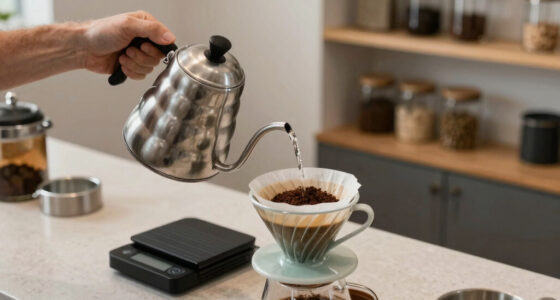
Pour Over Coffee Maker Set, Coffee Pour Over Dripper Kit with Kettle
- Complete Pour Over Coffee Set: Includes kettle, filter, cup, grinder, and scale
- High-Quality Materials: Made of food-safe stainless steel and borosilicate glass
- Dishwasher Safe Components: Kettle, filter, cup; grinder and scale not included
As an affiliate, we earn on qualifying purchases.
As an affiliate, we earn on qualifying purchases.
Comparison: How Different Grind Sizes Affect Your Coffee
| Grind Size | Visual Cue | Extraction Speed | Flavor Impact |
|---|---|---|---|
| Extra Fine | Powdery, like flour | Fast, 1-2 min | Bitter, over-extracted, muddy |
| Fine | Sugar or salt | Moderate, 2-3 min | Bright, balanced, can be slightly sour if too fine |
| Medium | Sea salt | Ideal, 2.5–4 min | Clean, balanced, sweet spot |
| Coarse | Coarse sand | Slow, 4–5 min | Sour, weak, under-extracted |
This table illustrates how small changes in grind size influence extraction time and flavor profile. Recognizing these visual cues and their implications helps you make more precise adjustments, ensuring your brew reaches the optimal extraction point for your beans and equipment. It’s about understanding that each grind size shift alters the surface area exposed to water, directly impacting how quickly and thoroughly flavors are dissolved. This understanding allows you to troubleshoot and refine your process, avoiding common pitfalls like over-extraction or under-extraction, and ultimately producing a more balanced, flavorful cup.

CEVING World's First 60g Large Capacity Manual Coffee Grinder, Black
- Large Capacity: 60g beans for bigger batches
- External Adjustment Dial: 40 precise grind settings
- Versatile Grind Settings: From espresso to French press
As an affiliate, we earn on qualifying purchases.
As an affiliate, we earn on qualifying purchases.
Common Mistakes That Wreck Your Perfect Pour-Over
- Using a blade grinder instead of a burr grinder—leads to uneven particles, which can cause inconsistent extraction and unpredictable flavors.
- Skipping notes—forgetting what grind size, brew time, or technique worked best previously makes it difficult to replicate successful results.
- Over-adjusting—making large jumps in grind size without understanding the impact can lead to over- or under-extraction, wasting time and coffee.
- Ignoring brew time—focusing only on taste or only on timing can cause you to miss crucial clues about the extraction process, leading to inconsistent results.
- Using stale coffee—freshness is a fundamental factor; stale beans won’t extract properly regardless of grind size, resulting in flat or dull flavors.
For example, increasing coarseness to fix a slow brew might seem logical, but if the coffee tastes sour, the problem might be water temperature or pour technique instead. Recognizing the tradeoffs and interconnected factors helps you troubleshoot more effectively and avoid common pitfalls that sabotage your efforts to perfect your pour-over.

Maestri House S2 Espresso Coffee Scale with Timer 0.1g Precision Shot Scale
- Compact and Portable: Fits in palm, lightweight for travel
- High Precision Measurement: 0.1g accuracy for perfect brewing
- Multiple Units & Timer Modes: g/oz/ml units, auto/manual timer
As an affiliate, we earn on qualifying purchases.
As an affiliate, we earn on qualifying purchases.
Tips for Consistency and Fine-Tuning Over Time
- Always start with a reliable burr grinder and set it to the same number each time. Consistency in your equipment setup minimizes variables and makes your adjustments more predictable.
- Keep detailed notes on grind size, brew time, and tasting notes. This record-keeping allows you to identify patterns and refine your process systematically.
- Adjust in tiny increments—no more than a quarter turn on your grinder—to avoid over-correction and to understand how each change affects extraction.
- Use the same beans, water temperature, and pouring method for each test to isolate the effect of grind size alone.
- Be patient. It might take several brews to dial in the perfect balance—embracing a gradual approach yields better long-term results.
For example, if your last brew was too bitter, note the grind size and reduce it slightly for the next round. Recognizing how small adjustments influence flavor and timing helps you develop a more intuitive feel for your specific setup, leading to consistently better cups over time.
Frequently Asked Questions
How do I know if my grind size is right?
If your brew takes 2.5–4 minutes and tastes balanced—neither bitter nor sour—you’re in the right zone. Adjust based on flavor and brew time, not just guesswork.
Can I use the same grind size for all pour-over drippers?
Not always. Different drippers like V60 or Chemex have unique flow rates, so you might need to tweak your grind slightly for each setup for best results.
How often should I adjust my grind size?
Whenever you change beans, notice a shift in brew time or flavor, or after cleaning your grinder. Small tweaks keep your coffee tasting perfect.
What’s better: finer or coarser grind?
It depends on your current brew. Start with medium, then make small adjustments. Finer increases extraction; coarser slows it down. Your taste and timing will guide you.
Conclusion
Perfecting your pour-over grind size is a matter of small, deliberate steps. Focus on consistency, taste, and timing. Each tweak brings you closer to that clean, vibrant cup that makes every morning worth it.
Remember: patience and attention to detail are your best tools. A little practice turns a good brew into a great one.
College move-in / dorm season Picks
dorm essentials
As an affiliate, we earn on qualifying purchases.