
TL;DR

Get kitchen gear delivered free — and shop member deals
- Fast, free delivery on millions of items
- Access to Prime Big Deal Days deals on October 6–7
- Prime Video, Amazon Music and more included
A mandoline slicer can produce perfect, uniform slices but comes with sharp blades. Always use a hand guard, keep fingers clear, and work on a stable surface to avoid cuts. Modern safety features make newer models safer and easier to handle.
Ever sliced a cucumber or potato on a mandoline and felt that jolt of fear as your fingers hovered dangerously close to the blade? You’re not alone. While a mandoline can turn your prep work into a quick, beautiful display of precision, it also demands respect for its sharpness.
In this guide, you’ll learn how to wield your mandoline confidently, avoiding cuts while getting those crisp, even slices that make your dishes stand out. Whether you’re off-grid or just love manual tools, mastering safe technique keeps your kitchen both efficient and injury-free.
Always use the provided hand guard to keep fingers away from the blade.
Set your desired thickness before starting to slice—adjustments during use increase risk.
Work on a stable, non-slip surface to prevent slipping and accidental cuts.
Disassemble and clean blades carefully, using a brush and protective storage to avoid injury.
Choose a mandoline with safety features like locking mechanisms and blade covers for better protection.
What Makes a Mandoline Slicer Dangerous? Know the Risks
A mandoline’s razor-sharp blade is designed for precision, but that same sharpness can turn dangerous if not handled properly. The biggest risk? Cuts to your fingers or hand.
Most injuries happen because users skip safety features or forget to use the included hand guard. Imagine slicing a carrot for a stew and accidentally slipping, slicing a fingertip instead. Ouch. Awareness of these risks helps you stay cautious and prepared.
Understanding why these injuries happen reveals the importance of safety features: they act as a barrier between your fingers and the blade, but only if used correctly. Neglecting them increases risk significantly. Additionally, the tradeoff between speed and safety is crucial; rushing can lead to careless slips, so taking your time with proper technique is vital for injury prevention.
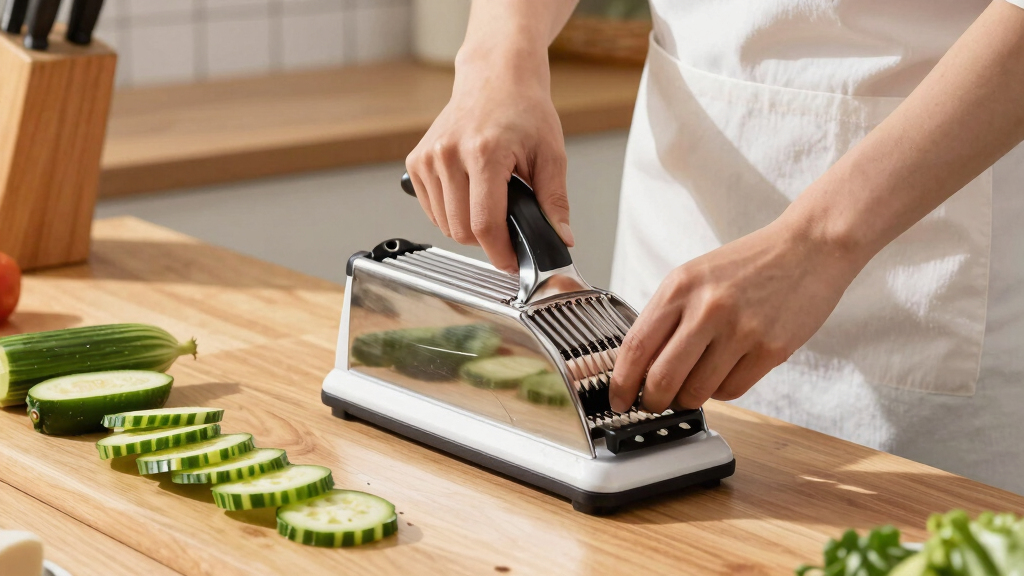
mandoline slicer with safety guard
As an affiliate, we earn on qualifying purchases.
As an affiliate, we earn on qualifying purchases.
How to Use a Mandoline Safely in 5 Easy Steps
- Secure your work surface. Place your mandoline on a non-slip mat or damp towel to prevent movement. Stability is key because even slight shifts during slicing can cause accidents, especially when applying force or adjusting the thickness.
- Adjust the thickness first. Set your desired slice thickness before starting. This reduces the need to touch the blade repeatedly, lowering the chance of slips. Making adjustments on the fly increases risk because it often involves handling the blade directly or manipulating the food near the sharp edge, both of which can cause accidents if not done carefully.
- Use the hand guard. Always grip your food with the provided guard, keeping fingers tucked in and away from the blade. This safety measure creates a physical barrier, but its effectiveness depends on proper placement and consistent use. Relying solely on the guard without proper technique can still be risky, especially if the guard slips or is used improperly.
- Slice with controlled, even pressure. Push the food steadily forward, applying consistent force. Sudden jerks or uneven pressure can cause the food to slip or the guard to shift, increasing injury risk. Developing a smooth, controlled motion is essential for safety and uniform slices.
- Disassemble and clean carefully. Remove blades and use a brush or sponge to clean blades safely, storing them in protective covers afterward. Proper cleaning prevents accidental cuts during handling and preserves blade sharpness for safe use later. Neglecting this step can lead to dull blades that require more force, increasing the chance of slips and injuries.
Imagine slicing a zucchini for ratatouille. You set the thickness, secure the zucchini with the guard, and push steadily, hearing the satisfying swish of perfect slices—fingers safe, dish perfect. This mindful process minimizes risks and ensures consistent results.
professional mandoline slicer for vegetables
As an affiliate, we earn on qualifying purchases.
As an affiliate, we earn on qualifying purchases.
Compare Modern Safety Features on Mandolines
| Feature | Manual Mandoline | Modern Mandoline |
|---|---|---|
| Blade Cover | Usually absent or basic | Many include protective covers or snap-on guards |
| Hand Guard | Often optional | Built-in, ergonomic guards |
| Locking Mechanism | Rare | Common, secures adjustable parts |
| Non-slip Base | Sometimes | Standard feature in newer models |
Choosing a mandoline with these features isn’t just about convenience—it’s about significantly reducing injury risk. For example, a secure locking mechanism prevents accidental movement of the blades during use, which can cause slips. Non-slip bases provide stability, especially when applying force or making adjustments. Safety covers or guards act as an essential physical barrier, but only if they are properly designed and consistently used. These features collectively create a safer environment, but they do not eliminate the need for careful technique and awareness. Think of them as the safety net that makes your slicing process more forgiving, but not foolproof. The tradeoff is that with better safety features, you can work more confidently and quickly, which is especially beneficial during busy prep sessions or when handling tougher vegetables.
As an affiliate, we earn on qualifying purchases.
Cleaning and Storing Your Mandoline Without Cutting Yourself
The blades are the most dangerous part to handle during cleaning. Always disassemble your mandoline carefully, avoiding direct contact with the blades. Proper disassembly involves following the manufacturer’s instructions to prevent accidental slips or contact with sharp edges, which can cause cuts. Using a towel or glove can provide extra grip and protection during this process.
Use a soft brush or sponge to clean the blades, and never run your fingers over the sharp edges. Dull blades may tempt you to apply more force, which can lead to slips. After cleaning, store blades in a protective cover or a dedicated blade holder—think of it like a safety sheath for a sword. Proper storage prevents accidental cuts during retrieval and maintains blade sharpness, reducing the need for forceful slicing that could cause injury.
Picture yourself cleaning a mandoline after slicing a batch of potatoes—gentle strokes, careful disassembly, and a safe storage spot keep your fingers intact for many more kitchen adventures. Taking your time during cleaning not only preserves your equipment but also reinforces safe handling habits, which are crucial for long-term safety.
As an affiliate, we earn on qualifying purchases.
Why Modern Electric Mandolines Are Safer Than You Think
Electric mandolines automate the slicing process and often include safety features that manual models lack. Some have automatic blade guards or sensors that stop the device if fingers get too close, which can be a significant safety advantage. These features reduce the likelihood of accidental contact during operation, especially for those with less experience or for repetitive tasks.
While they reduce manual handling, you still need to use the safety guard and follow proper procedures. Think of an electric model as a helpful assistant—still requiring respect, caution, and proper technique to prevent injuries. Relying solely on automation can create complacency, so it’s important to remain vigilant and adhere to safety protocols.
According to an anonymous researcher, electric mandolines can cut injury rates by up to 40% when used properly, thanks to built-in safety mechanisms. However, this doesn’t mean they are foolproof; user awareness and correct handling are still essential to maximize safety benefits.
Frequently Asked Questions
Are mandoline slicers safe for beginners?
Absolutely, but beginners should always start with the safety hand guard and work slowly. Practice on thicker slices first and gradually move to thinner cuts as confidence grows.
How do I prevent injuries while using a mandoline?
Use the hand guard, keep fingers tucked away from the blade, and work on a sturdy, non-slip surface. Never rush—controlled, deliberate movements are safest.
What features make a mandoline safer?
Look for models with safety locks, blade covers, non-slip bases, and integrated hand guards. These features significantly reduce the chance of accidents.
Can I put my mandoline in the dishwasher?
Many models are dishwasher safe, but always check the manufacturer’s instructions. Remove blades carefully before cleaning and store them safely afterward.
How should I clean and store my mandoline to stay safe?
Disassemble the blades, clean with a brush or sponge, and store blades in protective covers. Keep everything in a designated safe spot to prevent accidental cuts during storage.
Conclusion
Getting perfect slices without risking your fingers is all about respect and preparation. Treat your mandoline like a sharp tool—because it is—and use the safety features designed to protect you.
Every slice you make confidently, with safety in mind, keeps your off-grid kitchen running smoothly and injury-free. Remember: safety isn’t just a feature—it’s a mindset. Keep your fingers, and your food, in one piece.
Fall Picks
fall essentials
As an affiliate, we earn on qualifying purchases.