TL;DR
Open a free Amazon Business account
Business pricing, bulk buying and tax-exempt orders.
Create a free accountAs an affiliate, we earn on qualifying purchases.
Knives offer control and versatility, perfect for intricate cuts and dicing. Mandolines excel at quick, uniform slices—ideal for presentation and bulk prep. Choosing the right one depends on your task and safety considerations.
Ever tried slicing a cucumber paper-thin, only to struggle with uneven edges or risking a cut? Or maybe you’ve marveled at those perfectly uniform potato chips that seem to appear effortlessly on a mandoline. Both tools have their place, but knowing when to reach for your knife versus your mandoline can turn a good prep into a great one.
In this guide, you’ll learn the strengths and limitations of each tool, how to choose the right one for your task, and some practical tips to stay safe while slicing, julienning, or dicing. Whether you’re off-grid or just looking to sharpen your kitchen skills, mastering these tools makes cooking more efficient and enjoyable.
Knives offer control and finesse, ideal for intricate and delicate cuts.
Mandolines excel at speed and produce uniform slices—perfect for presentation and bulk prep.
Safety depends on proper technique and using safety features—never skip guards or sharpening.
Match the tool to the task: use knives for versatility, mandolines for speed and consistency.
Regularly sharpen and maintain your tools to keep cuts precise and safe.
What’s the real difference between a knife and a mandoline?
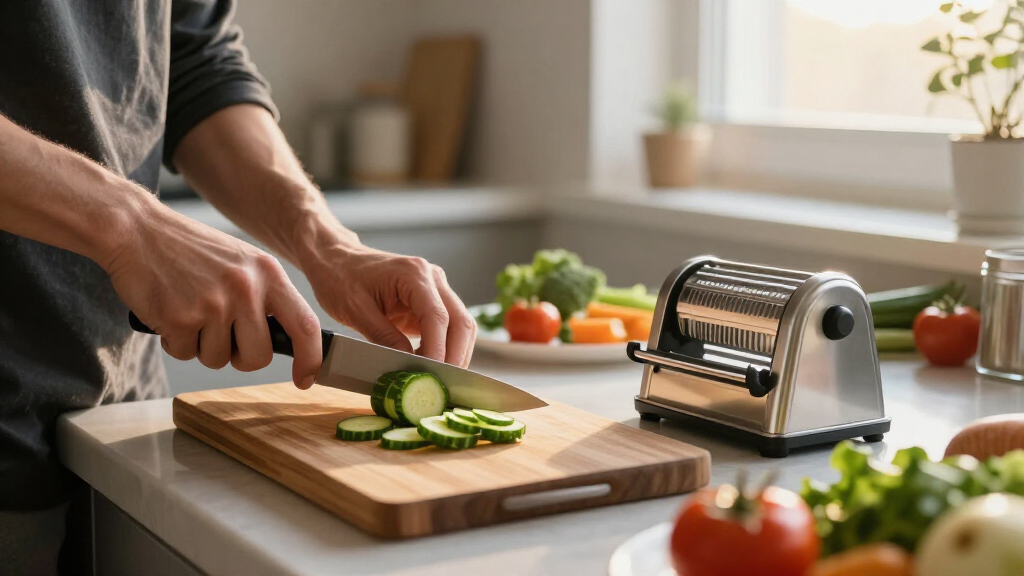
At their core, knives are versatile tools that can do almost anything—chop, dice, julienne, or mince. They require skill and control, but give you the ability to make nuanced cuts. Mandolines, on the other hand, are specialized devices designed for slicing with speed and uniformity. They have a sharp, adjustable blade that glides smoothly over your produce, creating consistent slices in seconds.
Imagine slicing a bunch of carrots for a salad. A knife takes finesse, patience, and a steady hand. A mandoline can do it faster and with identical thickness every time, making presentation and even cooking a breeze.

Dfito Chef Knife Sets with Roll Bag, 9 Pieces Professional Knife Set
- Super Sharp German Steel Blade: Rust-proof, high-quality stainless steel
- Durable High-Carbon Material: High hardness and corrosion resistance
- Ergonomic Non-Slip Handle: Comfortable, safe, and suitable for all hands
As an affiliate, we earn on qualifying purchases.
As an affiliate, we earn on qualifying purchases.
Why does precision matter in food prep?
Precision isn’t just about aesthetics—it directly influences how your dish turns out in terms of cooking time, texture, and visual appeal. When slices are uniform, they cook evenly, preventing some pieces from burning while others remain underdone. This consistency is especially crucial in professional or presentation-focused settings where appearance matters as much as taste. Moreover, precise cuts can affect the mouthfeel of a dish; for example, evenly julienned vegetables provide a better texture and more refined presentation.
For delicate garnishes or intricate cuts—like brunoise or fine julienne—a skilled knife allows for nuanced control that machines can’t replicate. The ability to adapt to irregular shapes or softer produce with a knife means you can execute more complex, refined presentations that elevate the dish. Conversely, a mandoline’s uniform slicing ensures predictable results, which is valuable when consistency is paramount, such as preparing large quantities for catering or meal prep.
Understanding these nuances helps cooks decide whether the tradeoff of speed for finesse (or vice versa) aligns with their goals, balancing aesthetics, texture, and cooking efficiency.
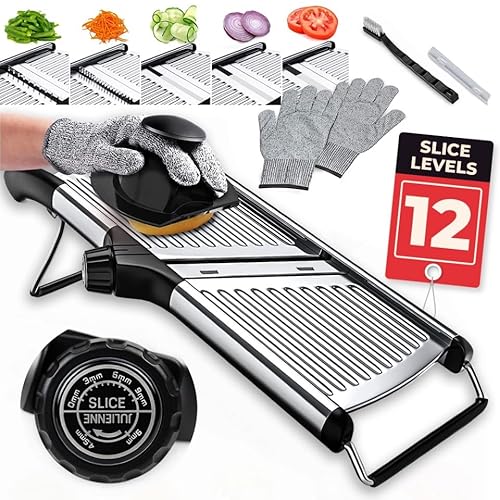
Gramercy Mandoline Slicer for Kitchen with 12 Slice Settings, Black Edition
- Adjustable Thickness Control: Built-in dial for quick slices
- Rotating Blade System: Seamless thickness adjustments for efficiency
- Non-Slip Stability Base: Ensures safe, stable slicing
As an affiliate, we earn on qualifying purchases.
As an affiliate, we earn on qualifying purchases.
Safety: Is one tool safer than the other?
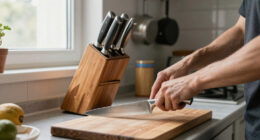
Both knives and mandolines require careful handling to prevent injuries, but their safety implications differ based on design and use. Knives demand proper technique—cutting away from your body, using a stable cutting surface, and keeping the blade sharp. A dull knife is more dangerous because it requires more force, increasing the chance of slips that can lead to cuts or punctures. Proper sharpening and technique reduce these risks significantly, transforming the knife into a safer, more controlled tool.
Mandolines pose their own safety challenges. Their blades are extremely sharp, and a slip can cause deep cuts. Many models include safety features like hand guards, but these are only effective if used correctly. Without proper safety guards or hand protection, the risk of injury increases, especially when slicing hard or slippery produce. The speed at which a mandoline cuts can make mistakes more costly. Therefore, understanding and properly utilizing safety features is essential.
Proactively, the safest approach involves working slowly when learning, always using guards, and maintaining awareness of your hand position. Recognizing that safety is a tradeoff—speed versus control—helps in choosing the right tool and technique for each task.

ZKIRON Safety Hand Guard and Food Holder for Mandoline Slicers
- Safe Finger Protection: Protects fingers during slicing
- Secure Food Holding: Keeps food stable while slicing
- Durable Construction: Made from impact-resistant materials
As an affiliate, we earn on qualifying purchases.
As an affiliate, we earn on qualifying purchases.
Frequently Asked Questions
Is a mandoline safer than a knife?
Both can be safe if used properly. Mandolines have safety guards and hand protectors that reduce risk, but they still require caution. A dull knife is more dangerous than a sharp one, so keeping your blades sharp and technique correct is key for safety.Can I replace a mandoline with a good knife?
For some tasks, yes—especially if you’re skilled with your knife. However, mandolines are faster and more consistent for slicing large quantities or uniform pieces, saving time and effort.What’s the best way to sharpen my knives?
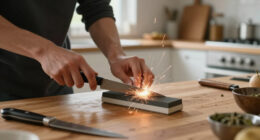
Use a whetstone or professional sharpening service regularly. Honing often keeps the edge aligned, while periodic sharpening refreshes the blade’s sharpness for precise cuts. Proper sharpening maintains the integrity of your blades, preventing uneven cuts and reducing the risk of slips, which enhances safety and efficiency.Are soft fruits suitable for mandolines?
Soft fruits like ripe tomatoes or berries aren’t ideal for mandolines—they can squish or slip, increasing the risk of injury or uneven slices. Firm, smooth produce like cucumbers or potatoes are best suited for even slicing, ensuring safety and uniformity.What safety gear should I use?
Always wear safety guards when using a mandoline and keep your fingers curled away from the blade. For knives, employ proper technique, keep blades sharp, and work on a stable surface. Using appropriate safety gear minimizes the risk of cuts and injuries, especially when working quickly or with hard produce.
Cuisinart C77TR-3PR Triple Rivet Collection 3.5" Paring Knife, Black
- Blade Material: High-carbon stainless steel blades
- Blade Length: 3.5-inch paring knife
- Handle Design: Ergonomic handle with full-tang
As an affiliate, we earn on qualifying purchases.
As an affiliate, we earn on qualifying purchases.
Conclusion
Choosing between a knife and a mandoline isn’t about which is better, but which suits the task. Mastering both allows you to work faster, safer, and with more precision—transforming your prep from a chore to a craft. The next time you reach for your tools, ask yourself: what’s the goal? Speed? Finesse? Both? Then pick accordingly.
And remember—good technique and safety awareness turn any tool into a true kitchen ally. Happy slicing!
Grilling season Picks
grills
As an affiliate, we earn on qualifying purchases.