
TL;DR
Open a free Amazon Business account
Business pricing, bulk buying and tax-exempt orders.
Create a free accountAs an affiliate, we earn on qualifying purchases.
Making sausage at home by hand is straightforward and rewarding. With fresh ingredients, proper hygiene, and a little practice, you can create personalized, preservative-free sausages that rival store-bought versions.
Start with fresh, high-quality meat and keep everything cold during prep.
Season thoroughly and test the flavor by frying a small patty before stuffing.
Hand-form sausages for quick batches, or use casings for a traditional look.
Cook sausages to safe internal temperatures—160°F for most meats.
Proper storage extends shelf life; vacuum-seal or wrap tightly in plastic before freezing.
Choose Fresh, Quality Meat for Perfect Sausage Every Time
The foundation of good sausage is fresh, high-quality meat. Think pork shoulder, beef chuck, or chicken thighs. Aim for around 20-30% fat—that fat keeps the sausage juicy and flavorful. Imagine slicing into a piece of pork that’s bright pink, firm, and smells clean—that’s your target. Using meat from a trusted butcher or local farm gives you control over quality and freshness.
For example, a friend once used a supermarket pork loin for sausage. It lacked flavor and moisture. Switch to a well-marbled shoulder, and suddenly, the sausage bursts with richness. The meat’s quality makes all the difference in your finished product—and in how much effort you’ll need to put in.

Huanyu Manual Meat Grinder Heavy Duty Stainless Steel Hand Crank Machine
- Material: Heavy-duty stainless steel construction
- Durability: Dishwasher safe and rust-resistant
- Stability: Double fixation with suction cup and clamp
As an affiliate, we earn on qualifying purchases.
As an affiliate, we earn on qualifying purchases.
How to Prepare Your Meat for Sausage — Step-by-Step
- Cut the meat into chunks no larger than 1 inch. This helps your hand-powered grinder or knife handle them easily.
- If grinding, chill all your equipment and meat in the freezer for 15-20 minutes. Cold meat grinds more cleanly and prevents smearing.
- Use a sharp knife to chop finely if grinding isn’t an option. Aim for a coarse, uniform texture—think slightly chunky but cohesive.
For example, when I made sausage with a manual grinder, pre-chilling the meat and equipment made the process smoother. The meat passed through easily, and I avoided the greasy, pasty texture that can happen when the meat warms up.

Bearded Butchers Natural Hog Sausage Casings 32-35mm, Edible Pre-Flushed
- Authentic Natural Hog Casings: Achieve professional snap and bite
- Pre-Flushed and Ready to Use: Easy to load and prepare
- High-Yield 30lb Capacity: Suitable for small-batch sausage making
As an affiliate, we earn on qualifying purchases.
As an affiliate, we earn on qualifying purchases.
Flavor Your Sausage Like a Pro — Simple Tricks for Better Taste
Freshly ground meat needs the right seasoning. Think salt, garlic, herbs, and spices. For 1 pound of meat, use about 1 teaspoon salt and 1-2 cloves minced garlic. Add crushed red pepper, fennel seeds, or paprika depending on your flavor goal.
Mix thoroughly, then fry a small patty to test the seasoning. Adjust as needed. For example, I like adding a splash of apple cider vinegar for a tangy twist or fresh herbs like parsley for brightness. This step ensures your sausage hits just the right note before stuffing.

Mueller 7-Inch Meat Cleaver Butcher Knife, German High Carbon Steel
- Laser-Tested German Steel Edge: Precision-forged high-carbon stainless steel blade
- Razor-Sharp Double-Bevel Blade: 18° angle for durability and sharpness
- Resistant to Rust and Corrosion: Maintains sharpness and appearance over time
As an affiliate, we earn on qualifying purchases.
As an affiliate, we earn on qualifying purchases.
Stuffing Sausage by Hand — Your Step-by-Step Guide
Using natural or synthetic casings is common, but hand-forming sausages is just as good. Here’s how:
- Soak and rinse casings if using natural ones—this removes salt and excess saltiness.
- Attach a sausage stuffing tube to your hand-powered grinder or use a piping bag fitted with a large tip.
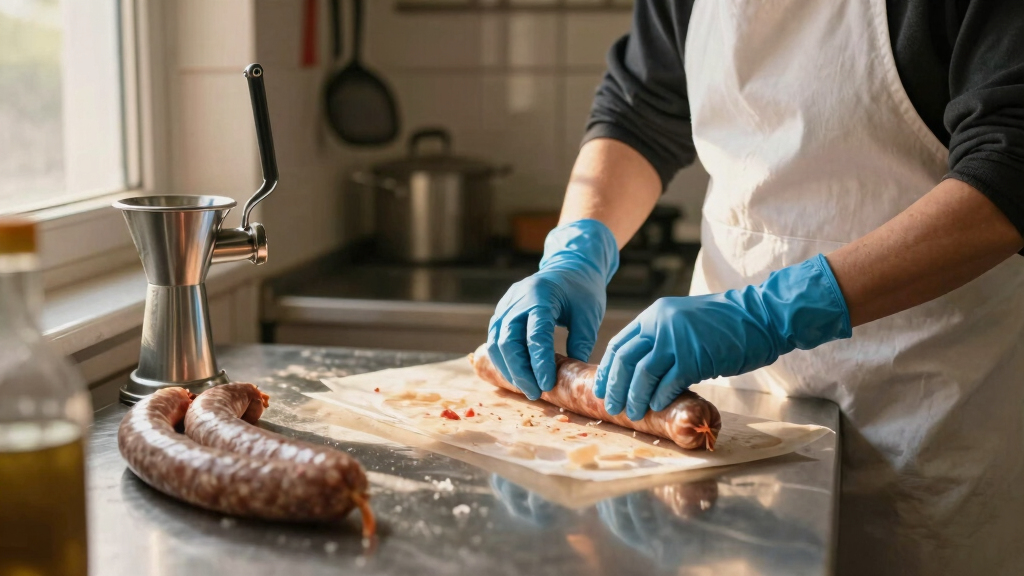
- Fill the casing or pipe the mixture onto a clean surface. Twist into links or shape into logs or patties.
- Chill the formed sausages for 20-30 minutes before cooking. This helps them hold their shape.
For example, I prefer hand-forming sausages for small batches. It’s simple, and no special tools are needed—just your hands and a little patience.

Hi Mountain BRATWURST Kit | Makes up to 24 lbs
- Complete Sausage Making Kit: Includes seasoning, cure, casings, and instructions
- Versatile Meat Options: Suitable for pork, beef, venison, and wild game
- Authentic German Flavor: Creates traditional bratwurst taste at home
As an affiliate, we earn on qualifying purchases.
As an affiliate, we earn on qualifying purchases.
Cooking and Storing Your Handmade Sausage
Cooking depends on your sausage style. Pan-fry for a crispy exterior, grill for smoky flavor, or bake for even cooking. Internal temperature should reach at least 160°F (71°C) for pork and beef, or 165°F (74°C) for poultry. Use a meat thermometer for accuracy.
Store fresh sausages in the fridge for 1-2 days, or freeze for longer. Wrap tightly in plastic or vacuum-seal to prevent freezer burn. Cured or smoked sausages last much longer—up to several weeks.
For example, I once made a batch of Italian sausage, cooked some immediately, and froze the rest. The frozen links kept their flavor and texture for months—ready for a quick pasta sauce or breakfast scramble.
Compare Hand-Formed Sausages vs. Casings — Which Works Best?
| Method | Pros | Cons |
|---|---|---|
| Using Casings | Authentic look, uniform shape, longer shelf life | Requires soaking, rinsing, and sometimes special equipment |
| Hand-Formed | Quick, flexible, no extra tools, perfect for small batches | Less uniform, may fall apart if not chilled properly |
Safety Tips for Making Sausage at Home — Stay Ahead of Food Risks
Always keep your workspace and tools clean. Use cold meat and equipment to prevent bacteria growth. Cook to the right temperature—160°F for most meats. Consider adding curing salts if you plan to store sausages long-term or cure them at home.
For example, I once left raw sausage at room temperature for too long. It smelled sour and was unsafe to eat. Proper hygiene and temperature control are your best defenses against foodborne illness.
Frequently Asked Questions
Do I need a special grinder to make sausage at home?
Not necessarily. A sharp knife can work if you chop the meat finely. However, a manual meat grinder makes the process faster and gives you a better texture, especially if making large batches.Can I make sausage without casings?
Absolutely. You can shape the sausage mixture into patties, logs, or balls by hand. This is perfect for immediate cooking and doesn’t require soaking or rinsing casings.How do I prevent my sausage from falling apart during cooking?
Chill the mixture before stuffing or shaping. Add binders like bread crumbs or a beaten egg if needed. Ensuring your sausage has the right fat content also helps it stay together.Are there safe ways to cure or preserve sausage at home?
Yes. Using curing salts like Prague Powder #1 and following proper procedures can make sausages safe for longer storage. Always follow safe curing practices to prevent botulism or spoilage.How long can I store homemade sausage?
Fresh sausages last 1-2 days in the fridge. Cured or smoked versions, if stored properly, can last several weeks. For extended storage, freeze tightly wrapped links or patties.Conclusion
Making sausage by hand is a skill worth building, especially if you value freshness and control. With just a few tools and some patience, you can craft flavors that outshine store-bought options. The best part? You get to taste your own craftsmanship—crispy, juicy, and full of your personal touch. So grab your meat, season it boldly, and shape your own satisfying links—your off-grid kitchen’s next proud creation.Back to school Picks
back to school
As an affiliate, we earn on qualifying purchases.