
TL;DR
Listen free for 30 days with Audible
Thousands of audiobooks and originals — cancel anytime.
Start your free trialAs an affiliate, we earn on qualifying purchases.
Using a mandoline for even slices requires proper setup, consistent technique, and safety. Advances in safety features and adjustable settings make it easier to get perfect cuts, saving time and improving presentation.
Nothing beats the satisfying snap of a perfectly even slice. Whether you’re preparing a colorful ratatouille or a delicate garnish, your mandoline can do the heavy lifting. But without proper technique, those slices can turn uneven, jagged, or — worst of all — dangerous.
In this guide, you’ll learn how to set up your mandoline for success, master the slicing motion, and understand recent improvements that make your work safer and more precise. Get ready to turn a simple tool into a true kitchen ally, especially when working off-grid or with hand-powered equipment.
Proper setup and safety gear are essential for even, safe slicing.
Consistent pressure and steady motion are the main drivers of uniform slices.
Recent safety innovations and adjustable settings make precision easier for all skill levels.
Practicing on softer foods helps build confidence and muscle memory.
Regularly cleaning and sharpening blades maintains cutting performance and safety.
How to set up your mandoline for flawless, even slices
Starting with the right setup is half the battle. Place your mandoline on a sturdy, flat surface—think a cutting board on a non-slip mat. Adjust the blade to your desired thickness—thin for salads, thicker for roasting. Always use the hand guard or food holder to protect your fingers; this little device is your best friend in safety and precision.
For round vegetables like zucchini, cut a flat base so the item doesn’t wobble. This stable platform helps you apply even pressure, which is key for consistent slices. Remember: a wobbly vegetable equals uneven slices. Practice on softer foods first to get a feel for the motion.

SupMaKin Safe Mandoline Slicer for Kitchen,Adjustable Potato Slicer 1-8 mm
- Safety Design: Built-in blades for safe slicing
- Adjustable Thickness: Slices from 0.1 to 8mm
- Quick and Easy: Fast, uniform slices with handle push
As an affiliate, we earn on qualifying purchases.
As an affiliate, we earn on qualifying purchases.
How to master the slicing motion for uniform cuts
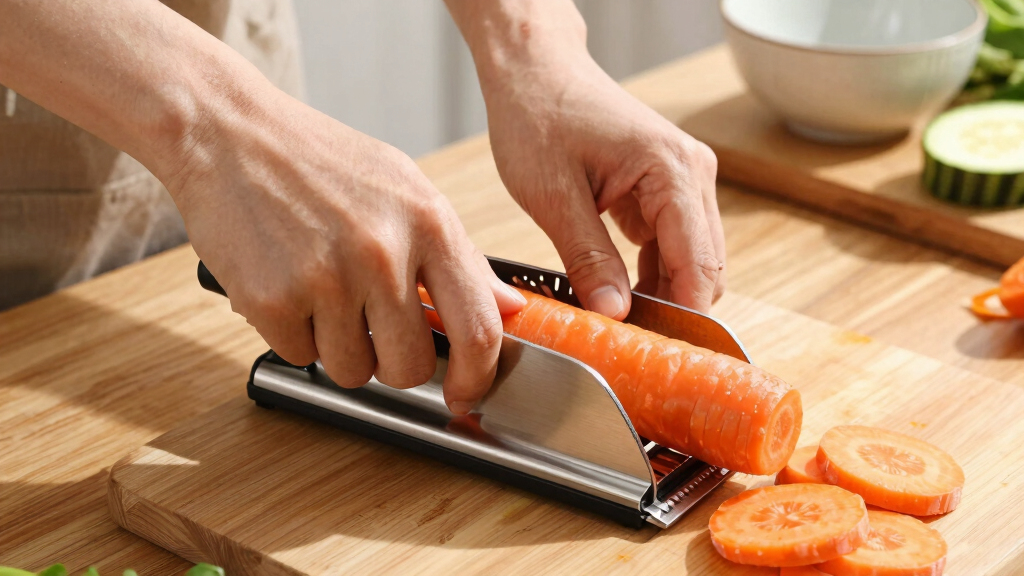
Consistent motion is the secret sauce. Think of your hand as the engine—steady, smooth, and controlled. Apply gentle, even pressure as you slide the food across the blade. Start slow—speed will come with practice. Keep the food flush against the blade, and push forward with a gentle, steady hand.
If you’re slicing a cucumber, for example, cut it into manageable lengths first. Then, use a gentle push to glide each piece across the blade, maintaining the same pressure and speed. Your goal? A continuous, fluid motion that doesn’t jerk or stop.
Practicing on softer vegetables—like carrots or zucchini—builds muscle memory, leading to slices that look like they came from a professional chef’s knife.
Why does this matter? Because the key to uniform slices isn’t just aesthetics—consistent slices ensure even cooking, which affects texture, flavor, and presentation. Uneven slices can cause some pieces to overcook or undercook, leading to inconsistent results. Moreover, a steady, controlled motion minimizes the risk of slips that could cause injury or damage to the blades. Developing this technique is a tradeoff: it requires patience and practice but results in safer, more reliable, and more attractive outcomes.
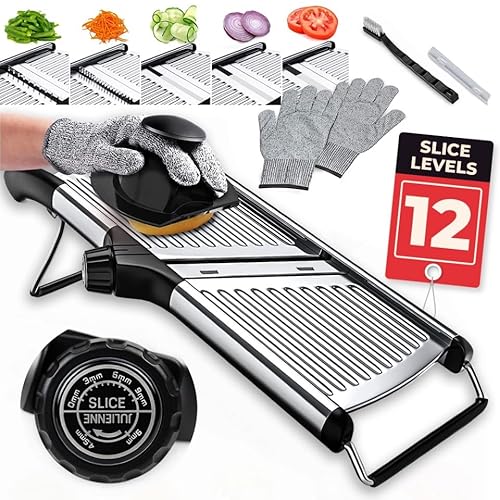
Gramercy Mandoline Slicer for Kitchen with 12 Slice Settings, Black Edition
- Adjustable Thickness Control: Built-in dial for quick slices
- Rotating Blade System: Seamless thickness adjustments for efficiency
- Non-Slip Stability Base: Ensures safe, stable slicing
As an affiliate, we earn on qualifying purchases.
As an affiliate, we earn on qualifying purchases.
Comparison table: Manual mandoline vs. new safety features
| Feature | Traditional Mandoline | Modern Safety-Enhanced Mandoline |
|---|---|---|
| Blade Adjustment | Manual, often fiddly | Easy-to-turn dial or lever that reduces setup time and minimizes mishandling, leading to more consistent slices |
| Safety Guard | Basic or optional | Integrated, fold-away or improved design that covers blades when not in use, significantly reducing accidental cuts during handling or storage |
| Stability | Depends on surface | Non-slip base, suction cups, or weighted design—these features prevent slipping and wobbling, which enhances precision and safety during use |
| Size & Storage | Bulkier, fixed | Foldable, compact models that are easier to store and transport, making them more adaptable for off-grid and limited-space kitchens |
Gramercy Mandoline Slicer for Kitchen with 12 Slice Settings, Black Edition
- Adjustable Thickness Control: Built-in dial for quick slices
- Rotating Blade System: Seamless thickness adjustments for efficiency
- Non-Slip Stability Base: Ensures safe, stable slicing
As an affiliate, we earn on qualifying purchases.
As an affiliate, we earn on qualifying purchases.
Recent tech updates making your slices more consistent and safe
Modern mandolines now come with features that make consistent slicing easier and safer. Adjustable thickness controls let you dial in the perfect slice without fiddling, which is crucial when working in environments where precision is key but tools are limited. Safety mechanisms—like fold-away blades and secure hand guards—reduce accidents, especially when working with sharp blades or in less stable, off-grid conditions.
Materials have also improved. High-grade stainless steel blades resist corrosion and stay sharp longer, which means less frequent sharpening and more reliable cuts over time. Some models are foldable or have compact designs, perfect for off-grid kitchens with limited storage. These technological updates are not just about convenience—they are about making your work safer and more consistent, reducing the learning curve and the risk of injury or uneven slices. Imagine slicing a dozen zucchinis for a summer vegetable bake—these updates mean you can produce uniform slices quickly and safely, even with minimal tools or support, and without sacrificing quality.

ZKIRON Safety Hand Guard and Food Holder for Mandoline Slicers
- Safe Finger Protection: Protects fingers during slicing
- Secure Food Holding: Keeps food stable while slicing
- Durable Construction: Made from impact-resistant materials
As an affiliate, we earn on qualifying purchases.
As an affiliate, we earn on qualifying purchases.
Why consistent slices matter — and how to get them right
Even slices aren’t just about looks. They’re fundamental to achieving even cooking and appealing presentation. When slices are uniform, they cook at the same rate, preventing some pieces from becoming overdone while others remain undercooked. This is especially critical for dishes like gratins or layered casseroles, where consistency enhances both appearance and texture. Moreover, precise slices facilitate better layering and portion control, elevating the dish’s overall presentation.
Getting consistent slices depends on more than just the blade setting; it’s about technique. Applying steady, even pressure and maintaining a stable food position are crucial. For tricky items like round squash or irregularly shaped vegetables, creating flat surfaces or stabilizing the item helps achieve uniform slices. The tradeoff here is patience—initially, it may take longer to get perfect slices, but with practice, your muscle memory and technique will improve. The reward? Reliable, professional-looking results that make your dishes stand out and cook evenly, showcasing your skill and attention to detail.
Step-by-step: Your routine for perfect, even slices every time
- Place your mandoline on a stable, flat surface.
- Adjust the blade to your desired thickness, ensuring it is securely locked in place to prevent shifting during use.
- Prepare your food: peel, trim, and cut flat bases if needed to ensure stability.
- Secure the food with the hand guard or food holder, making sure it is snug but not forcing the food against the blade excessively.
- Start with a gentle push, maintaining steady pressure and speed, and focus on a smooth, continuous motion.
- Check slices frequently to ensure consistency; if slices are uneven, adjust your grip or speed accordingly.
- Immediately clean blades after use, as residues can dull the blades and pose safety risks if not promptly removed.
Top tips for beginners to slice like a pro
- Use the hand guard every time—your fingers will thank you, and it helps maintain control for uniform slices.
- Start with thicker slices—thin slices come with practice and patience. Gradually reduce thickness as confidence grows.
- Keep your food stable—using flat, trimmed surfaces minimizes slips and uneven cuts.
- Practice on softer vegetables first to develop your technique and muscle memory before moving to tougher produce.
- Sharpen blades regularly—dull blades require more force, which can cause slips and uneven slices, and increase safety risks.
Frequently Asked Questions
How do I keep my mandoline blades sharp for even cuts?
Use a sharpening stone or professional sharpening service periodically. Regular maintenance extends the blade’s sharpness, which directly affects the quality of your slices. A sharp blade not only produces cleaner, more uniform slices but also requires less force, reducing fatigue and the chance of slips. Proper cleaning and avoiding cutting through bones or very hard objects prevent dulling. Investing in a sharpening system or professional service ensures your blades stay at peak sharpness, making your slicing safer and more efficient, especially important in manual or off-grid kitchens where replacements are less accessible.
Can I slice soft fruits like tomatoes on a mandoline?
Yes, but with caution. Use the thinnest setting and ensure your blade is very sharp—dull blades crush delicate foods, leading to uneven or messy slices. Chill the tomatoes slightly before slicing to firm them up, which helps achieve cleaner cuts. Support the fruit gently but firmly to prevent squishing, and work slowly, maintaining steady pressure. This careful approach preserves the fruit’s shape and texture, resulting in slices that are both uniform and visually appealing. Understanding the limitations and adjusting your technique accordingly ensures you get the best results without damaging the produce or risking injury.
What should I do if my slices are uneven even after following these tips?
Uneven slices often stem from issues like food instability, dull blades, or inconsistent pressure. First, ensure your food is properly stabilized—cut flat surfaces and use the hand guard effectively. Check your blades for sharpness; dull blades require more force and can cause uneven cuts. Practice slow, controlled pushes, focusing on maintaining uniform pressure and steady motion. If slices remain inconsistent, consider sharpening or replacing blades, as dull edges compromise precision. Also, review your technique—sometimes a slight adjustment in grip or speed can make a significant difference. Developing patience and consistency in your approach will lead to more uniform, professional results over time.
Are foldable or compact mandolines safe for off-grid cooking?
Many foldable or compact mandolines are designed with safety in mind, featuring locking blades, fold-away mechanisms, and non-slip bases that enhance stability and reduce risks, even in less stable environments. These features are especially valuable when working in off-grid settings where surface stability and lighting may be limited. Always use the safety guard provided and handle blades carefully during setup, use, and cleaning. While these models are generally safe, proper handling and maintenance are essential—never bypass safety features or rush the process. When used correctly, foldable and compact mandolines are excellent tools for safe, precise slicing in any setting, offering convenience without sacrificing safety or efficiency.
Conclusion
Perfect, even slices aren’t magic—they come from practice, the right setup, and a steady hand. Invest in a good mandoline, use the safety features, and keep practicing your technique. Over time, you’ll turn even the most challenging vegetables into uniform works of culinary art, off-grid or in any kitchen.
Remember: a sharp blade and a confident push are your best tools. How you slice shapes how your dish turns out—so slice smart, slice safe.
Baby shower & registry season Picks
baby registry must-haves
As an affiliate, we earn on qualifying purchases.