
TL;DR

Get kitchen gear delivered free with Prime
- Fast, free delivery on millions of items
- Prime Video, Amazon Music and more included
- Member-only deals all year
Adjusting grind texture on a hand mill involves small, incremental changes to the burr or stone gaps. Proper tuning ensures consistent, ideal results for your brewing method or recipe. Regular testing and maintenance keep your mill working smoothly.
Nothing beats the rhythmic feel of grinding your own coffee or spices by hand. But if your grind feels inconsistent or not quite right, tweaking the texture might be all you need. It’s not magic — just a little know-how and a few simple steps.
Today, you’ll learn exactly how to adjust your hand mill to get the perfect grind every time. Whether you’re aiming for a fine espresso or a chunky coarseness for cold brew, mastering this small adjustment can transform your manual food prep game.
Start with a baseline setting and adjust in tiny increments—about a quarter turn at a time.
Regular cleaning and documentation help maintain consistent grind quality.
Different brewing methods demand different textures; adjust accordingly.
Modern mills with marked dials or indicators make fine-tuning easier and more repeatable.
Small adjustments make a big difference in grind texture, so patience is key.
How to Adjust Grind Texture on a Hand Mill
Perfect texture comes from patient tuning: establish a baseline, move the burrs or stones in tiny increments, grind a test batch, and record the result. The rhythm stays simple—even when the recipe changes.
Dial it in, one small move at a time
The adjustment mechanism controls the distance between the grinding surfaces. Closer burrs or stones create finer particles; a wider gap creates a coarser texture. Begin from a known position so every change can be traced.
Locate the control
Find the screw, threaded knob, marked dial, lever, or sliding plate that changes the grinding gap.
IdentifySet a baseline
Choose the middle setting, a numbered mark, or a known zero point. Record it before moving on.
ReferenceTurn gradually
Move about a quarter turn. Avoid forcing the mechanism or over-tightening the burrs.
AdjustGrind and inspect
Test a small amount. Repeat the same incremental move until texture and extraction match the target.
VerifyMatch the grind to the method
Particle size controls exposed surface area and extraction speed. Fine particles extract quickly and demand more grinding effort; coarse particles extract slowly and allow longer contact times.
The grind spectrum
Use these positions as starting points, then tune for taste, flow, ingredient, and mill design.
Burr or stone: know what moves
Both systems alter the space between grinding surfaces, but their adjustment precision and maintenance needs differ. The best technique starts with understanding the mechanism in front of you.
| Feature | Burr mill | Stone mill |
|---|---|---|
| Adjustment method | Threaded knob, screw, or marked dial | Sliding stones or adjustable plates |
| Fine-tuning | ✓High precision and controlled steps | ~Moderate precision; manual repositioning |
| Durability | ✓Ceramic or steel can be long-lasting | ~Stone wear may require recalibration |
| Best suited to | Coffee, spices, and grains requiring repeatable control | Grains and recipes where traditional texture is preferred |
| Main caution | ✗Do not over-tighten or damage threads | ✗Uneven stone position can vary particle size |
Turn a good grind into a repeatable one
A correct setting is only half the equation. Clean surfaces, stable technique, written reference points, and small test batches make the result dependable from one session to the next.
Remove old residue
Built-up coffee oils, spice dust, or grain particles can narrow the gap, contaminate flavor, and reduce consistency.
Document every favorite
Note the dial number, clicks, or turns from zero. A simple recipe log eliminates repeated guesswork.
Use steady pressure
Keep loading, handle speed, and hand pressure consistent—especially on manual mills that flex under force.
Calibrate as parts wear
Revisit the baseline when burrs, stones, washers, or threads wear. Old marks may no longer produce the old texture.
Five habits that protect the result
Modern numbered dials, clearer markings, ceramic burrs, stainless components, and ergonomic handles make adjustment easier—but good operating habits still determine consistency.
Change one variable
Keep dose, pressure, and method stable while adjusting the gap so the cause of each result stays clear.
Test after every turn
Grinding a small sample prevents overshooting and teaches you how sensitive your mill is.
Mark useful settings
Save reference points for espresso, pour-over, French press, cold brew, grains, and spices.
Clean between ingredients
Thorough cleaning prevents spice oils or grain dust from affecting coffee flavor and particle flow.
Never force the dial
Resistance may indicate trapped material or burr contact. Back off, clean, and reset before continuing.
Patience beats precision marks
Numbers create repeatability, but the brewed result—not the printed setting—is the final test.
Hand-mill FAQ
Use these checks whenever texture, flow, flavor, or consistency begins to drift.
How do I know if the grind is too fine?
Look for excessive resistance, slow flow, clogged filters, or bitter flavor. Open the gap slightly and retest.
How do I know if the grind is too coarse?
Fast flow, watery flavor, low body, and weak extraction are common signals. Close the gap incrementally.
When should I change the setting?
Adjust when switching methods, ingredients, beans, or recipes—or whenever the usual result becomes inconsistent.
Can one mill handle coffee, spices, and grains?
Often yes, provided its texture range is suitable. Clean it thoroughly between ingredients to prevent cross-contamination.
How do I calibrate for repeatability?
Choose a baseline, grind a small sample, refine the gap, and record the final dial number or turn count.
How long should adjustment take?
Usually seconds to a minute. The best approach is deliberate rather than rushed: adjust, test, observe, repeat.
Know Your Hand Mill: The First Step to Better Grinding
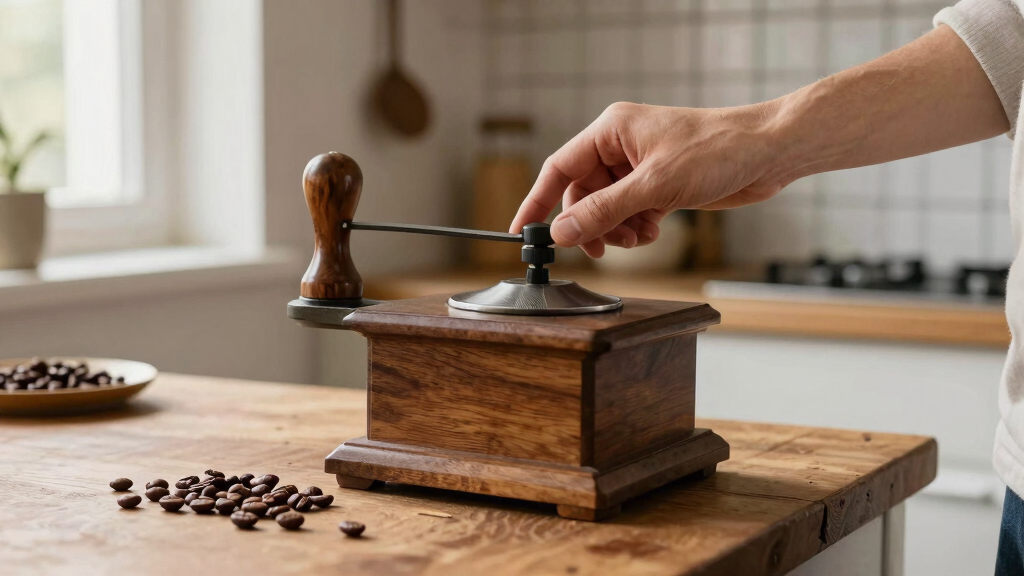
Understanding how your hand mill works is the foundation. Most models have an adjustment mechanism, like a screw, dial, or lever, that controls the distance between grinding surfaces. When you turn this, you change the size of the particles.
For example, a burr mill may have a threaded knob that moves the burrs closer or farther apart. Knowing where this mechanism is and how it reacts is key to fine-tuning your grind.
manual coffee grinder adjustable burr
As an affiliate, we earn on qualifying purchases.
As an affiliate, we earn on qualifying purchases.
How to Adjust Your Hand Mill in 4 Simple Steps
- Locate the adjustment mechanism—usually a screw, knob, or lever.
- Start with a baseline setting—usually the middle or a marked position.
- Make small, incremental turns—about a quarter to half a turn—then test by grinding a small amount.
- Observe the grind texture. If it’s too coarse or fine, adjust again, repeating until you reach your desired consistency.
Making these small adjustments is crucial because large changes can overshoot your target, leading to inconsistent results. Think of it like tuning a musical instrument: small, deliberate turns help you hit the perfect note. Testing after each tweak helps you understand how each adjustment affects the final grind, enabling you to replicate your ideal setting reliably.
As an affiliate, we earn on qualifying purchases.
Why Small Adjustments Make a Big Difference
Changing the gap between burrs or stones by just a hair — say, 0.1 mm — can turn a coarse grind into a fine one. This tiny shift significantly impacts extraction because grind size directly influences how water interacts with your ingredients. Finer grinds increase surface area, leading to faster extraction and potentially over-extraction if not controlled. Conversely, coarser grinds slow down extraction, risking under-flavored results.
Therefore, understanding the magnitude of these adjustments helps you balance flavor, strength, and brewing time. Small tweaks prevent over- or under-extraction, which can otherwise result in bitter or weak brews. Keep track of your adjustments, so you can consistently reproduce your perfect grind—this is especially important when switching between different beans, spices, or recipes, as each may require different textures for optimal flavor.
grain mill with grind texture control
As an affiliate, we earn on qualifying purchases.
As an affiliate, we earn on qualifying purchases.
Comparing Adjustment Types: Burr vs. Stone Mills
| Feature | Burr Mills | Stone Mills |
|---|---|---|
| Adjustment Method | Threaded knob or screw | Sliding stones or adjustable plates |
| Ease of Fine-Tuning | High — very precise, allows for small, controlled adjustments | Moderate — manual repositioning required, less precise control |
| Durability | Often ceramic or steel, long-lasting with proper maintenance | Stone wears over time, which can alter grind consistency and require re-calibration |
| Best For | Coffee, spices, grains — especially when precise control is needed | |
| Tradeoffs | Requires careful handling to avoid over-tightening or damaging threads |
As an affiliate, we earn on qualifying purchases.
Keeping Your Grind Consistent: Tips to Perfect Your Technique
- Clean your mill regularly—residue can clog or alter your grind, leading to inconsistent results or flavor contamination.
- Make tiny adjustments—half a turn at a time—to avoid overshooting your target texture and causing inconsistency.
- Document your settings—mark your favorite on the adjustment dial or note the turns—so you can quickly return to your preferred grind without guesswork.
- Use the same amount of pressure each time—varying pressure can change particle size and consistency, especially with manual mills.
- Test your grind with your brewing method—coarse for French press, fine for espresso—and adjust based on the results to optimize flavor extraction.
For example, when grinding coffee for pour-over, start with a medium-fine setting and tweak from there based on flow rate and flavor. Consistent technique ensures your grind remains predictable, which is critical for achieving the desired taste and strength in your brew.
Recent Innovations That Make Adjusting Easier
Modern hand mills now come with clearer markings, threaded knobs with numbered steps, and even visual indicators. Some models feature ceramic burrs that stay sharp longer, giving you more consistent grinds with less effort.
An example: a mill with a numbered dial allows you to dial in your ideal grind, then replicate it next time. Ergonomic handles and lightweight designs reduce fatigue, making adjustments smoother.
What Happens if You Over-Adjust or Don’t Tune Properly?
Over-adjusting can lead to uneven particles, clogging your filter, or weak extraction. For instance, grinding coffee too finely can cause over-extraction, making your brew bitter. Too coarse, and it will taste watery.
Proper tuning is essential because excessive adjustments can damage your mill or lead to inconsistent results that are hard to reproduce. Think of your mill like tuning a musical instrument—small, precise turns create harmony, while large, careless adjustments can throw off the entire performance. Regular testing and incremental tweaks help you maintain that harmony and ensure your results are predictable and high-quality over time.
Frequently Asked Questions
How do I know if my grind is too fine or too coarse?
For coffee, a too-fine grind can cause over-extraction, making your brew bitter or clogging your filter. Too coarse, and the flavor will be weak and under-extracted. Testing your brew method and adjusting based on taste and flow helps find the sweet spot.
How often should I adjust my hand mill’s grind?
Adjust whenever you switch brewing methods or notice inconsistent results. If you change beans or ingredients, a quick tweak helps keep your results predictable and flavorful.
Can I use the same mill for spices and grains?
Yes, most mills are adjustable enough for different ingredients, but cleaning thoroughly between uses prevents flavor cross-contamination and ensures consistent results.
What’s the best way to calibrate my mill for repeatability?
Grind a small batch, observe the texture, and note the adjustment setting—whether a dial number or turn count. Use this as your reference point for future batches.
Any tips for maintaining grind consistency over time?
Regularly clean your mill, make small incremental adjustments, and keep a record of your best settings. Over time, this helps maintain a steady, reliable grind.
Conclusion
Adjusting your hand mill’s grind texture isn’t complicated — it’s about patience, small tweaks, and understanding your tool. With practice, you’ll dial in the perfect grind for every brew or recipe, turning a simple mechanical task into a satisfying ritual.
Remember: your mill is a precision instrument. Treat it with care, tweak it thoughtfully, and enjoy the rich flavors that come from a perfectly ground batch every time.
Columbus Day / Indigenous Peoples' Day Picks
long weekend sales
As an affiliate, we earn on qualifying purchases.