
TL;DR
Listen free for 30 days with Audible
Thousands of audiobooks and originals — cancel anytime.
Start your free trialAs an affiliate, we earn on qualifying purchases.
Spiralizing vegetables by hand is an accessible, eco-friendly way to add variety to your meals. Using simple tools like peelers or handheld spiralizers, you can create beautiful, uniform veggie noodles with minimal equipment and effort.
Imagine transforming a humble zucchini into a delicate, curly ribbon — no electric gadgets, just your hands and a sharp tool. That’s the beauty of spiralizing by hand. It’s a skill that’s simple to learn, yet opens up a world of creative, healthy dishes.
If you’re off-grid or aiming to reduce reliance on electric appliances, mastering manual spiralizing offers freedom and control. You’ll impress with colorful salads, veggie noodles, or stir-fries, all crafted with your own muscle and skill. Let’s explore how to turn everyday vegetables into beautiful spirals, safely and efficiently.
Use the right tool for your vegetable and skill level — handheld spiralizers or peelers work well for most home cooks.
Consistent, gentle pressure and steady turns produce the best, uniform spirals.
Safety first: keep fingers clear of blades, and always work on a stable surface.
Store spiralized vegetables properly to keep them fresh for a day or two.
Practice makes perfect — your hand muscles will get better at producing even, beautiful spirals over time.
Pick the Right Tools and Vegetables for Hand Spiralizing
The key to successful hand-spiralizing starts with choosing the right gear and produce. A handheld spiralizer, a julienne peeler, or a sharp paring knife are your main options. For vegetables, stick to firm, elongated types like zucchini, carrots, cucumbers, sweet potatoes, and beets. These hold their shape and turn easily into noodles.
For example, a firm carrot can be turned into a vibrant orange spiral with just a julienne peeler, while a zucchini fits comfortably in a handheld spiralizer. Avoid soft or overly ripe vegetables; they tend to squish or break. Proper prep — washing, trimming, and cutting vegetables into manageable lengths — sets the stage for smooth spiralizing.

Veggetti Veggie Slicer, Dual Stainless Steel Blade Vegetable Cutter for Thick or Thin Noodle, Works with Zucchini, Squash, Cucumbers, Carrots, and more, 2.76"L x 2.76"W x 6.32"H, White
- Easy Vegetable Spiralizer: Turns vegetables into noodles with a twist
- Versatile Spiral Noodle Maker: Suitable for zucchini, squash, carrots, cucumbers
- Dual Stainless Steel Blades: Thick and thin noodle options
As an affiliate, we earn on qualifying purchases.
As an affiliate, we earn on qualifying purchases.
Step-by-Step: How to Hand Spiralize Vegetables Without a Fancy Device
- Wash and cut your vegetable into 4-6 inch lengths. For a carrot, peel if desired, then trim both ends.
- Secure the vegetable on your cutting surface or in the spiralizer’s holder. For peelers, hold firmly with fingers curled back to avoid slips.
- If using a handheld spiralizer, turn the crank steadily with one hand while guiding the vegetable with the other. For peelers, rotate the vegetable against the blade, applying even pressure.
- Keep turning or rotating until you reach the core or end of the vegetable.
- Gather your spirals and rinse off any excess pieces or peelings.
For example, I once turned a thick carrot into a bowl of bright orange noodles in about two minutes, feeling the resistance of the vegetable as I worked. Steady, consistent pressure is key — no rushing or forcing.
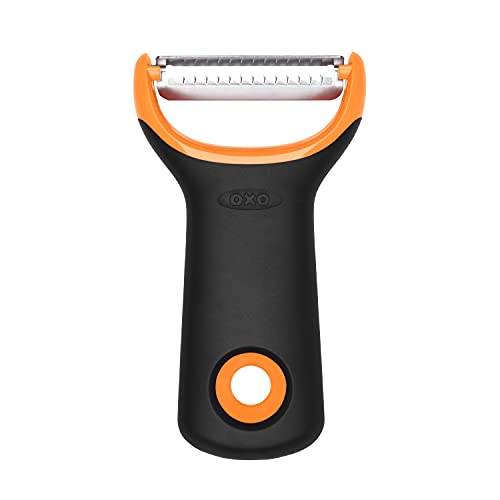
OXO Good Grips Julienne Prep Peeler
- Versatile Julienne Peeler: Peels precise strips of vegetables
- Ergonomic Design: Compact, comfortable Y-shape handle
- Durable Stainless Steel Blades: Rust-resistant, sharp blades
As an affiliate, we earn on qualifying purchases.
As an affiliate, we earn on qualifying purchases.
Safety Tips for Hand-spiralizing Vegetables
Safety is crucial when working with blades. Always keep your fingers away from cutting edges. Use tools designed for spiralizing or julienning, which often have safety guards or non-slip grips. When using a peeler, hold the vegetable firmly, and rotate slowly to prevent slips.
For example, I once nearly cut a finger because I was rushing with a dull knife. Now, I always use a sharp tool and work slowly. A non-slip mat underneath your cutting board or vegetable helps keep everything stable. Remember: a sharp blade is safer than a dull one because it requires less force, reducing slips and accidents.

Badelite Vegetable Spiralizer 4-IN-1 Rotating Blade Veggie Spiralizer Zucchini Noodle Maker with Strong Suction Cup Spiral Vegetable Cutter Slicer – White
- Versatile 4-in-1 Rotary Blades: Create various vegetable shapes with rotating blades
- Time-Saving Vertical Design: Gravity-assisted design for easier vegetable prep
- Healthy Meal Preparation: Make vegetable pasta for gluten-free and low-carb diets
As an affiliate, we earn on qualifying purchases.
As an affiliate, we earn on qualifying purchases.
How to Achieve Uniform, Beautiful Spiral Veggies Every Time
Consistency comes with practice and technique. Keep your vegetables steady, apply even pressure, and turn smoothly. For handheld spiralizers, turn the crank at a steady pace, avoiding jerks. When using a peeler, rotate the vegetable slowly and evenly against the blade.
For instance, I noticed that applying gentle, consistent pressure while peeling a cucumber gave me neat, ribbon-like spirals. If your spirals turn out uneven, check your grip, or try to cut vegetables into uniform lengths first. Over time, your hand muscles will develop a rhythm that produces consistent results.

SUREWIN 3 in 1 Vegetable Spiralizer Slicer, Adjustable Zucchini Carrot Noodle Maker, Cucumber Spiral Cutter, Easy to Use Kitchen Tool(Green)
- 3-in-1 Vegetable Spiralizer: Switches between 3 noodle sizes
- Compact & Easy to Clean: Small size, fully disassemblable for cleaning
- Safe to Use: Includes non-slip cover for safety
As an affiliate, we earn on qualifying purchases.
As an affiliate, we earn on qualifying purchases.
Compare Hand Spiralizer Options: Which Tool Fits Your Style?
| Feature | Handheld Spiralizer | Julienne Peeler | Sharp Knife |
|---|---|---|---|
| Ease of use | High — crank mechanism simplifies spinning | Moderate — requires manual rotation and pressure | Low — best for experienced cooks |
| Speed | Fast for small quantities | Moderate | Slowest |
| Control over shape | Consistent spirals | Variable, depends on skill | Variable |
| Safety | Design includes safety features | High — keep fingers curled back | Lower — risk of slips |
Choosing your tool depends on your comfort, the amount you want to prepare, and how much effort you’re willing to put in. For quick, uniform results, a handheld spiralizer is best. A julienne peeler offers flexibility, and a sharp knife gives maximum control but requires more skill.
Storing and Using Your Hand-Spiraled Veggies
Freshly spiralized vegetables are best enjoyed soon after prep. Store leftovers in an airtight container in the fridge for up to 2 days. To prevent browning or wilting, toss with a splash of lemon juice or a drizzle of oil.
For example, I made zucchini noodles yesterday and kept them overnight. A quick rinse and a squeeze of lemon kept them fresh and crunchy for a salad the next day. Avoid freezing spiralized vegetables, as they tend to become mushy once thawed.
Don’t Forget These Handy Tips for Better Spiralizing
- Choose vegetables that are firm and straight for easier spiralizing.
- Cut vegetables into manageable lengths — about 4-6 inches.
- Maintain a steady, gentle pressure — don’t force the tool.
- Work slowly to avoid slips and uneven spirals.
- Clean blades thoroughly after use to prevent rust and buildup.
Frequently Asked Questions
Can I spiralize soft vegetables like tomatoes or cooked carrots?
Soft vegetables tend to squish or break apart when spiralized. For best results, stick to firm, raw vegetables like zucchini, carrots, or cucumbers.What’s the safest way to use a handheld spiralizer?
Always keep fingers curled away from blades, work on a stable surface, and turn the crank or peel slowly. Use tools with safety guards if available.How can I prevent vegetables from slipping while spiralizing?
Use a non-slip mat, hold the vegetable firmly, and work slowly. Cutting vegetables into manageable lengths also helps maintain control.How long do spiralized vegetables stay fresh?
Store in an airtight container in the fridge for 1-2 days. Toss with lemon juice or oil to keep them crisp and fresh.Conclusion
Spiralizing by hand isn’t just a skill — it’s a way to connect with your food, cut waste, and enjoy fresh, colorful meals. With a sharp tool, steady hands, and a bit of practice, you can turn ordinary vegetables into eye-catching, nutritious noodles that elevate any dish.
So grab a vegetable, pick your tool, and start twisting. Your off-grid kitchen just got a lot more creative and satisfying — one spiral at a time.
Labor Day sales Picks
labor day deals
As an affiliate, we earn on qualifying purchases.