
TL;DR

Get kitchen gear delivered free with Prime
- Fast, free delivery on millions of items
- Prime Video, Amazon Music and more included
- Member-only deals all year
Ceramic filters excel at removing bacteria and sediments, making them ideal for pathogen protection. Carbon filters are better for improving taste and removing chemicals. Combining both offers broad-spectrum filtration for off-grid water safety.
Ceramic filters are best for removing bacteria, protozoa, and sediments, and can be cleaned and reused multiple times.
Carbon filters excel at removing chemicals, chlorine, and improving taste and smell, but need regular replacement.
Combining ceramic and carbon filters offers broad-spectrum protection against pathogens and chemicals.
Always verify filter certifications and consider your water source when choosing filtration solutions.
Routine maintenance—cleaning ceramic filters and replacing carbon filters—is vital for consistent water safety.
Ceramic vs Carbon Water Filters, Explained
Ceramic is the physical barrier for bacteria, protozoa and sediment. Carbon is the chemical sponge for chlorine, VOCs, odors and unpleasant taste. Your water source determines which strength matters most—and when the safest answer is both.
Barrier, sponge—or both?
The two technologies solve different problems. Ceramic pores physically strain water; activated carbon adsorbs dissolved compounds onto an enormous internal surface area.
Ceramic
Microscopic pores block sediment, cysts, protozoa and many bacteria. A strong choice for creek, pond, rain-catchment and uncertain rural sources.
Best for: E. coli, Giardia, turbidity and reusable off-grid systemsActivated Carbon
Carbon captures chlorine, VOCs, pesticides and odor-producing compounds. It improves palatability but is not a dependable bacterial barrier by itself.
Best for: chemicals, chlorine, taste, smell and treated tap waterCeramic + Carbon
A ceramic stage handles particles and pathogens while carbon addresses chemicals and flavor. This is the most versatile arrangement for variable water sources.
Best for: broad-spectrum protection and better-tasting off-grid waterThe capability matrix
No single filter is universally superior. The meaningful comparison is contaminant by contaminant—and source by source.
| Performance area | Ceramic filter | Carbon filter | Combined system |
|---|---|---|---|
| Bacteria & protozoa | ✓ Excellent | ✗ Unreliable alone | ✓ Excellent |
| Sediment & cysts | ✓ Excellent | ~ Limited | ✓ Excellent |
| Chlorine & VOCs | ✗ Poor | ✓ Excellent | ✓ Excellent |
| Taste & odor | ~ Minimal effect | ✓ Excellent | ✓ Excellent |
| Viruses | ✗ Usually too small | ✗ Not dependable | ✗ Add UV or disinfection |
| Reuse | ✓ Scrub & reuse | ✗ Replace when saturated | ~ Mixed maintenance |
| Typical flow | ~ Slower | ✓ Often faster | ~ System dependent |
Different strengths, clearly visible
These relative capability scores visualize the practical strengths described by each filtration mechanism. They are comparative guides, not certified removal percentages.
Ceramic capability
Strongest against physical and biological contaminants.
Carbon capability
Strongest against adsorbable chemicals and sensory problems.
Particle-size reality
A typical ceramic pore range of 0.2–0.5 microns blocks many bacteria and protozoa, but most viruses are smaller and may pass through.
Virus protection requires another step. Add UV sterilization, boiling or an appropriate chemical disinfectant when viruses may be present. Verify that every treatment method is suitable for the source and intended contaminants.
Match the tool to the water
Muddy creek water and chlorinated city water do not present the same risks. Test uncertain sources, inspect local advisories and select certified equipment for the contaminants you actually need to reduce.
A resilient off-grid filtration sequence
Assess source
Identify sediment, biological and chemical risks.
Pre-settle
Let heavy debris settle to reduce premature clogging.
Ceramic stage
Block sediment, bacteria, cysts and protozoa.
Carbon stage
Adsorb chlorine, VOCs, odors and taste compounds.
Disinfect if needed
Add UV, heat or chemical treatment for virus risk.
Reusable is not maintenance-free
Safe filtration depends on flow, media condition and timely service. A neglected filter can lose performance even when the housing still looks intact.
Ceramic care
Gently scrub accumulated material from the surface according to the manufacturer’s instructions. Inspect for cracks, thinning or erosion before reuse.
Carbon care
Adsorption sites eventually fill. Cleaning cannot reliably restore saturated carbon, so track installation dates, volume and any change in taste or odor.
Frequently asked questions
The short version: ceramic handles the physical threat, carbon handles many chemical and sensory problems, and neither automatically solves every possible risk.
Can ceramic filters remove viruses?
Most cannot do so reliably because viruses are smaller than typical ceramic pores. Add a suitable disinfection stage when virus protection is required.
How do I know which filter I need?
Choose ceramic for cloudy water, sediment and bacterial concerns. Choose carbon for chemical taste, chlorine or odors. Combine both for mixed risks.
Is a combined system worth it?
Usually, when the source varies or both pathogens and chemicals are plausible. The added stage provides broader protection and improves taste.
How often should filters be serviced?
Clean ceramic as flow declines and inspect it regularly. Replace carbon according to rated capacity—often every 6–12 months, depending on use and water quality.
Are reusable ceramic filters environmentally preferable?
They can reduce replacement waste and long-term cost because the surface may be cleaned repeatedly. Their benefit depends on correct care, safe cleaning and replacing damaged elements.
Your source decides. A paired system covers more.
For pathogen-heavy or sediment-rich water, ceramic is the stronger first line. For chemicals, chlorine, taste and odor, carbon wins. In an off-grid kitchen facing uncertain or changing supplies, ceramic followed by activated carbon—and disinfection where necessary—creates the most resilient treatment strategy.
What Do Ceramic and Carbon Filters Actually Do?
Ceramic filters work like tiny sieves, physically blocking bacteria, protozoa, and sediments with pores as small as 0.2 microns. They excel at removing pathogens and large particles, making them a staple in survival or rural settings.
Carbon filters use activated carbon to adsorb chemicals, chlorine, VOCs, and improve the taste and smell of water. They don’t physically strain out bacteria unless combined with other technologies.
For example, in a remote cabin, a ceramic filter can keep out Giardia and E. coli, while a carbon filter can eliminate the chlorine taste from city water or pesticides in surface water.
ceramic water filter for off-grid use
As an affiliate, we earn on qualifying purchases.
As an affiliate, we earn on qualifying purchases.
Which Is Better for Removing Bacteria and Pathogens?
Ceramic filters are the clear winners when it comes to removing bacteria and protozoa. Their tiny pores physically trap these pathogens, preventing them from reaching your glass.
Imagine collecting water from a muddy pond after a rainstorm. A ceramic filter can block out bacteria like E. coli and Giardia, making it safe to drink.
In contrast, carbon filters alone can’t reliably remove bacteria without additional disinfection steps, such as boiling or UV treatment.
Choosing a ceramic filter for pathogen removal is crucial because it provides a physical barrier, which means fewer steps and less reliance on chemicals or energy-intensive treatments. The tradeoff is that ceramic filters can clog faster if the water contains high sediments, requiring regular cleaning to maintain flow and effectiveness.
As an affiliate, we earn on qualifying purchases.
Can Ceramic and Carbon Filters Handle Chemicals and Odors?
Yes, but with important differences. Carbon filters excel at removing chemicals, chlorine, VOCs, and odors. They absorb these impurities effectively, making water taste better and smell fresher.
Imagine filtering city tap water with a pitcher that has activated carbon. The chlorine smell disappears, and the bitter taste is replaced with clean, fresh water.
Ceramic filters don’t remove chemicals well. They’re mostly for physical and biological filtration, not chemical contaminants.
The implication here is that if your water source contains chemical pollutants or has a strong chemical taste, relying solely on a ceramic filter leaves you vulnerable to chemical exposure. Using a carbon filter or a combined system ensures a broader spectrum of contaminant removal, which is especially important in areas with industrial runoff or heavily chlorinated municipal water.
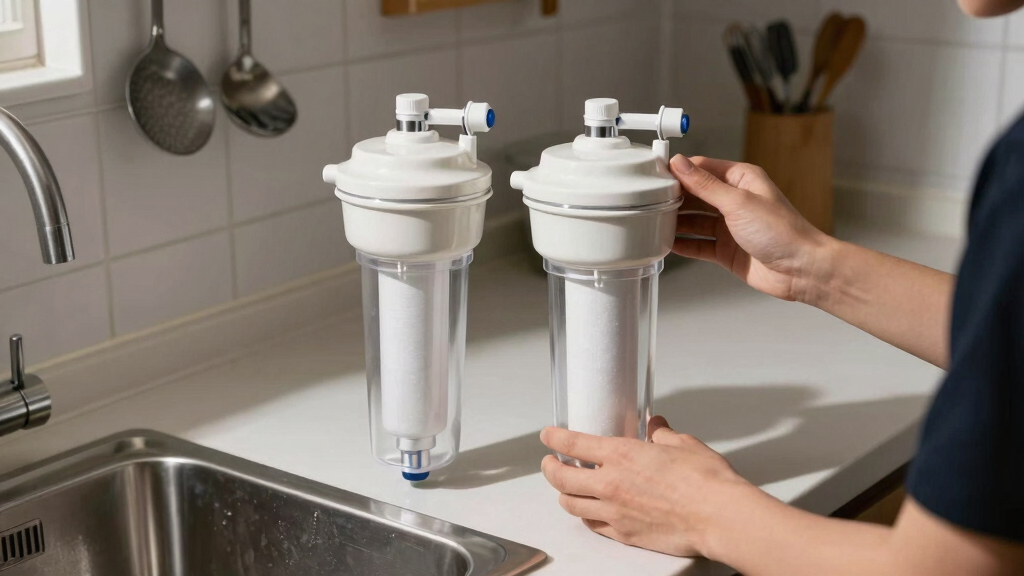
dual-stage ceramic and carbon water filter system
As an affiliate, we earn on qualifying purchases.
As an affiliate, we earn on qualifying purchases.
How Long Do These Filters Last, and Can They Be Reused?
Ceramic filters can often be cleaned and reused multiple times. You just scrub off the debris and bacteria buildup, extending their lifespan for years in some cases.
In a camping scenario, a ceramic filter can last through several trips if cleaned properly—saving money and reducing waste.
However, the effectiveness of cleaning depends on the level of contamination and the integrity of the ceramic material. Over time, microscopic cracks or erosion can reduce filtration efficiency, so regular inspection is necessary.
Carbon filters, on the other hand, become saturated. Once the activated carbon is full of contaminants, they need replacing—usually every 6 to 12 months, depending on water quality.
Ignoring replacement schedules can lead to reduced filtration performance and potential breakthrough of contaminants. Always follow manufacturer guidelines, as improper cleaning or delayed replacement can compromise water safety.
portable water filter for bacteria and chemicals
As an affiliate, we earn on qualifying purchases.
As an affiliate, we earn on qualifying purchases.
Frequently Asked Questions
Can ceramic filters remove viruses?
Most ceramic filters can’t reliably remove viruses due to their tiny size. For virus protection, add UV sterilization or chemical disinfection after filtration.
How do I know if my water needs a ceramic or carbon filter?
If your water is cloudy with sediments or you’re worried about bacteria, a ceramic filter is ideal. If it has a chemical taste or smell, go for a carbon filter—or better yet, combine both.
Is it worth investing in a combined ceramic and carbon filter system?
Yes. It broadens your protection—removing bacteria, sediments, chemicals, and odors—giving you safer, better-tasting water in all situations.
How often should I clean or replace my filters?
Clean ceramic filters every few months by scrubbing, and replace carbon filters every 6-12 months, depending on water quality and usage.
Are reusable ceramic filters better for the environment?
Yes. They last years with proper cleaning, reducing waste and cost over time—especially important in off-grid or emergency setups.
Conclusion
Choosing the right water filter in an off-grid setup isn’t just about price—it’s about matching the filter’s strengths to your water source. A ceramic filter can keep out nasty bacteria; a carbon filter makes your water taste fresh. Combining both gives you the best of both worlds—safe, great-tasting water, no matter where you are. Keep your filters clean and replace them as needed, and you’ll stay hydrated, healthy, and self-reliant.Fall Picks
fall essentials
As an affiliate, we earn on qualifying purchases.