TL;DR
Listen free for 30 days with Audible
Thousands of audiobooks and originals — cancel anytime.
Start your free trialAs an affiliate, we earn on qualifying purchases.
Ceramic water filters last 6 months to 10 years depending on use and water quality, and they’re cleaned by scrubbing the outside under clean running water with a Scotch-Brite pad or soft brush — never soap, never the porous inside. Clean when flow slows noticeably (usually every 1–3 months), and replace the candle when scrubbing no longer restores flow, when cracks or chips appear, or when it’s worn thin enough that light passes through the wall.
The white ceramic candle sitting in your counter-top filter is quietly doing some of the best water-cleaning work available without electricity. It’s trapping bacteria, sediment, and protozoa in a wall of fired clay so fine that water has to be pulled through it like syrup through cheesecloth. And unlike a disposable cartridge, you can clean it.
But here’s the part most people get wrong: cleaning a ceramic filter the wrong way — with soap, bleach, or a scrub on the wrong surface — can ruin it or make your water worse instead of better. And knowing when to stop cleaning and start replacing is the difference between a $30 part swap and drinking compromised water without knowing it.
In this guide you’ll learn exactly how to clean a ceramic candle, how often to do it, and the three unmistakable signs the element has reached end of life. No lab required. Just a sink, a clean pad, and your eyes.
Clean a ceramic candle only when flow slows — usually every 1 to 3 months — using clean water and a Scotch-Brite pad on the OUTSIDE only; never soap, bleach, o…
A ceramic-only candle can last 1–10 years and survive 50–100 cleanings; carbon-cored candles are spent at 6–12 months (roughly 2,000–8,000 liters) no matter ho…
Do the light test after every cleaning: any crack, chip, or glow through the sidewall means replace the candle immediately, because cracked ceramic lets water…
Replace when scrubbing no longer restores flow, when taste/odor returns (spent carbon), or when the ceramic wall has visibly thinned.
Keep one dated spare in dry storage and mark install dates — a five-minute planned swap beats a surprise filter failure.
Ceramic Filter Cleaning & Lifespan
A ceramic water filter lasts 6 months to 10 years depending on use and water quality — and it’s cleaned by scrubbing the outside under clean running water. No soap. No scrubbing the porous inside. Here’s exactly how to clean it, how often, and when to replace the candle.
How a Ceramic Filter Actually Works
Ceramic filtration is mechanical: contaminants are physically blocked in the tiny, winding channels of a fired-clay wall rated at 0.5–1 micron — tight enough to trap E. coli, cholera, sediment, rust, and protozoan cysts. Many candles add activated carbon or silver for taste, odor, and surface-growth control. The key: nearly everything caught lodges in the outermost layer — so scrubbing that layer off exposes fresh ceramic.
Water enters the wall
Pressure pulls water through the fine ceramic matrix like syrup through cheesecloth — no electricity required.
Contaminants lodge outside
Bacteria, sediment, and cysts get trapped in the outer few microns of the fired-clay wall. Gunk never penetrates deep.
Flow slows to a trickle
The clogged surface chokes flow — your signal that it’s cleaning time, not failure time.
Scrubbing restores it
Like sharpening a good knife: removing a thin layer IS the maintenance. A candle survives 50–100 cleanings.
Ceramic does not remove dissolved chemicals, salts, heavy metals, or viruses. If your source water carries those, ceramic is one stage in a system — not the whole system.
How to Clean a Candle Without Ruining It
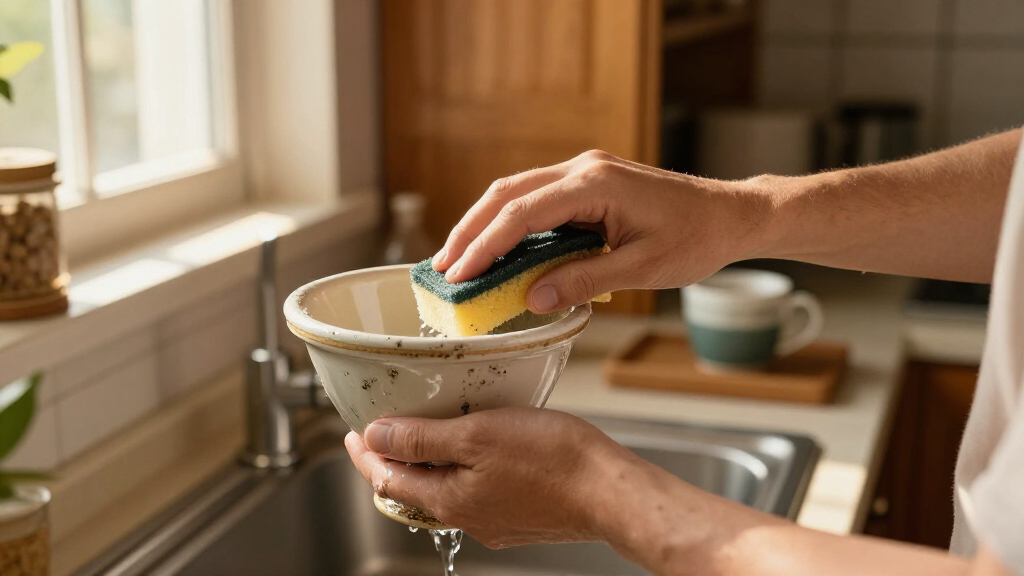
You need clean water, a Scotch-Brite pad or new soft toothbrush — and nothing else. Golden rule: scrub the outside only, and never let soap or untreated water touch the clean inside.
Wash hands, remove candle
Take the candle out of the housing. Keep track of washers and the wing nut — set them somewhere clean.
Block the mount hole
Cover the threaded fitting at the top with a clean thumb or palm. This stops dirty wash water flooding the inside — the exit path for drinking water.
Rinse under clean water
Use filtered, boiled, or treated water if your tap supply is questionable. You’re rinsing drinking-water equipment.
Scrub outside, gently
Work top to bottom with the Scotch-Brite pad. The brown or yellow layer sloughs off and white ceramic emerges. Light, even strokes — don’t dig.
Do the light test
Hold the candle up to a bright light or window before reinstalling: no cracks, no chips, and the wall should still look substantial.
Reassemble & flush
Rebuild with clean hands and run the first liter or two to waste — freshly scrubbed ceramic sheds fine dust.
Porous ceramic absorbs chemicals and releases them into your drinking water for days afterward. Water and friction are the entire toolkit.
Read Flow Rate, Not the Calendar
A healthy candle delivers roughly a liter every few minutes. When the drip becomes a slow dribble, the outer surface is clogged — time to scrub. Every scrub removes a little ceramic, so don’t clean unnecessarily; but don’t wait until flow stops entirely either.
A pencil mark inside the filter housing lid each time you clean gives you a free record of both water-quality trends and the element’s remaining life. Muddy rainy-season water may need a scrub every two weeks; clear catchment can go four months.
Ceramic Filter Lifespan by Type
The spread is enormous because three variables dominate: how dirty your water is, how often you clean, and whether the element contains carbon. The ceramic itself is often the longest-lived part of the assembly — the catch is carbon.
| Filter Type | Typical Lifespan | Limited By |
|---|---|---|
| Ceramic-only candle | 1–10 years (50–100 cleanings) | Physical wear, cracks, thinning |
| Ceramic + carbon core | 6–12 months | Carbon exhaustion (taste/odor returns) |
| Ceramic with silver | Same as ceramic body | Silver doesn’t deplete quickly; wear rules |
| Ceramic pre-filter, multi-stage | 2–5 years | Sediment load from raw source water |
Mineral scale can crust the surface and mimic clogging. A gentle scrub handles light scale the same way it handles silt.
3 Unmistakable Signs It’s Time to Replace
Knowing when to stop cleaning and start replacing is the difference between a $30 part swap and drinking compromised water without knowing it. Check after every cleaning — no lab required.
Scrubbing no longer restores flow
If a good clean doesn’t bring back a steady stream, the ceramic wall is worn too thin or too clogged deep to trust. Replacement time.
Cracks, chips, or glow through the wall
Hold the candle to bright light: any crack, chip, or glow passing through the sidewall means replace immediately — cracked ceramic lets water bypass filtration entirely.
Taste or odor returns
In carbon-cored candles, returning taste and odor means the carbon is spent — even if the ceramic looks perfect. Swap on schedule: 6–12 months.
Key Takeaways
Clean only when flow slows — usually every 1–3 months — using clean water and a Scotch-Brite pad on the outside only; never soap, bleach, or detergent.
A ceramic-only candle lasts 1–10 years and survives 50–100 cleanings; carbon-cored candles are spent at 6–12 months (~2,000–8,000 liters) regardless of appearance.
Do the light test after every cleaning: any crack, chip, or glow through the sidewall means replace immediately.
Replace when scrubbing no longer restores flow, when taste/odor returns, or when the wall has visibly thinned.
Keep one dated spare in dry storage and mark install dates — a five-minute planned swap beats a surprise filter failure.
How a Ceramic Filter Actually Works (and Why Scrubbing Fixes It)
A ceramic filter works by mechanical filtration — physically blocking contaminants in the tiny, winding channels of a fired-clay wall. The ceramic is typically rated at 0.5 to 1 micron, tight enough to trap bacteria like E. coli and cholera, plus sediment, rust, and protozoan cysts. Many candles also contain activated carbon or silver, which tackle taste, odor, and bacterial growth on the filter surface.
Here’s the part that explains everything else: nearly everything the filter catches lodges in the outermost layer of the ceramic. The gunk never penetrates deep. So when flow slows to a trickle, the clogged material is sitting right there on the surface — and scrubbing that thin outer layer off exposes fresh ceramic underneath.
Think of it like sharpening a good knife. You’re removing a little material each time, but that removal is the maintenance. A standard candle is thick enough to survive 50 to 100 cleanings before it’s worn too thin to trust.
One caveat worth knowing: a ceramic filter does not remove dissolved chemicals, salts, heavy metals, or viruses. If your source water carries those, ceramic is one stage in a system, not the whole system.
As an affiliate, we earn on qualifying purchases.
How to Clean a Ceramic Filter Candle Without Ruining It
Cleaning a ceramic filter takes about five minutes and requires clean water, a Scotch-Brite pad or new soft toothbrush, and nothing else. The golden rule: you scrub the outside only, and you never let soap or untreated water touch the clean inside.
- Wash your hands thoroughly, then remove the candle from the housing. Keep track of the washers and wing nut — set them somewhere clean.
- Block the mount hole. Place a clean thumb or your palm over the threaded fitting at the top of the candle. This stops dirty wash water from flooding into the inside, which is the exit path for your drinking water.
- Rinse under clean running water. Use filtered, boiled, or treated water if your tap supply is questionable — you’re rinsing drinking-water equipment, after all.
- Scrub the outside gently with the Scotch-Brite pad, working top to bottom. The discolored brown or yellow layer will slough off and you’ll see white ceramic emerge. Don’t dig — light, even strokes.
- Rinse again and inspect. Hold the candle up to a bright light or window before reinstalling. No cracks, no chips, and the ceramic should still look substantial.
- Reassemble with clean hands and run the first liter or two to waste, since freshly scrubbed ceramic sheds fine dust.
Never use soap, bleach, or detergent on a ceramic candle. The porous ceramic absorbs chemicals and releases them into your drinking water for days afterward. Water and friction are the entire toolkit.
A real-world example: a household filtering silty spring water might find flow drops from a steady stream to a sad drip after three weeks. One gentle scrub restores full flow in minutes. That’s normal operation, not a defect.
As an affiliate, we earn on qualifying purchases.
How Often to Clean — Reading Flow Rate Instead of the Calendar
Clean a ceramic filter when flow slows noticeably — for most households that’s every 1 to 3 months, but your water dictates the real schedule. Muddy creek water in rainy season might need cleaning every two weeks; relatively clear rainwater catchment might go four months between scrubs.
Flow rate is the honest gauge. A healthy candle delivers roughly a liter every few minutes depending on the housing design. When you find yourself waiting noticeably longer to fill a kettle — or the drip becomes a slow dribble — the outer surface is clogged and it’s time to scrub.
Don’t clean on a rigid schedule just because the calendar says so. Every scrub removes a little ceramic, so unnecessary cleaning shortens the element’s total life. Conversely, don’t wait until flow stops entirely; a fully clogged candle forces water to sit longer in contact with trapped organic material, which isn’t great either.
- Murky or surface water: check flow every 2–3 weeks
- Rainwater or clear well water: check monthly, clean as needed
- Municipal water used for taste/backup: cleaning may only be needed every 4–6 months
Log it. A pencil mark inside the filter housing lid each time you clean gives you a free record of both your water quality trends and the element’s remaining life.
As an affiliate, we earn on qualifying purchases.
Ceramic Filter Lifespan: What the Numbers Actually Say
Ceramic filter lifespan ranges from 6 months to 10 years, and the spread is enormous because three variables dominate: how dirty your water is, how often you clean, and whether the element contains carbon. According to Unplugged Kitchen’s experience maintaining off-grid filtration systems, the ceramic itself is often the longest-lived part of the whole assembly.
The catch is carbon. Candles with an activated carbon core do more work — better taste, reduced chlorine, some chemical reduction — but carbon exhausts long before the ceramic wears out. Most manufacturers rate carbon-cored candles at 6 months to 1 year of use, or roughly 2,000 to 8,000 liters, regardless of how good the ceramic still looks.
| Filter Type | Typical Lifespan | Limited By |
|---|---|---|
| Ceramic-only candle | 1–10 years (50–100 cleanings) | Physical wear, cracks, thinning |
| Ceramic + carbon core | 6–12 months | Carbon exhaustion (taste/odor returns) |
| Ceramic with silver | Same as above for ceramic body | Silver doesn’t deplete quickly; wear rules |
| Ceramic pre-filter in a multi-stage system | 2–5 years | Sediment load from raw source water |
Hard water adds another wrinkle: mineral scale can crust the surface and mimic clogging. A gentle scrub handles light scale the same way it handles silt.
As an affiliate, we earn on qualifying purchases.
3 Signs Your Ceramic Filter Is Done (Not Just Dirty)
Replace a ceramic filter candle when scrubbing no longer restores flow, when the body shows cracks or chips, or when the wall has worn thin enough to pass light. Each sign means something different, and only one of them is invisible until you look.
Sign 1: Flow won’t recover after a good scrub. You’ve cleaned off the surface, the candle looks white and smooth, and it still drips like a dying faucet. The internal channels or the carbon core are clogged, and no amount of outside scrubbing fixes that. Replace it.
Sign 2: Cracks, chips, or a loose mount. This is the dangerous one, because a hairline crack lets water bypass the ceramic entirely — unfiltered water taking the express lane. Hold the candle up to a bright window and rotate it slowly. Any line that admits light, any chip at the base or around the threaded fitting, and the candle goes in the bin. No exceptions, no “it’s probably fine.”
Sign 3: The wall is thin. Years of scrubbing remove ceramic, and eventually the wall thins from roughly a centimeter down to a few millimeters. Do the light test: if you see a glow through the sidewall — not just at the top where some candles are thinner by design — the filtration path has shortened and integrity is questionable.
A cracked ceramic filter can look perfectly clean and still deliver untreated water. The light test after every cleaning is the cheapest safety inspection in off-grid water treatment.
One more trigger, independent of the ceramic: if your carbon-cored candle’s output starts tasting like nothing happened — flat, chlorinated, or earthy — the carbon is spent and the clock has run out even if the ceramic looks brand new.
Mistakes That Quietly Shorten Filter Life
Most ceramic filters don’t die of old age — they die of small, avoidable habits. The fastest killer is soap or bleach soaking into the pores; the second is scrubbing the inside of the candle, which opens up the very surface that does the filtering.
Handling matters too. A candle dropped on a counter from a foot up can develop an invisible crack that never shows until you do the light test. Set it on a folded towel while you work on the housing, not on a hard edge where it can roll.
- Soap or detergent: absorbed into ceramic, leaches back into water
- Scrubbing the interior: enlarges pores, degrades filtration
- Letting it dry out with trapped sediment: biological growth inside the clogged layer
- Hard scrubbing with wire or abrasive pads: removes ceramic too fast
- Storing spares in a damp garage or basement: mold and musty taste, even in sealed packaging
Store spare candles dry, sealed, and indoors. A spare kept in a musty basement can pick up an odor that no amount of cleaning removes — you’ll taste it in the first ten liters.
Keep a Rotation So You’re Never Without Clean Water
Buy at least one spare candle before you need it, and date it with a marker when it goes into service. This one habit turns filter replacement from an emergency into a five-minute swap you do at your convenience.
In a sustained off-grid setup, consider two identical filters run in rotation: while one element soaks and dries after cleaning, the other carries the load. This halves the handling risk for each candle and gives you a built-in backup if one cracks during cleaning.
- Mark the install date on every candle with permanent marker.
- Keep one sealed spare in dry indoor storage.
- Log each cleaning date inside the housing lid.
- Do the light test after every single scrub.
- Replace on signs of failure — never on vague suspicion, never on ignoring the signs.
That pencil-and-marker system costs nothing and tells you more about your filter’s condition than any chart or manual.
Frequently Asked Questions
Can I clean a ceramic filter with vinegar or bleach?
No. Both are absorbed into the porous ceramic and leach into your drinking water afterward. The only cleaning agents you need are clean water and gentle friction from a Scotch-Brite pad or soft brush on the outside of the candle. Vinegar can also interact with carbon cores in some candles.
How do I know if my ceramic filter has a crack?
Hold the dry candle up to a bright window or lamp and rotate it slowly. Any hairline that admits light, any chip near the base or threaded mount, means the candle must be replaced — a crack lets unfiltered water bypass the ceramic entirely, so the filter can look clean while delivering untreated water.
Why has my ceramic filter slowed down even after cleaning?
If a thorough outside scrub doesn’t restore flow, either the internal channels or a carbon core is clogged, or the water source has become heavily scaled or sediment-laden. Try one more careful scrub; if flow stays poor, the element has reached the end of its service life and needs replacing.
Do ceramic water filters expire if unused?
The ceramic itself doesn’t expire on a shelf — fired clay is stable for many years if kept dry, sealed, and odor-free. Carbon-cored candles are the exception in practice: carbon is most effective when fresh, so buy those close to when you’ll use them rather than stockpiling years ahead.
Does cleaning a ceramic filter remove its silver protection?
Silver is incorporated into or coated on the ceramic during manufacturing and doesn’t wash away with normal gentle scrubbing. What does end a silver-treated candle’s life is the same as any ceramic: thinning walls, cracks, or an exhausted carbon core if one is present.
Conclusion
Treat your ceramic filter like a good carbon-steel knife: maintain it with the right touch, inspect it every time you handle it, and retire it when the material itself — not your patience — tells you it’s worn. Scrub outside-only, water-only, and hold it up to the light. That’s the whole discipline.
The satisfaction of off-grid water isn’t the gear. It’s pouring a glass from a system you understand down to the last micron of fired clay — and knowing exactly how many more cleanings that candle has left in it.
NFL season / tailgating Picks
team gear
As an affiliate, we earn on qualifying purchases.