
TL;DR

Get kitchen gear delivered free — and shop member deals
- Fast, free delivery on millions of items
- Access to Prime Big Deal Days deals on October 6–7
- Prime Video, Amazon Music and more included
Online interest in whether frozen food can expire is spiking, though the trigger is unconfirmed. Long-standing guidance from food safety agencies, including the USDA, holds that food kept continuously frozen at 0°F (-18°C) remains safe indefinitely, but texture and flavor decline over months.
Surging online interest in the question “can frozen food go bad?” is putting a spotlight on one of the most commonly misunderstood areas of home food safety. According to long-standing guidance from the US Department of Agriculture, food stored continuously at 0°F (-18°C) or below remains safe to eat indefinitely — a fact that contradicts the popular assumption that frozen food carries a hard expiration date. The reason for the current spike in interest is not confirmed.
The core distinction, repeated across USDA Food Safety and Inspection Service (FSIS) materials, is between safety and quality. Freezing at 0°F keeps food safe because it halts the growth of microorganisms, including bacteria, yeasts, and molds, that cause both spoilage and foodborne illness. Because those organisms cannot multiply while food stays frozen, time alone does not make frozen food unsafe.
Quality, however, is a different matter. The USDA’s published Freezer Storage Guidelines recommend keeping most foods for limited periods — for example, roughly 3 to 4 months for ground meat, 4 to 12 months for whole poultry, and around 2 to 3 months for cooked leftovers — not for safety reasons but because flavor, texture, and moisture content degrade over time. Freezer burn, the grayish-brown patches caused by air reaching the food’s surface, is a quality problem rather than a health hazard, according to the same guidance.
The USDA also notes that food safety can only be guaranteed if the freezer has maintained a consistently cold temperature. Food that has thawed partially or fully — as in a power outage or a malfunctioning freezer — enters different territory. Bacteria resume growth above 40°F, and food left in the “danger zone” between 40°F and 140°F for more than two hours may be unsafe regardless of whether it is later refrozen.
Why Freezer Guidance Confuses Shoppers
The confusion has practical consequences in household kitchens. Many consumers treat “best by” and package dates on frozen products as safety deadlines and discard food that the USDA considers safe to eat. Conversely, others misunderstand the guidance in the opposite direction, assuming “safe forever” means frozen food never spoils even after thawing cycles or temperature abuse.
The distinction also carries economic weight. USDA guidance implicitly supports reducing household food waste, since Americans discard substantial amounts of edible food each year, and frozen storage is one of the most effective tools for extending the usable life of groceries. Understanding that freezer timelines are quality benchmarks rather than expiration cutoffs can change how households buy, store, and decide when to discard food.
Food safety educators have long identified frozen-food dates as a recurring point of public confusion, which is why agencies maintain dedicated explainer pages on the topic.
The Science Behind Indefinite Freezing
The scientific basis for the USDA’s position has been settled for decades. Freezing to 0°F does not kill most microorganisms, but it renders them dormant, preventing the multiplication that drives both spoilage and illness. That is why safety does not degrade with time, provided the cold chain is unbroken.
Quality loss happens through separate mechanisms: ice crystal formation damages cell structures, oxidation degrades fats and flavors, and moisture migration causes freezer burn. Enzyme activity slows dramatically but does not fully stop, which is why blanching vegetables before freezing is standard practice. These processes explain why a two-year-old frozen steak is safe but may taste notably worse than a fresh-frozen one.
Public interest in freezer storage questions has historically spiked around events that put frozen food in the news — power outages, bulk buying, and cost-of-living pressures that push households toward frozen and batch-cooked meals. Whether any specific event drove the current wave of interest has not been established.
What’s Driving the Interest Spike
The trigger for the current surge in searches and coverage on this question is unconfirmed. No specific announcement, study release, recall, or public health event tied to the topic has been verified as the cause. It is also unclear whether the interest reflects a seasonal pattern, a viral social media discussion, or broader consumer attention to food costs and waste.
While the underlying science on frozen-food safety is well established, individual household situations vary: freezer temperatures fluctuate, door openings affect stability, and partially thawed food may look normal. The USDA advises evaluating thawed or temperature-abused food case by case rather than relying on time in the freezer alone.
How to Check Your Own Freezer
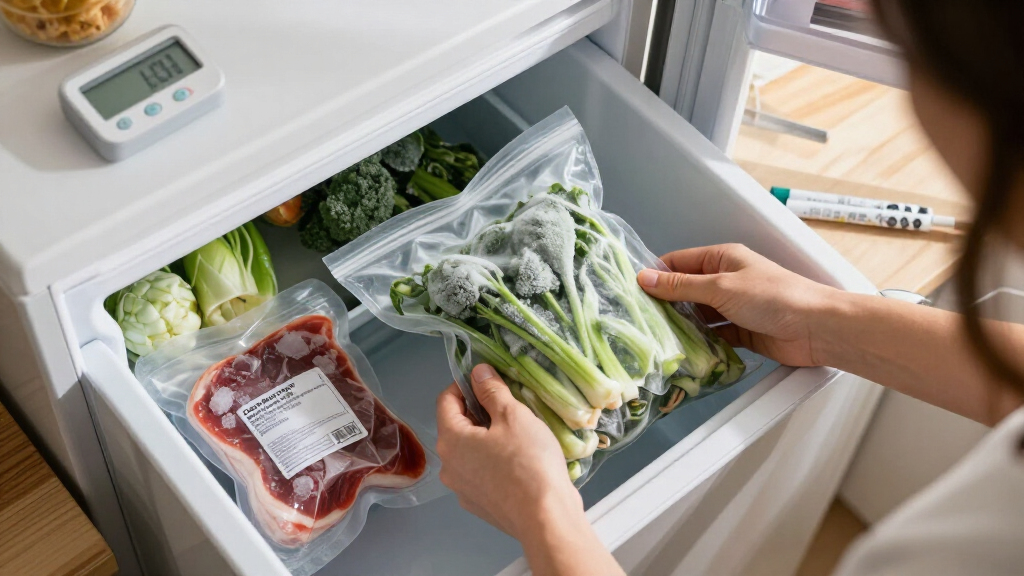
For readers acting on this guidance, food safety agencies recommend a few concrete steps: use an appliance thermometer to confirm the freezer holds 0°F or below, package food tightly to limit air exposure and freezer burn, and label items with freeze dates so quality timelines can be tracked. After any outage, the USDA advises checking whether food still contains ice crystals — a sign it can safely be refrozen — and discarding anything held above 40°F for more than two hours. Continued consumer interest may prompt food safety agencies and educators to reissue or refresh their existing guidance pages, though no such announcement is confirmed.
Key Questions
Does frozen food ever actually expire?
No, not in a safety sense. According to USDA guidance, food kept continuously at 0°F (-18°C) or below is safe indefinitely. Package dates and freezer timelines refer to quality, not safety.
Is freezer-burned food safe to eat?
Yes. The USDA states that freezer burn is a quality issue caused by air exposure, not a health hazard. Affected areas may be trimmed away or the food used in recipes with moisture, though taste and texture will suffer.
What happens if my freezer partially thaws?
Food that still contains ice crystals may be safely refrozen, per USDA guidance. Food held above 40°F for more than two hours should be discarded, since bacteria resume growth at those temperatures.
How long should I keep common frozen foods?
USDA quality guidelines suggest roughly 3–4 months for ground meat, 4–12 months for whole poultry, and 2–3 months for cooked leftovers. These are quality benchmarks, not safety limits.
Why is there suddenly so much interest in this question?
Search and media interest is spiking, but the specific trigger is unconfirmed. The underlying science and USDA guidance are long established and have not changed.
Source: rss
Fall Picks
fall essentials
As an affiliate, we earn on qualifying purchases.