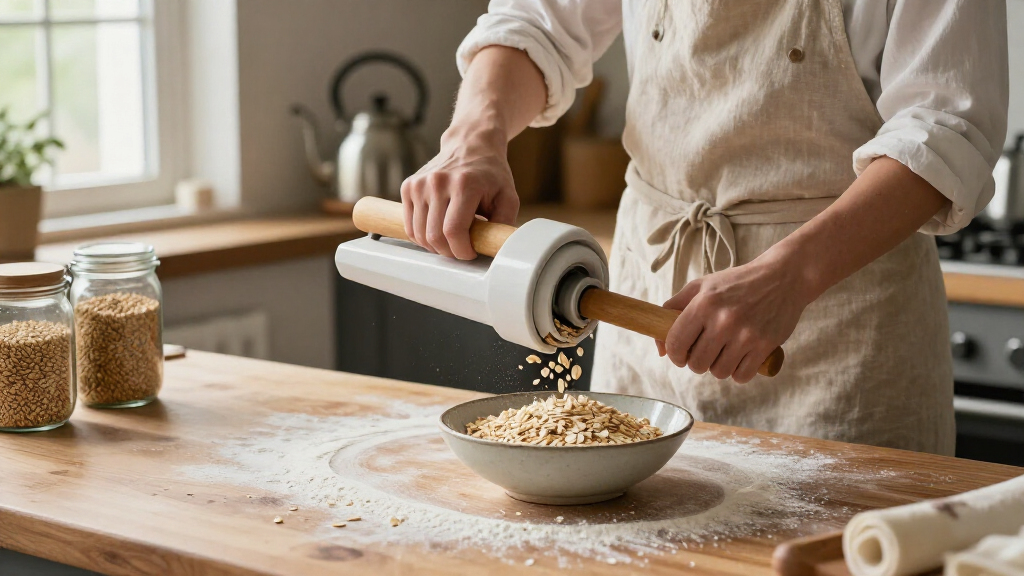

For a dedicated hand-cranked flaker, I would start with the Schnitzer ME1154 Campo: it combines continuously adjustable flakes with a listed range that includes grains, seeds, and spices. The Schnitzer Campo Steel ME1191 is a close alternative for buyers who want a similar grain-focused setup with ball-bearing stainless steel rollers. If you also want to make flour, the Marcato Marga Mulino has the broadest role, since it handles both flaking and grinding and offers coarse, medium, and fine settings.

Get kitchen gear delivered free with Prime
- Fast, free delivery on millions of items
- Prime Video, Amazon Music and more included
- Member-only deals all year
The choice comes down to more than the crank. The Schnitzer models are straightforward flakers with continuous adjustment and a worktop clamp, while the Marcato adds flour-making but describes its texture controls as three broad settings. All three require manual effort in their hand-operated form, and none is a universal grain processor: the Campo ME1154 explicitly excludes corn, while the Marcato’s listed grains and the ME1191’s listed range should guide what you buy them for. I rank them by how well each fits a distinct home-kitchen need, not by treating every extra feature as an automatic advantage.
Complete the kit


Key Takeaways
- The Schnitzer ME1154 ranks first for dedicated flaking because it combines continuous thickness adjustment with a stated range that includes seeds and spices as well as grains; it does not process corn.
- The Schnitzer Campo Steel ME1191 offers a closely comparable grain-flaking setup, with ball-bearing stainless steel rollers, but its listed use centers on grains rather than the wider seeds-and-spices range given for the ME1154.
- The Marcato Marga Mulino is the most versatile choice here if you want both flakes and flour, though its coarse, medium, and fine options are less finely described than Schnitzer’s continuous adjustment.
- Both Schnitzer flakers list a capacity of 110 g per minute and use a worktop clamp, so buyers should have a suitable surface and room to crank.
- The Marcato can pair with a separate Pastadrive Motor, but that accessory is not included in the supplied product details; its motor compatibility does not make the hand-operated setup electric by itself.
| Schnitzer ME1154 Campo Grain Crusher and Stone Flaker |  | Best Overall Dedicated Manual Flaker | Brand: Schnitzer | Material: Beechwood body | Rollers: Stainless steel | VIEW LATEST PRICE | See Our Full Breakdown |
| Schnitzer Campo Steel Grain Crusher, Roller and Flaker |  | Best for a Straightforward Grain-Flaking Setup | Model: ME1191 | Body: Beechwood with linseed finish | Rollers: Stainless steel, ball-bearing | VIEW LATEST PRICE | See Our Full Breakdown |
| Marcato Marga Mulino Grain Mill and Flaker |  | Best for Flakes and Flour in One Machine | Construction: Chrome steel | Rollers: Food-safe anodized aluminum | Functions: Grinds grains into flour and flakes cereals | VIEW LATEST PRICE | See Our Full Breakdown |
| manual grain flaker | Rollers | Flaking capacity | Dimensions | Crank length |
|---|---|---|---|---|
| Schnitzer ME1154 Campo Grain C | Stainless steel | 110 g/min | 12 × 25 cm (W × H) | 18.5 cm |
| Schnitzer Campo Steel Grain Cr | Stainless steel, ball-bearing | 110 g/min | 7.3 × 4.75 × 9.85 in | 18.5 cm |
| Marcato Marga Mulino Grain Mil | Food-safe anodized aluminum | — | — | — |
More Details on Our Top Picks
Schnitzer ME1154 Campo Grain Crusher and Stone Flaker
The ME1154 is my first choice for someone whose main task is making flakes by hand. Its continuously adjustable thickness lets a user work toward a preferred texture rather than choosing only among a few fixed levels. That distinction matters when the same machine may be used for different grains or for flakes intended for different breakfasts and recipes. The listed 110 g/min capacity gives a useful reference point, though actual output can depend on the grain and the pace of cranking.
Compared with the Campo Steel ME1191, this model has the more expansive stated ingredient range: it is described for oats, spelt, rice, rye, wheat, seeds, and spices. That gives it a clearer case for a kitchen that wants more than oat flakes. Both Schnitzer options use stainless steel rollers, beechwood construction, continuous adjustment, and a table clamp, so the ME1154 does not win simply by having a different basic setup. Its advantage is the breadth of the supplied use description.
The clamp is a practical part of the design, not a minor accessory. A stable worktop mount can make hand cranking easier to manage, but it also means the machine needs a suitable counter or table edge. The 18.5 cm crank gives the user a lever for manual operation; it does not remove the effort involved. Compared with the Marcato, this is the more focused flaker: it does not add flour milling, but its continuous adjustment is more specifically suited to dialing in flakes.
There are clear limits. The maker’s supplied description excludes corn, so this is not the pick for someone seeking one machine for every grain. It also requires manual cranking, and the stated capacity should not be mistaken for effortless or automatic processing. I would choose it over the ME1191 when seeds and spices are part of the intended use; I would choose the Marcato instead if producing flour matters as much as flaking.
Pros:- Continuous adjustment gives more control over flake thickness than a small set of fixed settings.
- The stated ingredient range includes oats, spelt, rice, rye, wheat, seeds, and spices.
- Stainless steel rollers pair with a beechwood body.
- Includes a table clamp for securing it to a suitable worktop.
Cons:- The supplied description says it is not suitable for corn.
- Manual cranking takes effort and requires the user to operate the machine throughout.
- A worktop edge suitable for the clamp is needed for mounting.
Best for: Home cooks who want a dedicated hand-cranked flaker with continuous thickness adjustment and a stated range extending beyond common grains to seeds and spices.
Not ideal for: Shoppers who need to process corn, want motorized operation without extra equipment, or prefer a combined flaker and flour mill.
- Brand:Schnitzer
- Material:Beechwood body
- Rollers:Stainless steel
- Power:Manual
- Flaking capacity:110 g/min
- Dimensions:12 × 25 cm (W × H)
- Crank length:18.5 cm
- Adjustment and mounting:Continuous flake thickness adjustment; table clamp
- Suitable ingredients:Oats, spelt, rice, rye, wheat, seeds, and spices; not corn
Our verdict“I rank the ME1154 first for dedicated manual flaking because it pairs continuous adjustment with the broadest stated ingredient range in this lineup, provided corn is not on your list.”
Schnitzer Campo Steel Grain Crusher, Roller and Flaker
The Campo Steel ME1191 is a strong fit for buyers who want a dedicated manual grain flaker and do not need the wider seed-and-spice use stated for the ME1154. It handles oats, spelt, rice, rye, and wheat, with a continuously adjustable setting for flake thickness. That makes it a close functional match to the top-ranked Schnitzer rather than a lower-control alternative. Its place at number two reflects a narrower supplied ingredient description, not a lack of the main flaking features.
Its ball-bearing stainless steel rollers are a differentiating detail within the lineup. The ME1154 also has stainless steel rollers, but the supplied information does not specify ball bearings for that model. For a buyer comparing the two, the ME1191 is the clearer choice if that roller construction detail is a priority and the named grain range meets the need. Both share a 110 g/min stated capacity, continuous adjustment, an 18.5 cm crank, and a table clamp, so their everyday setup is closely related.
The beechwood body has a linseed finish, and the listed weight is 5.5 lb. Those details help define the physical product, but they do not remove the need for a stable mounting surface. The clamp is useful if a worktop edge suits it; it is a limitation if the kitchen has no suitable place to secure the machine. Like the ME1154, this is a hand-operated model, so the user supplies the turning effort. Unlike the Marcato, it is not described as a flour mill or as compatible with a separate motor.
I would choose the ME1191 when the job is regular flaking of the listed grains and the buyer values the specified roller construction. I would pay closer attention to the ME1154 if seeds and spices are part of the plan, since that model explicitly lists them. The Marcato makes more sense when flour is also a goal. The ME1191’s main drawback is that its concise grain-focused range leaves less reason to choose it for unusually varied ingredients, while its clamp and manual crank demand the same hands-on setup as the other Schnitzer.
Pros:- Ball-bearing stainless steel rollers are specified.
- Continuously adjustable flake thickness offers more texture control than three fixed categories.
- The listed grain range covers oats, spelt, rice, rye, and wheat.
- A table clamp is included for worktop mounting.
Cons:- Manual cranking is required during use.
- The clamp requires a compatible worktop or table edge.
- The supplied description lists fewer ingredient types than the ME1154 and does not add flour milling like the Marcato.
Best for: Buyers who mainly flake oats, spelt, rice, rye, and wheat and want a hand-cranked Schnitzer with ball-bearing stainless steel rollers.
Not ideal for: People who want the widest stated ingredient range, flour milling, motorized operation out of the box, or a machine that does not need a clampable worktop.
- Model:ME1191
- Body:Beechwood with linseed finish
- Rollers:Stainless steel, ball-bearing
- Flaking capacity:110 g/min
- Dimensions:7.3 × 4.75 × 9.85 in
- Item weight:5.5 lb
- Crank length:18.5 cm
- Adjustment and mounting:Continuous flake thickness adjustment; table clamp
- Listed grains:Oats, spelt, rice, rye, and wheat
Our verdict“I recommend the ME1191 for grain-focused buyers who value its specified ball-bearing rollers, while the ME1154 offers a broader stated ingredient range and the Marcato adds flour-making.”
Marcato Marga Mulino Grain Mill and Flaker
The Marcato Marga Mulino is the clearest choice for a buyer who wants more than a flaker. It is described as both a grain mill and flaker, processing soft and hard grains into flakes or flour. That changes its role in this group: the Schnitzer machines focus on adjustable flaking, while the Marcato can support home baking with flour as well as cereal preparation. If those two jobs matter equally, its added function may be more useful than the Schnitzer models’ continuous flake adjustment.
Its texture control is described as coarse, medium, and fine. These three settings offer a simple choice, but they are not the same as the Schnitzers’ continuous thickness adjustment. Buyers who want to make small changes in flake thickness may prefer either Campo; people who are comfortable selecting among broader settings may appreciate the Marcato’s direct setup. The listed compatible grains—oat, barley, rye, spelt, Kamut, rice, and buckwheat—include several options, but the supplied details do not give the same seeds-and-spices use stated for the ME1154.
Construction is another point of difference. The Marga Mulino has a chrome-steel structure and food-safe anodized aluminum rollers, with the rollers described as designed to prevent particles from releasing during use. It is made in Italy and can pair with a Pastadrive Motor. That compatibility may appeal to someone considering motor-assisted operation later, but the motor is separate; buyers should not treat it as part of the manual machine. The supplied details also do not state a flaking capacity or mention a table clamp, unlike both Schnitzer entries.
For a dedicated flaking purchase, I place it behind the two Campo models because its settings are broader categories and the product asks the buyer to value milling as well as flaking. For a baker who wants one hand-operated appliance to make both flakes and flour, that ranking can reverse: the Marcato is the only listed option that covers both jobs. It is not the right match for someone seeking continuous adjustment, a stated output figure, or a specified clamp-mounted setup. Its strongest case is versatility, not a closer match to every dedicated-flaker preference.
Pros:- Combines grain flaking and flour milling in one machine.
- Processes listed soft and hard grains, including oat, barley, rye, spelt, Kamut, rice, and buckwheat.
- Coarse, medium, and fine settings provide distinct texture choices.
- Food-safe anodized aluminum rollers are described as designed to prevent particles from releasing during use.
Cons:- Three broad settings do not offer the continuous adjustment listed for both Schnitzer models.
- The Pastadrive Motor is a separate compatible accessory, not built-in motorized operation.
- The supplied details do not state a flaking capacity or include a worktop clamp.
Best for: Home bakers who want one manual machine for cereal flakes and flour, and who are comfortable with coarse, medium, and fine texture settings.
Not ideal for: Buyers focused only on finely adjustable flakes, those who need a stated capacity or clamp mounting detail, or anyone expecting the Pastadrive Motor to be included.
- Construction:Chrome steel
- Rollers:Food-safe anodized aluminum
- Functions:Grinds grains into flour and flakes cereals
- Texture settings:Coarse, medium, and fine
- Compatible grains:Oat, barley, rye, spelt, Kamut, rice, and buckwheat
- Origin:Made in Italy
- Motor compatibility:Compatible with the separate Pastadrive Motor
Our verdict“I would choose the Marga Mulino over either Schnitzer when flour-making matters as much as flakes, but not when continuous flake adjustment is the main priority.”

How We Picked
I ranked these three products for people who specifically want manual grain flakers, rather than for shoppers looking for a general-purpose grain mill. My first question was whether each machine clearly flakes grain by hand. I then compared the useful differences that can shape daily use: the range of ingredients named, how texture is adjusted, the roller and body materials, mounting, and whether flour-making adds meaningful value to a flaking purchase.
That approach puts the Schnitzer ME1154 Campo first as the strongest dedicated flaker on the supplied details. Its continuous adjustment gives the user more control than a few fixed settings, and its stated suitability for seeds and spices makes it the broadest ingredient match among the two Schnitzer entries. The Campo Steel ME1191 follows closely: it shares the 110 g/min listed capacity, continuous adjustment, stainless steel rollers, and clamp-based mounting, but the supplied description names grains rather than seeds and spices. I treat those as distinct buying reasons rather than assuming the machines are interchangeable.
The Marcato Marga Mulino earns its place for a different kind of buyer. It is the only option here described as both a flaker and a flour mill, and it covers soft and hard grains with three texture settings. That extra function may be more useful than continuous flake adjustment for a baker who wants flour as well as cereal flakes. It is not automatically the better flaker, though: the provided details do not state a flaking capacity or a table clamp, and its motor is a separate compatible accessory rather than a built-in feature.
I have not inferred performance claims beyond the supplied specifications. For example, a stated capacity is useful for comparing the Schnitzer models, but it does not establish that every grain will process at the same rate. Ingredient suitability also matters: the ME1154 explicitly says it is not suitable for corn, and the Marcato’s listed compatible grains should not be read as an unrestricted promise for every seed or grain. My ranking rewards clear fit, practical texture control, and honest tradeoffs; buyers should still match the maker’s guidance to the grains they plan to use.
| manual grain flaker | Rollers |
|---|---|
| Schnitzer ME1154 Campo Grain C | Stainless steel |
| Schnitzer Campo Steel Grain Cr | Stainless steel, ball-bearing |
| Marcato Marga Mulino Grain Mil | Food-safe anodized aluminum |
Factors to Consider When Choosing Manual Grain Flakers
I would choose a manual grain flaker by working backward from what I want it to make. If the goal is a bowl of fresh flakes, continuous adjustment and clear grain compatibility matter most. If flour is also on the menu, a combined mill may be more useful even if its flake settings are less finely adjustable. The following points explain why the three products do not serve exactly the same buyer.
Decide Whether You Need a Flaker or a Flaker-Mill
The Schnitzer ME1154 and Campo Steel ME1191 are presented as grain crushers and flakers. Their main value is a direct, hand-cranked route to flakes, with continuous thickness adjustment. The Marcato Marga Mulino adds grinding grains into flour, giving it a broader role in a baking kitchen. I would not treat that extra function as an automatic upgrade: if I only plan to make flakes, the Marcato’s flour capability may matter less than the Schnitzers’ continuous adjustment and clearer clamp-mounted setup.
Think about the foods you actually prepare. A buyer who makes porridge or adds flakes to recipes may prefer a dedicated flaker. Someone who wants to process grain into flour as well could benefit from the Marcato’s two functions. The tradeoff is that the Marcato describes texture as coarse, medium, and fine, while both Schnitzers describe continuous adjustment. This is a choice between more machine functions and more granular flake control, rather than a simple difference in quality.
Match the Grain List to Your Pantry
Ingredient lists can be more useful than broad claims about versatility. The ME1154 lists oats, spelt, rice, rye, wheat, seeds, and spices, and explicitly excludes corn. The ME1191 names oats, spelt, rice, rye, and wheat. The Marcato lists oat, barley, rye, spelt, Kamut, rice, and buckwheat and describes processing soft and hard grains into flakes or flour. Those stated ranges point to different strengths: the ME1154 is the clearest match for someone interested in seeds and spices, while the Marcato names barley, Kamut, and buckwheat.
I would check the maker’s guidance for any grain that is not explicitly listed before buying. A product’s ability to handle several grains does not establish that every seed, kernel, or hard ingredient is suitable. Corn deserves particular care here because the ME1154 description rules it out. The supplied ME1191 and Marcato details do not name corn, so I would not assume they process it based on this information alone.
Choose the Adjustment Style You Will Use
Both Schnitzer models have continuous flake thickness adjustment. That gives the user room to tune the result across a range rather than selecting only from preset categories. It can be a useful difference for people who want a specific flake texture or expect to adjust between ingredients. The Marcato offers coarse, medium, and fine settings. That is easier to understand as a short menu of options, but it does not describe the same fine-grained adjustment system.
Neither approach is right for everyone. If I want to experiment with small thickness changes, I would favor a Campo. If I mainly need a few broad textures and also want flour, the Marcato’s settings may be enough. The product details do not provide a direct texture sample or a common measurement scale across all three, so I would compare their stated control methods rather than assume that one setting maps precisely to another machine’s result.
Account for Cranking and Mounting
The Schnitzer flakers are manual and include a table clamp. That setup can secure the machine during cranking, but it assumes a worktop edge that fits the clamp and leaves enough space to turn the handle. Their listed crank length is 18.5 cm. I would check the available counter space before choosing one, especially in a small kitchen or a shared preparation area. The clamp is helpful, but it also makes the mounting location part of the buying decision.
The Marcato is also presented as a hand-operated grain mill and flaker, and its details list compatibility with a separate Pastadrive Motor. That gives a possible route to motor-assisted operation, but the accessory is not included in the supplied information. The details also do not state that a clamp is included. If mounting is a deciding feature, the Schnitzers have the clearer specification; if motor compatibility is useful for a future setup, the Marcato has that distinct option.
Use Capacity Figures Carefully
Both Schnitzer models list a 110 g/min flaking capacity, which offers a shared reference point when comparing them. The Marcato information provided does not include a capacity figure, so I would not use this lineup to claim that it is faster or slower. A listed capacity also does not promise the same output for every grain or every person using the crank. It is best treated as a specification for comparison, not a guarantee of real-world pace.
If speed matters, consider the amount you expect to prepare and how often you are willing to crank. Manual machines require active operation, and none of these descriptions suggests that hand use is effortless. The Schnitzers’ figures can help narrow a choice between those two models, but your grain choice, texture setting, and working pace may affect the time required.
Compare Materials Without Overreading Them
The Campo ME1154 pairs a beechwood body with stainless steel rollers. The ME1191 also uses a beechwood body, with a linseed finish, and specifies ball-bearing stainless steel rollers. The Marcato instead uses a chrome-steel construction and food-safe anodized aluminum rollers. These differences help identify what each machine is made from, but the supplied details do not establish a universal durability ranking. I would use the materials to distinguish designs and then match the machine’s functions to the job.
For the ME1191, ball-bearing rollers are the most specific roller detail in the lineup. For the Marcato, the stated food-safe roller design and flour-making function may carry more weight for a baker. For the ME1154, the combination of beechwood and stainless steel supports its role as a dedicated adjustable flaker. None of those materials removes the need to follow product care and use instructions.
Frequently Asked Questions
Which of these manual grain flakers is best for making only flakes?
I would choose the Schnitzer ME1154 for most dedicated flaking needs because it combines continuous thickness adjustment with a stated range that includes grains, seeds, and spices. The Campo Steel ME1191 is a close alternative for users focused on oats, spelt, rice, rye, and wheat, especially if its specified ball-bearing rollers matter to them. The Marcato is the better fit when flour-making is part of the plan as well.
Can the Schnitzer ME1154 process corn?
No. The supplied product description specifically says the ME1154 is not suitable for corn. If corn is a regular ingredient, I would not select this model on the assumption that another grain’s suitability applies to it. The provided details for the ME1191 and Marcato do not establish corn compatibility either, so check product guidance before using either one for corn.
Which option can make flour as well as flakes?
The Marcato Marga Mulino is the only product in this comparison described as both a grain mill and flaker. It processes soft and hard grains into flakes or flour and offers coarse, medium, and fine settings. The two Schnitzer models are presented as flakers and do not have flour milling listed in the supplied product details.
Do these machines adjust flake thickness in the same way?
No. Both Schnitzer Campo models list continuous adjustment, while the Marcato lists three settings: coarse, medium, and fine. I would favor a Schnitzer if I want to vary the thickness beyond a short set of preset choices. The Marcato’s settings may be sufficient for someone who prefers a simpler selection and values its flour-making function.
Does the Marcato Marga Mulino include a motor?
The supplied information says that the Marcato is compatible with the Pastadrive Motor, but it does not say the motor is included. I would treat the machine as hand-operated unless the particular package being considered clearly states otherwise. Buyers interested in motor-assisted use should verify the contents and compatibility of the motor separately before ordering.
Conclusion
For a dedicated manual flaker with broad stated ingredient use, I recommend the Schnitzer ME1154 Campo, especially if continuous thickness control and seeds or spices matter. Choose the Campo Steel ME1191 if your pantry centers on the listed grains and you want its specified ball-bearing stainless steel rollers; its use case is narrower, but its core flaking setup remains close to the top pick. If you are a home baker who wants flakes and flour, I would choose the Marcato Marga Mulino instead and accept its three broad texture settings in exchange for milling capability.
Before deciding, match the grain list to what you intend to process, confirm that a clampable worktop suits your kitchen if choosing a Schnitzer, and remember that each option requires manual effort in its hand-operated form. I would not buy any of these on a general promise of processing every grain. The best fit is the one whose stated ingredients, adjustment style, and extra functions match the way you actually cook.