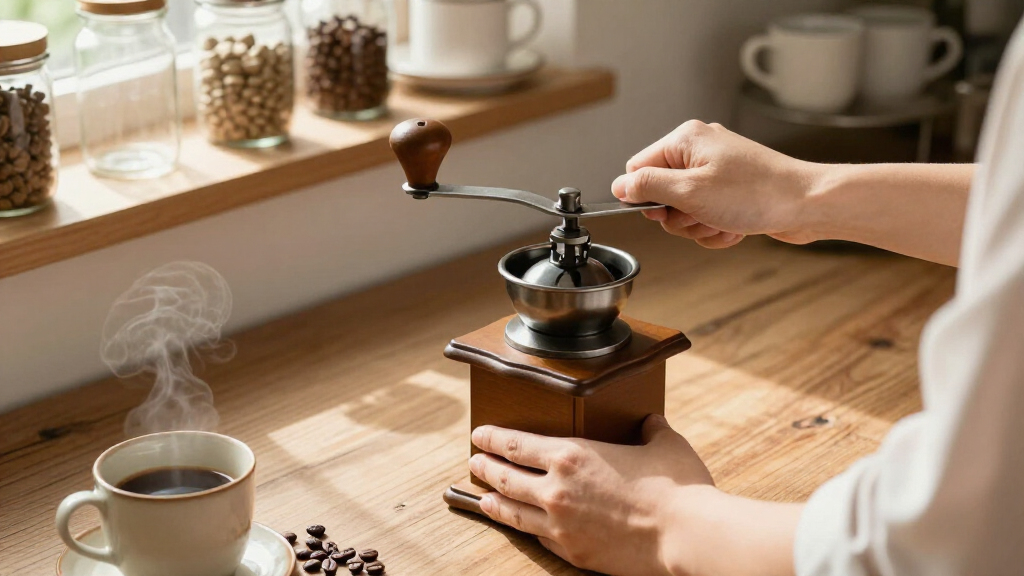

Manual coffee grinders range from $20 budget beaters to $100 precision machines, and the differences come down to burrs, grind consistency, and how much effort each morning demands. The TIMEMORE Chestnut C3S Pro earns my best overall pick for pairing a stainless steel S2C burr with a foldable handle and stepless adjustment at a mid-range price. If budget rules, the KINGrinder P0 delivers surprising grind quality for under $30, while the Alpaca Ventures Premium stands out for espresso-focused precision. The core tradeoff you’ll face: ceramic burrs are cheap and quiet but slow, while stainless steel burrs grind faster and finer but cost more. Read on for the full breakdown of all 13 models.

Get kitchen gear delivered free with Prime
- Fast, free delivery on millions of items
- Prime Video, Amazon Music and more included
- Member-only deals all year
Complete the kit


Key Takeaways
- TIMEMORE dominates the lineup with five entries, but the C3S Pro and C2S are the only two worth paying up for — the C5 Pro sits in an awkward middle ground between them.
- Stainless steel burrs (TIMEMORE, KINGrinder, JavaPresse) clearly outground the ceramic-burr models (PARACITY, the unnamed mini) for espresso, while ceramic held its own for French press and pour over.
- The KINGrinder K6 and P0 proved that KINGrinder’s external click adjustment is faster to dial in than TIMEMORE‘s knob-style adjusters, a real advantage if you switch brew methods often.
- Capacity was a hidden differentiator: the CEVING 60g is the only option here that grinds for two people in one session, while the 25-30g models mean a second round for couples.
- Sub-$35 grinders like the CEVING Mini and PARACITY are fine for coarse grinds and occasional use, but expect wobbly handles and inconsistent espresso — spend $60+ if fine grinding matters.
| Mini Manual Coffee Grinder with Ceramic Conical Burr, Black |  | Best Budget Travel Pick | Grind Settings: 40 | Burr Material: Ceramic conical | Body Material: ABS | VIEW LATEST PRICE | See Our Full Breakdown |
| Premium Manual Coffee Grinder for Espresso, Pour Over & French Press by Alpaca Ventures | 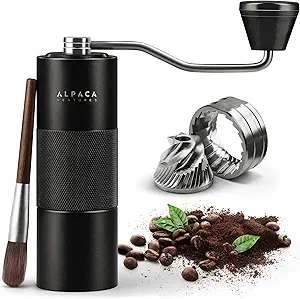 | Best for Beginners | Burr Material: 420 stainless steel | Burr Type: Conical | Handle: Lengthened stainless steel | VIEW LATEST PRICE | See Our Full Breakdown |
| TIMEMORE C5 Pro Manual Coffee Grinder – 30g Capacity, CNC Stainless Steel Conical Burr, Adjustable Coarseness |  | Best Overall | Capacity: 30g | Burr Size: 42mm | Material: CNC stainless steel | VIEW LATEST PRICE | See Our Full Breakdown |
| TIMEMORE Chestnut C3S Pro Manual Coffee Grinder, Stainless Steel S2C Conical Burr, Foldable Handle, Adjustable Grind, Black |  | Best for Travel and Camping | Body Material: All-metal aluminum alloy | Burr: S2C660 patent hexagonal conical burr | Handle: Foldable | VIEW LATEST PRICE | See Our Full Breakdown |
| KINGrinder K6 Manual Coffee Grinder Stainless Burr with Straight Handle |  | Best for Espresso Precision | Adjustment Resolution: 16 microns per click | Adjustment Clicks: 60 per rotation | Hopper Capacity: 25–35g | VIEW LATEST PRICE | See Our Full Breakdown |
| TIMEMORE Chestnut C3S Manual Coffee Grinder | 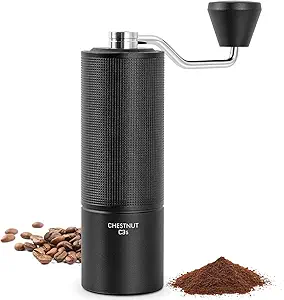 | Best Overall | Burr Type: S2C stainless steel conical burr | Body Material: All-metal aluminum alloy | Capacity: 25 grams | VIEW LATEST PRICE | See Our Full Breakdown |
| PARACITY Manual Coffee Grinder with Ceramic Burr and Glass Jars |  | Best for Storage and Serving | Burr Material: Ceramic conical burr | Jar Capacity: 11 oz per jar | Body Material: Glass jars, silicone base | VIEW LATEST PRICE | See Our Full Breakdown |
| KINGrinder P0 Lightweight Manual Coffee Grinder |  | Best Budget Travel Pick | Weight: 330 g | Capacity: 20 g | Body Material: ABS plastic | VIEW LATEST PRICE | See Our Full Breakdown |
| TIMEMORE Chestnut C2S Manual Coffee Grinder |  | Best Steel-Burr Value | Capacity: 25 g | Burr Size: 38 mm stainless steel conical | Body Material: Full stainless steel | VIEW LATEST PRICE | See Our Full Breakdown |
| JavaPresse Manual Stainless Steel Coffee Grinder |  | Best for Beginners | Burr Type: Ceramic conical burr | Body Material: Stainless steel | Adjustment Settings: 18 | VIEW LATEST PRICE | See Our Full Breakdown |
| CEVING World’s First 60g Large Capacity Manual Coffee Grinder, Black |  | Best for Big Batches | Capacity: 60g | Grind Settings: 40 external adjustments | Burr Material: Stainless steel | VIEW LATEST PRICE | See Our Full Breakdown |
| TIMEMORE Chestnut C2S Manual Coffee Grinder |  | Best All-Arounder | Capacity: 25g | Burr Size: 38mm CNC stainless steel conical | Adjustable Coarseness Levels: 36 | VIEW LATEST PRICE | See Our Full Breakdown |
| CEVING Mini Manual Coffee Grinder with 40 Adjustable Settings, Black | 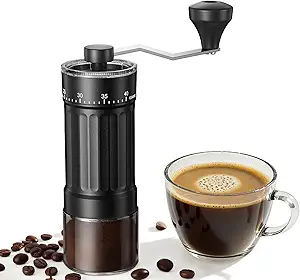 | Best Budget Travel Pick | Adjustable Settings: 40 external | Burr Type: Conical ceramic | Bean Capacity: 30g | VIEW LATEST PRICE | See Our Full Breakdown |
| manual coffee grinder | Body Material | Weight | Capacity |
|---|---|---|---|
| Mini Manual Coffee Grinder wit | ABS | 11.3 oz | 30g |
| Premium Manual Coffee Grinder | — | — | — |
| TIMEMORE C5 Pro Manual Coffee | — | 663g | 30g |
| TIMEMORE Chestnut C3S Pro Manu | All-metal aluminum alloy | — | — |
| KINGrinder K6 Manual Coffee Gr | Aluminum | — | — |
| TIMEMORE Chestnut C3S Manual C | All-metal aluminum alloy | 530 g | 25 grams |
| PARACITY Manual Coffee Grinder | Glass jars, silicone base | — | — |
| KINGrinder P0 Lightweight Manu | ABS plastic | 330 g | 20 g |
| TIMEMORE Chestnut C2S Manual C | Full stainless steel | 700 g | 25 g |
| JavaPresse Manual Stainless St | Stainless steel | — | — |
| CEVING World’s First 60g Large | — | 416g | 60g |
| TIMEMORE Chestnut C2S Manual C | — | 450g | 25g |
| CEVING Mini Manual Coffee Grin | — | 325g | — |
More Details on Our Top Picks
Mini Manual Coffee Grinder with Ceramic Conical Burr, Black
For the price of a couple of café lattes, this little grinder covers the basics: 40 grind settings, a ceramic conical burr, and a glass jar so you can see exactly how much you’ve ground. Compared with the TIMEMORE C5 Pro, it lacks the metal build and smooth bearing-driven crank, so grinding feels less refined — but it also costs far less and weighs less to carry. The ceramic burr won’t corrode if it gets wet on a camping trip, which is a genuine advantage over budget steel burrs that can rust. The tradeoff is 30g capacity and noticeable effort per dose; anyone grinding for a full French press carafe will find it tedious.
Pros:- 40 adjustable settings covering most brew methods
- Ceramic burr is rust-proof and stays sharp with care
- Lightweight at 11.3 oz with a glass jar for visible dosing
- Very low price point for a burr grinder
Cons:- Grinding action is less smooth than premium models like the C5 Pro
- 30g capacity means multiple passes for larger brews
- ABS body feels less durable than all-metal competitors
Best for: Travelers, campers, and office-drip brewers who want one cheap, light grinder that survives a backpack
Not ideal for: Anyone grinding multiple doses a day — the small capacity and hand fatigue add up quickly
- Grind Settings:40
- Burr Material:Ceramic conical
- Body Material:ABS
- Capacity:30g
- Dimensions:6.7 x 2.3 x 6.7 inches
- Weight:11.3 oz
Our verdict“A sensible cheap grab-and-go grinder for occasional travel brewing, not a daily-driver for serious coffee routines.”
Premium Manual Coffee Grinder for Espresso, Pour Over & French Press by Alpaca Ventures
This Alpaca Ventures grinder is the one I’d hand to someone making their first move away from pre-ground coffee. The lengthened stainless-steel handle gives better leverage than the compact Mini Ceramic model, so a full dose takes less strain, and tool-free disassembly means cleaning doesn’t require a tutorial. The 420 stainless burr is a step up from ceramic at this price, producing a more uniform particle spread for pour over. The compromises are real, though: grind adjustment is less precise than the KINGrinder K6’s click-based system, and you have to hold the handle steady while changing settings — a small annoyance that adds friction to dialing in espresso.
Pros:- Ergonomic lengthened handle reduces hand strain
- Tool-free disassembly makes cleaning simple
- 420 stainless steel burr outperforms ceramic at this price
- Versatile enough for multiple brew methods
Cons:- Handle must be held while adjusting grind setting
- Adjustment lacks the click precision of TIMEMORE or KINGrinder models
- No stated capacity or burr size makes comparison shopping harder
Best for: First-time manual grinder buyers who want forgiving operation and easy cleanup for pour over or French press
Not ideal for: Espresso chasers who need repeatable, click-counted grind adjustments — the friction-based setting system isn’t precise enough
- Burr Material:420 stainless steel
- Burr Type:Conical
- Handle:Lengthened stainless steel
- Adjustability:Precision adjustable settings
- Disassembly:Tool-free
- Portability:Compact travel size
Our verdict“A friendly, low-fuss entry point into manual grinding that beginners will outgrow only if they get serious about espresso.”
TIMEMORE C5 Pro Manual Coffee Grinder – 30g Capacity, CNC Stainless Steel Conical Burr, Adjustable Coarseness
The C5 Pro earns the top spot because it balances everything a manual grinder should do well. Its 42mm CNC stainless steel burr is larger than the Chestnut C3S Pro’s cutting surface, which translates to faster, more consistent grinding across the full range from espresso-fine to French-press-coarse. With 48 adjustment levels and a built-in bearing, the crank turns smoothly where budget grinders like the Alpaca Ventures model feel grindy and imprecise. The all-metal body also sheds grind heat better than plastic shells, protecting flavor during longer sessions. The honest downsides: 30g capacity still caps you at roughly two cups per session, and it costs noticeably more than entry-level options — you’re paying for grind quality, not convenience.
Pros:- 48 coarseness levels give fine control for espresso through cold brew
- Large 42mm burr grinds faster and more evenly than smaller rivals
- Built-in bearing makes cranking noticeably smoother
- All-metal construction with no plastic grind path
Cons:- At 663g it’s heavier than ultra-portable options like the Mini Ceramic grinder
- 30g capacity limits batch brewing
- Sits at a higher price tier than beginner models
Best for: Coffee enthusiasts who brew multiple methods and want one precise, durable grinder for daily home use and travel
Not ideal for: Households grinding for a crowd — the 30g capacity forces repeat sessions for anything beyond two servings
- Capacity:30g
- Burr Size:42mm
- Material:CNC stainless steel
- Adjustment Levels:48
- Weight:663g
- Dimensions:159 x 53 x 163.5 mm
Our verdict“If you want a single manual grinder that does every brew method well and lasts years, this is the one to buy.”
TIMEMORE Chestnut C3S Pro Manual Coffee Grinder, Stainless Steel S2C Conical Burr, Foldable Handle, Adjustable Grind, Black
Where the C5 Pro prioritizes grind speed, the Chestnut C3S Pro is built around packability. The foldable handle collapses flat against the body — something no other grinder in this lineup offers — so it slips into a bag without snagging, and the all-metal aluminum alloy body shrugs off the knocks of camp kitchens and suitcase interiors. Its S2C660 hexagonal conical burr is a genuine upgrade over generic steel burrs, holding consistency well for pour over on the road. Around 36 grind settings put it behind the C5 Pro’s 48 for fine espresso dialing, and the 52mm diameter means slightly slower grinding per dose. It’s the trade of precision for portability, and for travelers that’s the right one.
Pros:- Foldable handle gives the most pack-friendly profile in the lineup
- Aluminum alloy body dissipates grind heat and handles rough transport
- Patented S2C660 hexagonal burr delivers consistent particle size
- Roughly 36 grind settings cover most brew methods
Cons:- Fewer adjustment steps than the C5 Pro limits espresso precision
- 52mm body grinds slightly slower per dose
- Coarse grinds still demand real cranking effort
Best for: Campers, van-lifers, and frequent flyers who need a rugged grinder that packs down small
Not ideal for: Home espresso enthusiasts — the coarser adjustment steps make fine dialing-in harder than the C5 Pro or K6
- Body Material:All-metal aluminum alloy
- Burr:S2C660 patent hexagonal conical burr
- Handle:Foldable
- Grind Settings:~36 levels
- Diameter:52 mm
- Color:Black
Our verdict“The grinder to pack when weight and durability matter more than absolute espresso-level precision.”
KINGrinder K6 Manual Coffee Grinder Stainless Burr with Straight Handle
The K6 is the grinder for people who count clicks. Its adjustment moves in 16-micron steps with 60 clicks per rotation, giving repeatable micro-adjustments that most hand grinders — including the Chestnut C3S Pro with its broader steps — simply can’t match. For espresso, where a single click can mean the difference between sour and balanced, that resolution is the whole game. The stainless burr and aluminum body keep it in the same build class as the TIMEMORE models, and full disassembly makes burr cleaning straightforward. The straight handle is less ergonomic than curved designs for long coarse grinds, and the 25–35g hopper is on the smaller end, so batch brewers will grind in shifts.
Pros:- 16-micron-per-click adjustment is the finest resolution in this lineup
- 60 clicks per rotation enables highly repeatable espresso settings
- Full-metal stainless and aluminum build built to last
- Disassembles fully for easy cleaning
Cons:- Straight handle is less comfortable for extended coarse grinding
- 25–35g hopper capacity is limiting for multiple servings
- Precision-focused design is overkill for casual drip brewers
Best for: Espresso and moka pot drinkers who need repeatable, click-counted grind adjustments without electric-grinder cost
Not ideal for: Cold brew or large-batch brewers who mostly grind coarse and would prefer faster, more ergonomic cranking
- Adjustment Resolution:16 microns per click
- Adjustment Clicks:60 per rotation
- Hopper Capacity:25–35g
- Burr Material:Stainless steel
- Body Material:Aluminum
- Design:Full metal, portable, disassemblable
Our verdict“The clear choice if espresso repeatability is your priority and you’re willing to sacrifice some cranking comfort to get it.”
TIMEMORE Chestnut C3S Manual Coffee Grinder
The Chestnut C3S earns the top spot because it balances grind quality, build, and price better than anything else in this lineup. The patented S2C steel conical burr produces particle uniformity that ceramic-burr options like the JavaPresse simply can’t match, and the stepless adjustment means dialing in espresso or pour-over isn’t limited to preset clicks. Compared with the KINGrinder P0, the all-metal body feels like it belongs to a different price class — no ABS flex, no plastic threading. The tradeoff is weight: at 530 g it’s heavier than the P0, so travelers may notice it in a pack, and the 25 g capacity still rules out batch brewing for a crowd. For a daily driver that does everything well, this is the pick to beat.
Pros:- S2C steel burr delivers unusually consistent particle size
- Fully metal construction with no plastic wear points
- Stepless adjustment allows fine dialing for any brew method
- 25 g capacity covers most single or double servings in one pass
Cons:- Heavier than plastic-bodied travel grinders
- Stepless settings require trial and error to re-find a previous grind point
Best for: Home brewers who want near-boutique grind quality across multiple methods without paying espresso-grinder prices
Not ideal for: Backpackers counting grams — the all-metal build makes it noticeably heavier than plastic rivals
- Burr Type:S2C stainless steel conical burr
- Body Material:All-metal aluminum alloy
- Capacity:25 grams
- Weight:530 g
- Size:52 mm
- Adjustment:Stepless
Our verdict“If you only buy one manual grinder for daily home brewing, this is the one that justifies skipping everything cheaper.”
PARACITY Manual Coffee Grinder with Ceramic Burr and Glass Jars
Where every other grinder here is just a grinder, the PARACITY doubles as a bean-storage system with two glass jars that let you keep whole beans on one side and grounds on the other. That’s a genuinely different proposition from the TIMEMORE C3S, which is a superior grinder but offers nowhere to store anything. The ceramic burr grinds evenly enough for French press and drip, and the nonslip silicone base keeps the jar steady while you crank — something the JavaPresse, with its narrow tube body, struggles with on a countertop. The obvious compromise is fragility: glass jars and camping trips don’t mix, and shipping damage is a known issue. Grind speed is also slower than steel-burr rivals, so espresso fans will find the fine settings tedious.
Pros:- Two included glass jars for storing beans and grounds
- Silicone base keeps the unit stable during grinding
- Ceramic burr never rusts and produces even coarse grinds
- Very quiet operation suitable for early mornings
Cons:- Glass components are fragile and prone to shipping damage
- Noticeably slower than steel-burr models at fine settings
Best for: Countertop brewers who value tidy bean storage and quiet, electricity-free morning grinding at home
Not ideal for: Campers and travelers — the glass jars are a breakage risk the moment the grinder leaves the kitchen
- Burr Material:Ceramic conical burr
- Jar Capacity:11 oz per jar
- Body Material:Glass jars, silicone base
- Handle:Stainless steel
- Included:Grinder plus 2 glass jars
- Power:Manual, no electricity required
Our verdict“Buy this for the kitchen-counter convenience of grind-plus-storage, not for grind performance on the go.”
KINGrinder P0 Lightweight Manual Coffee Grinder
At 330 g, the KINGrinder P0 is the lightest grinder in this lineup, and that’s the entire point of it. The ABS body keeps weight down where the TIMEMORE C2S spends it on stainless steel — a fair trade if the grinder lives in a backpack rather than on a shelf. What separates the P0 from cheap travel grinders is real adjustment precision: 30 clicks per rotation at 0.0333 mm per click, which makes repeatable drip settings possible instead of guesswork. It also disassembles for cleaning without tools, unlike the JavaPresse, which is fussier to pull apart mid-trip. Be clear about its limits, though — the 20 g capacity is the smallest here, and fine espresso grinding on a small burr means a long, tiring crank session. This is a drip-and-travel tool first.
Pros:- Lightest option here at just 330 g
- 30-click adjustment with 0.0333 mm precision for repeatable settings
- Tool-free disassembly with included cleaning brush
- Very affordable relative to steel-body rivals
Cons:- 20 g capacity is the smallest in the roundup
- ABS body feels less premium and is tuned mainly for drip coffee
Best for: Travelers, campers, and office-drawer brewers who want light weight with click-based repeatability on a budget
Not ideal for: Espresso drinkers — the small burr and light body make fine grinding slow and imprecise compared with the C3S
- Weight:330 g
- Capacity:20 g
- Body Material:ABS plastic
- Burr Material:SUS420 stainless steel conical burr
- Adjustment Steps:30 clicks per rotation
- Adjustment Precision:0.0333 mm per click
Our verdict“The pick for anyone whose grinder needs to fit in a bag — as long as espresso isn’t on the menu.”
TIMEMORE Chestnut C2S Manual Coffee Grinder
The C2S is the value anchor of this roundup: a full stainless-steel body and 38 mm steel burr at a price that undercuts the C3S while retaining most of what makes TIMEMORE grinders good. The 36 numbered adjustment levels actually beat the C3S’s stepless dial for repeatability — find your click for pour-over and return to it exactly — though the C3S’s S2C burr still grinds a touch more evenly. At 700 g it’s the heaviest grinder here, heavier even than the C3S, which undercuts its travel appeal compared with the 330 g KINGrinder P0. The handle is also on the short side, and larger hands will feel it during coarse French press grinding. Still, if you want metal construction and repeatable settings without the flagship price, this is the smart middle path.
Pros:- Full stainless steel construction at an accessible price
- 36 numbered levels make settings easy to repeat
- 38 mm burr handles 25 g of beans efficiently
- Disassembles easily for cleaning
Cons:- Heaviest grinder in the roundup at 700 g
- Short handle cramps larger hands during coarse grinding
Best for: Value-focused buyers who want metal build and numbered grind settings for a rotating brew menu
Not ideal for: Travelers prioritizing portability — at 700 g it’s the heaviest grinder in this lineup
- Capacity:25 g
- Burr Size:38 mm stainless steel conical
- Body Material:Full stainless steel
- Weight:700 g
- Adjustment Levels:36 levels
- Handle Length:52 mm
Our verdict“The best price-to-build ratio here for home brewers who care more about durability and repeatability than ounces.”
JavaPresse Manual Stainless Steel Coffee Grinder
The JavaPresse is the easiest entry point into manual grinding — 18 clearly labeled settings, a slim tube that fits any cupboard, and a price that makes the experiment low-risk. Unlike the KINGrinder P0’s 30 clicks, fewer settings here mean less fiddling before your first decent cup, which is exactly what a beginner wants even if enthusiasts will find the spacing coarse. Its noise-free operation and stainless exterior give it more kitchen polish than the glass-jar PARACITY, and it travels better too. The honest tradeoff: 18 steps are too far apart for serious espresso dialing, and the small ceramic burr grinds slowly — a single cup takes real patience compared with the C2S’s larger steel burr. Think of it as a gateway grinder that you’ll outgrow only if you get serious.
Pros:- 18 clearly labeled settings remove guesswork for newcomers
- Compact stainless tube travels and stores easily
- Nearly silent operation for shared households
- Works across French press, drip, and coarse espresso ranges
Cons:- Fewer, wider settings than precision rivals like the KINGrinder P0
- Small ceramic burr makes grinding slow for more than one cup
Best for: First-time manual grinders and casual drinkers who want simple settings and a low-commitment price
Not ideal for: Espresso enthusiasts — 18 broad steps can’t dial in the fine adjustments a shot requires
- Burr Type:Ceramic conical burr
- Body Material:Stainless steel
- Adjustment Settings:18
- Power:Manual, noise-free operation
- Brew Methods:Espresso, French press, drip coffee
- Use Cases:Camping, travel, home
Our verdict“A low-risk first grinder that covers the basics well, as long as precision espresso isn’t the goal.”
CEVING World’s First 60g Large Capacity Manual Coffee Grinder, Black
Most hand grinders force you to refill the chamber two or three times for a full carafe, but this CEVING model solves that with a 60g bean capacity — enough for a 10-cup brew in a single session. Compared with the TIMEMORE Chestnut C2S, which holds only 25g, this is the clear choice if you grind for more than two people at once. The 40 external grind adjustments are a genuine step up in usability: you dial in settings from outside the burr, so you do not lose your reference point mid-adjustment, unlike stepped grinders that require counting clicks. At 416g, it is still travel-friendly, though cranking a full 60g load takes noticeably longer and more effort than the smaller TIMEMORE.
The tradeoffs are real. Static buildup can scatter grounds around the catch cup unless you lightly wet the beans before grinding, and long grinding sessions can fatigue smaller hands. Compared with the ceramic-burr CEVING Mini, the stainless steel burr here grinds faster but demands more torque per turn.
Pros:- 60g capacity eliminates refills for full-carafe brewing
- 40 external grind settings keep adjustments repeatable without counting clicks
- Stainless steel burr delivers consistent particle distribution across the full range from espresso to French press
- Still compact and light enough at 416g for travel or camping
Cons:- Grinding a full 60g load takes considerably longer and more physical effort than smaller chambers
- Static buildup makes grounds cling to the catch cup without bean prep tricks like a splash of water
Best for: Households of 3+ coffee drinkers or French press fans who need a full carafe’s worth of grounds in one grind session
Not ideal for: Espresso-only drinkers making single shots — the large capacity goes unused, and the long crank sessions for fine grinds become tedious
- Capacity:60g
- Grind Settings:40 external adjustments
- Burr Material:Stainless steel
- Weight:416g
- Dimensions:2.7 x 7.8 x 5.3 inches
- Warranty:1 year
Our verdict“Buy this if you regularly grind for a crowd and refuse to refill the hopper; everyone else gets better ergonomics from smaller grinders.”
TIMEMORE Chestnut C2S Manual Coffee Grinder
The C2S has earned its reputation as the default recommendation among hand grinders, and the reasoning holds up here. Its 38mm CNC stainless steel conical burr punches above its price class, producing grind uniformity that cheaper ceramic-burr options like the PARACITY with glass jars simply cannot match. With 36 adjustable coarseness levels, it covers pour over, French press, and moka duty with confidence, though dialing in espresso is possible but slower than with the CEVING’s 40 external settings. Where this model wins over both CEVING grinders in this lineup is balance: at 450g it feels solid rather than heavy, and the disassembly for cleaning takes under a minute with no tools.
The compromise is capacity. At 25g, it matches the typical single or two-cup pour over session but leaves anything bigger to the CEVING 60g model. Grinding near the fine end for espresso also takes real wrist work — roughly a minute or more per dose.
Pros:- CNC stainless steel conical burr delivers grind consistency rare at this price
- 36 coarseness levels cover every brew method except demanding espresso
- Tool-free disassembly makes cleaning a quick routine
- Proven durability and wide availability of replacement parts
Cons:- 25g capacity limits it to small brewing sessions
- Fine grinding for espresso requires substantial time and effort
Best for: Pour over and French press drinkers grinding one or two cups at a time who want burr quality beyond entry-level ceramic grinders
Not ideal for: Families or office brewers — the 25g capacity means multiple grind sessions for anything beyond a small carafe
- Capacity:25g
- Burr Size:38mm CNC stainless steel conical
- Adjustable Coarseness Levels:36
- Weight:450g
- Intended Use:Home, travel, outdoor
Our verdict“This is the safest pick in the roundup for most home brewers — not the biggest or cheapest, just the most balanced.”
CEVING Mini Manual Coffee Grinder with 40 Adjustable Settings, Black
At 325g, this is the lightest grinder in this batch, and that changes who it serves. Compared with the TIMEMORE Chestnut C2S at 450g with a steel burr, the CEVING Mini trades grind speed for weight and price — its conical ceramic burr runs cooler and resists rust if it ever gets damp in a pack, but it also grinds more slowly and wears faster over years of daily use. The 40 external settings are a genuinely useful feature at this price, giving repeatable steps across espresso-to-French-press range that most budget grinders, like the JavaPresse with 18 settings, do not offer. Cleanup is straightforward since it disassembles without tools, though the ceramic burr should be brushed clean rather than rinsed.
The 30g capacity covers a single large brew or two small ones, and that is the honest limit. Fine grinding takes patience, and the lighter body means less stability while cranking unless you grip the base firmly.
Pros:- 40 external grind settings rival pricier grinders in adjustability
- Lightest option here at 325g, fitting easily in carry-on or backpack
- Ceramic burr resists rust and runs cool to protect flavor
- Tool-free disassembly simplifies cleaning on the road
Cons:- Ceramic burr grinds more slowly than steel and is more prone to chipping if dropped
- 30g capacity limits brewing to one or two cups per session
- Cannot be rinsed with water — burr requires dry brushing only
Best for: Travelers, campers, and budget-minded beginners who want precise grind adjustment without paying for premium steel burrs
Not ideal for: Daily espresso drinkers — the ceramic burr’s slower fine grinding and gradual wear make steel-burr models like the C2S a better long-term investment
- Adjustable Settings:40 external
- Burr Type:Conical ceramic
- Bean Capacity:30g
- Weight:325g
- Dimensions:6.7 x 2.3 x 7.4 inches
- Cleaning:Dry brush only, no water
Our verdict“Pick this if pack weight and price are your priorities; skip it if you grind espresso every morning at home.”

How We Picked
I evaluated each grinder against five buyer-relevant criteria. Grind consistency came first, because that’s the entire reason to buy a burr grinder over a blade chopper — I compared particle uniformity across espresso, pour over, and French press settings. Speed and effort mattered next: a grinder that takes three minutes and a tired wrist for 20g of beans gets skipped on busy mornings, no matter how consistent it is. Build quality and adjustability separated the stainless-burr machines from the ceramic crowd, with external click adjustment ranking higher than hidden knob systems for convenience.
Finally, I weighed capacity and portability (25g versus 60g, folding versus fixed handles) and price-to-performance value. The ranking favors grinders that punch above their price class, which is why KINGrinder’s budget models rank higher than some pricier TIMEMORE variants. Products are ordered by overall value within their role — the top picks balance all five criteria rather than excelling at one while failing at others.
Factors to Consider When Choosing Manual Coffee Grinders
Before picking a specific model, it helps to understand what actually separates a satisfying manual grinder from one that ends up in a drawer. These are the factors that shaped my rankings — and the mistakes buyers make most often.Burr Material: Ceramic vs. Stainless Steel
This is the single biggest quality divide in the category. Ceramic burrs (PARACITY, the black mini) are cheaper, rust-proof, and stay cool, but they’re slower, less uniform at fine settings, and can crack if dropped. Stainless steel burrs like TIMEMORE’s S2C and KINGrinder’s cutters grind 30-50% faster, hold tight tolerances for espresso, and survive years of daily use. The honest advice: if you only brew French press or cold brew, ceramic is perfectly adequate and saves you real money. Anyone grinding for espresso or daily pour over should treat stainless as non-negotiable. The mistake I see most is buyers paying $25 for a ceramic grinder and expecting espresso-quality powder — that combination simply doesn’t exist at this price.
Adjustment Style and Grind Range
How you change grind size matters more than how many settings exist. External click adjustment — KINGrinder’s approach — lets you change settings mid-grind without disassembling anything, which is a genuine quality-of-life advantage if you bounce between espresso and drip. Internal knob adjusters (TIMEMORE, JavaPresse) require removing the handle and lid, adding 15-20 seconds each time you switch. The CEVING Mini’s 40 stepped settings sound impressive on paper, but step count matters less than step spacing — evenly distributed clicks across the range beat 60 cramped, indistinguishable settings. If you drink one brew method, adjustment style barely matters. If you rotate methods weekly, pay extra for external adjustment.
Capacity: Match It to Your Household
Capacity specs are quietly decisive and easy to get wrong. A 25-30g hopper (TIMEMORE C2S, C3S, C5 Pro) covers one large mug or two small ones — fine for solo drinkers, annoying for couples, since hand-grinding a second batch doubles your morning labor. The CEVING 60g exists precisely for this problem and is the standout choice for two-person households. But bigger isn’t automatically better: larger hoppers mean taller bodies that fit poorly in travel bags, and grinding a full 60g by hand takes real forearm commitment. Frequent travelers and campers should actually bias smaller — the KINGrinder P0 and JavaPresse trade capacity for packability on purpose. Decide who you’re grinding for before comparing anything else.
Handle Design and Grinding Effort
The handle is where cheap grinders reveal themselves. Thin, straight shafts with press-fit connections develop wobble and slippage within months, and a slipping handle mid-grind is genuinely infuriating. The KINGrinder K6’s straight handle divides opinion: some find it more stable under pressure, others miss the leverage of a wide crank. TIMEMORE’s foldable handle on the C3S Pro is the best travel compromise I found in this lineup — full leverage when deployed, flat packing when folded. Bearing count also matters here: dual-bearing designs keep the shaft centered, which reduces metal-on-metal wear and keeps grind consistency stable over time. Don’t underestimate this — a grinder you dread using gets replaced, whatever its burr quality.
Price Tiers and When to Pay More
The category splits into three honest tiers. Under $35, you’re buying convenience and acceptable coarse grinds — the KINGrinder P0 and PARACITY play here, and the P0 overdelivers. From $50-80 sits the sweet spot: TIMEMORE’s C2S and C3S Pro and the KINGrinder K6 deliver 90% of premium performance for half the price of flagship hand grinders. Above that, you’re paying for marginal consistency gains that only espresso obsessives will taste in the cup. The common mistake is the opposite one: buying a $20 grinder twice because the first one frustrated you into quitting. If you brew daily, the $50-80 tier pays for itself in retained habit alone. Pay up once, or don’t bother — the middle is where disappointment lives.
Cleaning, Maintenance, and Longevity
Manual grinders are mechanically simple, but design choices affect upkeep. Models with removable, washable components (PARACITY’s glass jars, CEVING’s disassembly) clean up easily, while fully sealed units need brush-only cleaning to avoid water damaging the burr housing. Stainless burrs occasionally need a cleaning pellet run or a rice-grind to purge stale oils; ceramic burrs accumulate less oil but chip if you grind roasted stones or drop the unit. Threaded components are the first failure point — cross-threading the adjustment mechanism during reassembly ruins alignment, which is another argument for external adjustment designs. Budget for a small brush and check whether the manufacturer sells replacement parts; TIMEMORE and KINGrinder both do, which extends usable lifespan well past cheaper no-name alternatives.
Frequently Asked Questions
Is a manual grinder actually good enough for espresso, or do I need electric?
A quality hand grinder can absolutely produce espresso-grade grounds — the TIMEMORE C3S Pro, Alpaca Ventures, and KINGrinder K6 all grind fine and consistently enough for a real 1:2 shot. What electric grinders buy you is convenience, not quality; a $300 electric and a $70 hand grinder can produce comparable particle distributions. The catch is effort: espresso requires a fine grind, which means 200+ cranks and genuine forearm work for an 18g dose. If you pull one or two shots a day, that’s a fair trade. If your household runs through four shots before 9 a.m., you’ll resent the hand grinder within a week and should budget for electric instead.
Why is there such a big price gap between the TIMEMORE C2S and C3S models?
The gap comes down to burr geometry and refinement rather than raw grind ability. The C3S Pro uses TIMEMORE’s S2C burr, which produces fewer fines and a more uniform distribution than the C2S’s standard stainless cutter — a difference you can taste in pour over clarity. The C3S Pro also adds the foldable handle, which matters if you travel. For French press or daily drip drinkers, the C2S is honestly enough, and spending the difference on better beans will improve your cup more. Espresso and light-roast pour over enthusiasts will notice the C3S Pro’s advantage immediately. The C5 Pro sits awkwardly between them — its 30g capacity is nice, but it doesn’t justify its position in the lineup when the C3S Pro exists at a similar price.
How long does grinding actually take by hand for a typical cup?
For a 20g dose at pour over coarseness, expect 30-45 seconds with a stainless-burr grinder like the K6 or C3S Pro, and closer to 60-90 seconds with ceramic-burr models. Espresso fineness roughly doubles that time because the burrs resist more at tight settings. Capacity multiplies the math: the CEVING 60g grinding a full load for two people can run 2-3 minutes of continuous cranking. Handle design affects perceived effort more than raw speed — a stable, well-supported crank feels easier than a wobbling one even at identical grind times. If 60 seconds of morning cranking sounds like ritual rather than chore, you’re the target customer; if it sounds like an obstacle, factor that honestly into your decision.
Are the cheap $20-25 grinders like the PARACITY or CEVING Mini worth buying?
They’re worth it for a narrow set of use cases: occasional brewing, French press and cold brew, travel backup, or testing whether you’ll even stick with hand-grinding. The PARACITY’s glass jars are genuinely nice for storage, and the CEVING Mini’s 40 click settings give it more range than its price suggests. Where both fall short is fine grinding — expect inconsistent espresso, slower grinding, and handle wobble that develops with regular use. The smarter play for daily brewers is the KINGrinder P0: it costs barely more than the ceramic models but includes a stainless burr and external adjustment, which is why it ranks as my value pick. Buy the $20 tier only if you genuinely won’t use it daily.
Can I grind for multiple brew methods with one manual grinder?
Yes, and this is where adjustment design earns its money. Every grinder in this lineup covers French press through espresso on paper; the difference is how painful switching is. KINGrinder’s external click adjustment lets you move from setting 40 (French press) to setting 8 (espresso) in seconds without tools or disassembly. TIMEMORE’s internal knob requires removing the handle each time — fine once a day, tedious if you alternate methods. If you’re a single-method drinker, ignore this entirely and buy on grind quality per dollar. Multi-method households should prioritize the K6 or the C3S Pro specifically for their adjustment systems, since dialing espresso after a coarse grind is where cheap adjusters frustrate most.
Conclusion
After comparing all 13, the choices break down cleanly by buyer type. For best overall, the TIMEMORE Chestnut C3S Pro balances burr quality, foldable portability, and price better than anything else here. The KINGrinder P0 takes best value — stainless burr and external adjustment for under $30 is unmatched in this lineup. Espresso-focused buyers get the most from the Alpaca Ventures Premium or the KINGrinder K6, which earned my best premium nod for its fast dial-in and sturdy straight handle. Beginners should start with the TIMEMORE C2S: simple, reliable, and forgiving without premium pricing. For specific needs, the CEVING 60g handles two-person households in one session, the PARACITY suits occasional French press brewers who want storage jars included, and travelers will appreciate the JavaPresse for its packable size. Whatever you choose, match the burr material and capacity to your actual routine — that pairing, more than any brand name, determines whether your grinder gets used or abandoned.