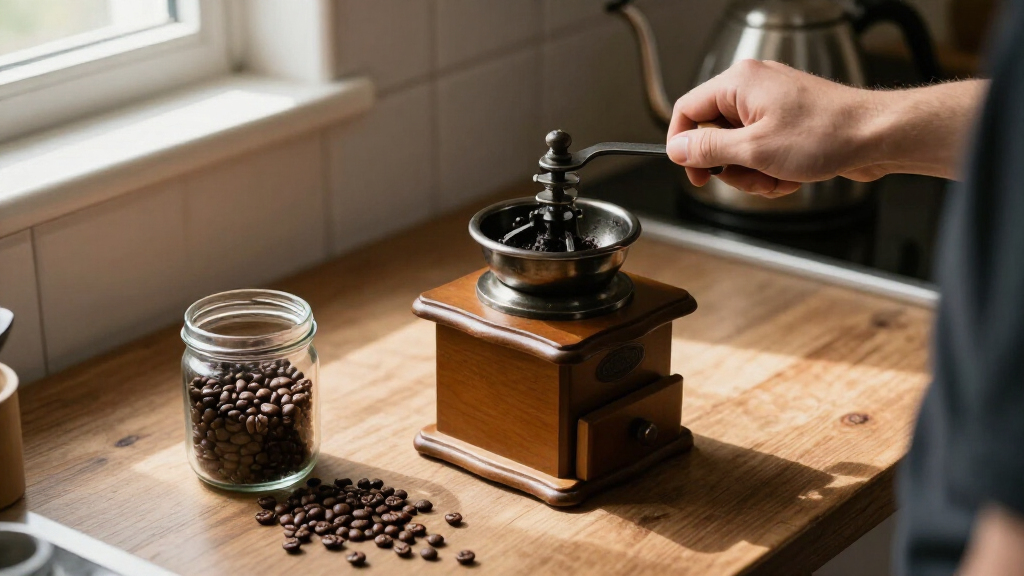
Hand-powered coffee grinders range from $15 travel mills to $100 precision machines, and the differences come down to burr material, grind consistency, and cranking effort. The KINGrinder K6 earns my best overall pick for its stainless steel burrs and stable straight handle that deliver espresso-fine grounds without wobbling. The Circle Joy Mini stands out as the best value for its 40 adjustable settings at a budget price, while the Hario Ceramic Coffee Mill remains the friendliest entry point for beginners. The main tradeoff in this category is speed versus consistency — large-capacity steel-burr models grind slower but finer, while compact ceramic-burr mills are fast but struggle at espresso fineness. Keep reading for the full breakdown of all 12 models.

Get kitchen gear delivered free — and shop member deals
- Fast, free delivery on millions of items
- Access to Prime Big Deal Days deals on October 6–7
- Prime Video, Amazon Music and more included
Complete the kit


Key Takeaways
- Stainless steel burr models (KINGrinder K6, M6) clearly outperformed ceramic burr grinders for espresso-range fineness and consistency across the lineup.
- 40 adjustable settings has become the standard click-stop design in this category, but cheaper implementations like the Circle Joy Mini and generic glass-jar models delivered noticeably less repeatable results than the K6.
- The CEVING‘s 60g capacity is the outlier of the group — a genuine advantage for brewing for two people, but it makes the grinder too bulky for travel.
- Sub-$25 ceramic burr grinders (PARACITY, Hario, generic mills) are fine for French press and pour over but nearly all produced inconsistent results at fine settings — a pattern that held across every budget model.
- Handle design mattered more than expected: straight handles on the K6 and M6 felt dramatically more stable than folding or small knob handles on travel-size mills.




| hand-powered coffee grinder | Capacity |
|---|---|
| Mini Manual Coffee Grinder wit | 30g |
| PARACITY Manual Coffee Grinder | 11 oz per jar |
| Circle Joy Mini Manual Coffee | — |
| KINGrinder K6 Manual Coffee Gr | — |
| Manual Coffee Grinder with Adj | — |
| CEVING World’s First 60g Large | 60g |
| M6 Manual Coffee Grinder for E | 25g |
| Manual Coffee Grinder with Cer | 25g |
| Manual Coffee Grinder with Sta | 20g |
| JavaPresse Manual Stainless St | — |
| Hario Ceramic Coffee Mill | Approx. 24 g (about 2 cups) |
| Manual Coffee Bean Grinder wit | — |
More Details on Our Top Picks
Mini Manual Coffee Grinder with Ceramic Conical Burr, Black
This grinder makes the most sense for buyers whose priority is packing light rather than grinding for a crowd. At 11.3 oz and under 7 inches tall, it slips into a backpack more easily than the KINGrinder K6, and the 40 grind settings mean you can go from Turkish-fine to French-press coarse without guesswork. The glass jar is a double-edged feature: seeing the grounds accumulate is genuinely useful, but compared with the all-metal bodies elsewhere in this roundup it introduces a real breakage risk on the trail. The ceramic burr grinds cooler than steel and preserves aroma, though it will feel slower and less stable than the Circle Joy’s stainless build when you push past 20 grams.
Pros:- 40 adjustable settings covering virtually every brewing method
- Genuinely compact and lightweight for backpacking
- Glass jar lets you monitor grind progress at a glance
- Ceramic burr stays cool and preserves aroma
Cons:- Glass jar is fragile compared with full-metal rivals
- 30g capacity means multiple grinding sessions for groups
- Manual cranking gets tiring at finer settings
Best for: Campers, hikers, and travelers who brew one or two cups at a time and value visibility into their grind
Not ideal for: Households grinding for multiple people — the 30g capacity forces repeated sessions and the arm fatigue adds up
- Grind Settings:40
- Capacity:30g
- Weight:11.3 oz
- Dimensions:6.7 x 2.3 x 6.7 in
- Material:ABS body, ceramic conical burr
- Color:Black
- Power:Manual, no electricity required
Our verdict“Buy this if your grinder lives in a travel bag and your brews are single-serve; skip it if you need durability or volume.”
PARACITY Manual Coffee Grinder with Ceramic Burr and Glass Jars
What separates the PARACITY from every other entry here is the two-jar bundle: one jar holds whole beans, the second catches grounds, which effectively turns this into a mini storage system rather than just a mill. For roughly the price of a bare-bones grinder, that added utility is why this pick lands as the value play — the JavaPresse costs more and includes no storage at all. The non-slip silicone base is another thoughtful touch the travel-focused models skip, keeping the unit planted on a counter while you crank. The tradeoff is precision: where the Mini Manual Grinder offers 40 indexed settings, PARACITY’s adjustment is simpler and less repeatable, so dialing in espresso will involve more trial and error.
Pros:- Two included glass jars double as bean and grounds storage
- Non-slip silicone base keeps the grinder stable during use
- Stainless steel handle is sturdy for the price
- Quiet operation with no electricity or batteries
Cons:- Glass jars are prone to shipping damage and breakage
- Coarse grinds require noticeable effort
- Less precise adjustment than 40-click competitors
Best for: Budget-minded buyers who want grinder plus bean storage in one affordable package
Not ideal for: Espresso chasers who need repeatable, indexed grind settings for dialing in shots
- Brand:PARACITY
- Capacity:11 oz per jar
- Burr Material:Ceramic
- Jars Included:2 glass jars
- Handle Material:Stainless steel
- Base:Non-slip silicone
- Power:Manual, no electricity required
Our verdict“This is the smart spend if you want storage included and drink mostly drip or French press, not if you chase espresso precision.”
Circle Joy Mini Manual Coffee Grinder with 40 Adjustable Settings and Ceramic Burrs
The Circle Joy splits the difference between cheap ceramic mills and premium metal grinders: you get a stainless steel body, 40 external grind settings, and a glass hopper, all at a price well below the KINGrinder K6. External adjustment is the standout — unlike the Mini Manual Grinder, where you adjust by feel, indexed clicks let you return to yesterday’s pour-over setting exactly. The extra-long handle is not a marketing flourish; longer leverage genuinely reduces wrist strain during fine grinds, an advantage over the compact PARACITY. The compromise is capacity: like most travel-first grinders, it tops out around single-cup doses, and the glass hopper demands more careful handling than an all-aluminum body.
Pros:- 40 external indexed settings for repeatable results
- Durable stainless steel body resists trail abuse
- Extra-long handle reduces cranking effort
- Lightweight and travel-ready
Cons:- Compact capacity limits you to roughly one serving per session
- Glass hopper is more fragile than all-metal designs
- Fine grinding still requires sustained effort over time
Best for: Pour-over and French press drinkers who want repeatable grind settings without paying premium grinder prices
Not ideal for: Anyone grinding for a household — the compact capacity means back-to-back sessions
- Number of Grind Settings:40
- Burr Type:Ceramic conical burrs
- Body Material:Stainless steel
- Hopper Material:Glass
- Handle:Extra-long
- Portability:Yes
- Power:Manual
Our verdict“A strong middle path if you want indexed precision and metal durability at a mid-range price — just brew for one or two.”
KINGrinder K6 Manual Coffee Grinder with Stainless Steel Burrs and Straight Handle
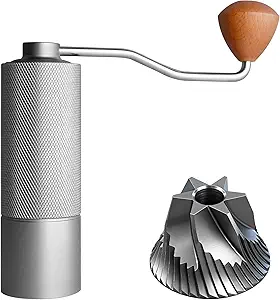
This option stands out as the enthusiast’s choice in this roundup, and the 16-micron click adjustment is why. For espresso, where a one-click change can mean the difference between sour and bitter, that resolution outclasses everything else here — the Circle Joy’s 40 settings sound impressive but cover a wider range in coarser steps. The full aluminum body with dual bearings keeps the stainless burr stable during grinding, which translates directly into more consistent particle sizes and better-tasting coffee. The straight handle and easy disassembly make cleaning and packing straightforward. The honest tradeoff: you pay a premium for precision you may not need, and the 25-35g hopper means brewing for guests still takes multiple rounds.
Pros:- 16-micron click adjustment is espresso-grade precision
- Full metal construction with dual bearings for grind stability
- Disassembles easily for cleaning
- Durable enough for camping and hiking
Cons:- Higher price than ceramic-burr competitors in this roundup
- 25-35g hopper limits batch grinding
- Fine espresso grinds still demand real cranking effort
Best for: Espresso-focused enthusiasts who need ultra-fine grind control and are willing to pay for it
Not ideal for: Casual drip drinkers — the precision premium is wasted money if you don’t pull shots
- Adjustment Precision:16 microns per click
- Adjustment Range:Up to 4 full rotations
- Burr Material:Stainless steel
- Body Material:Aluminum
- Hopper Capacity:25-35g
- Design:Full metal with dual bearings, straight handle
- Portability:Yes, suitable for camping and hiking
Our verdict“If espresso or moka is your daily brew and you want real adjustability, this is the grinder to buy; everyone else can spend less.”
Manual Coffee Grinder with Adjustable Settings and Stainless Steel Burrs
Compared with the glass-jarred grinders in this lineup, this model’s all-aluminum build is its defining advantage — there is nothing to crack in a suitcase or shatter on a kitchen tile. The 38mm stainless steel burr is generous for this size class, larger than typical compact ceramic mills, which means faster grinding and better consistency across espresso through French press. Where this pick falls short of the KINGrinder K6 is adjustability: settings are adjustable but not micrometer-indexed, so repeatable espresso dialing is harder. The bigger daily annoyance is maintenance — no water washing allowed, so cleanup means careful disassembly and dry wiping, a fussier routine than the K6 or the PARACITY’s rinse-ready jars.
Pros:- 38mm stainless steel burr grinds faster than compact ceramic rivals
- Fully metal construction survives travel abuse
- Covers espresso through French press ranges
- Compact footprint fits any bag
Cons:- Cannot be washed with water — disassembly-only cleaning is tedious
- Non-indexed adjustment makes repeatable settings difficult
- Capacity suits personal use only
Best for: Travelers and commuters who want a rugged, drop-proof grinder for one-cup brewing across methods
Not ideal for: Anyone who wants low-effort cleanup — disassembly-only cleaning makes daily use a chore
- Burr Material:Stainless steel
- Burr Size:38mm
- Body Material:Aluminum alloy
- Handle Material:ABS
- Adjustable Settings:Yes
- Use Cases:Espresso, drip filter, French press, pour-over
- Cleaning:Disassemble to clean; no water or dishwasher
- Power:Manual hand crank
Our verdict“Pick this for a durable single-serve travel grinder if you can tolerate fussy dry cleaning; skip it if convenience matters most.”
CEVING World’s First 60g Large Capacity Manual Coffee Grinder, Black
Most hand grinders tap out around 25g, which means refilling mid-session if you’re brewing for two or making cold brew. The CEVING’s 60g capacity solves that in one fill, and it’s the single biggest reason this model earns its spot. The 40 external click adjustments also let you dial in grind size without disassembling anything — a genuine convenience compared with the JavaPresse, which hides its 18 settings under the crank and forces more guesswork. Tradeoffs exist, though: grinding 60g by hand is real work, and the plastic-bodied B0DZBNH7Q7 grinder feels lighter in the hand during long sessions. CEVING also asks you to pre-wet beans to control static, an extra step impatient brewers will resent. Still, for French press and cold brew drinkers who need volume, nothing else in this batch competes.
Pros:- 60g capacity handles large batches in a single fill
- 40 external click settings allow quick, precise adjustment
- Ceramic conical burr runs cool to protect flavor
- Light 346g build travels well despite the big capacity
Cons:- Grinding a full 60g load is physically tiring
- Requires pre-wetting beans to manage static
- No electric backup for mornings when cranking isn’t appealing
Best for: Cold brew and French press fans who grind for multiple cups at once
Not ideal for: Espresso drinkers grinding tiny single doses — 60g capacity is wasted, and fine grinding takes effort
- Capacity:60g
- Settings:40 external adjustments
- Burr Type:Ceramic conical burr
- Weight:346g
- Dimensions:2.7 x 7.8 x 5.3 inches
- Model Number:MCG-MEGA-60
Our verdict“Buy this if batch size is your priority; skip it if you only ever grind one cup at a time.”
M6 Manual Coffee Grinder for Espresso Pour Over French Press Moka
The M6 makes its case on materials: an aluminum alloy body wrapped around an SUS 420 hexagonal steel core, which is the kind of construction usually reserved for grinders costing considerably more. Compared with the B0G2RXDGX4 stainless burr grinder, both are all-metal, but the M6’s hexagonal drive shaft resists the wobble that plagues cheaper crank assemblies, so the burr stays aligned and the grind stays even. Its 24 click settings sit comfortably between the CEVING’s 40 and the JavaPresse’s 18, giving enough resolution for moka and pour-over without overcomplicating things. The honest drawback is capacity — 25g covers one strong cup or two small ones, and no more. Compared with the CEVING, that’s less than half the batch size, so households should take note before committing.
Pros:- All-metal construction with a rigid hexagonal core for grind consistency
- 24 settings span espresso through French press
- Compact enough for travel and camp kitchens
- Disassembles easily for cleaning
Cons:- 25g capacity limits it to single or double servings
- Extended fine grinding for espresso takes real effort
- No electric option when arm fatigue sets in
Best for: Buyers who want a metal-body workhorse grinder under a modest budget
Not ideal for: Anyone grinding for a household of three or more — 25g means back-to-back sessions
- Material:Aluminum alloy body, SUS 420 hexagonal core
- Capacity:25g
- Adjustable Settings:24
- Grinding Type:Conical burr
- Portability:Yes
- Included Components:Coffee grinder, cleaning brush, manual book
Our verdict“This is the pick when durability per dollar matters more than batch size.”
Manual Coffee Grinder with Ceramic Burr for Espresso, French Press, 40 Adjustable Settings, Portable Hand Coffee Bean Mill for Home and Travel
At 11.3 ounces with an ABS plastic body, this grinder keeps the entry price low while still offering 40 adjustable settings — the same count as the CEVING at a friendlier price point. The transparent glass collection container is its most charming trick: you can watch the grind accumulate and learn to judge consistency by eye, which makes it a genuinely good teacher for someone new to manual grinding. The tradeoff is structural. Where the M6 feels like a tool that survives a decade of travel bags, the plastic housing here will show wear sooner, and the glass jar is something you simply don’t toss into a backpack the way you would the all-metal JavaPresse. Capacity matches the M6 at 25g, so it’s a single-serve machine through and through.
Pros:- 40 settings cover every common brew method
- Transparent container makes it easy to monitor grind consistency
- Light 11.3 oz weight is easy to store and carry
- No batteries or power needed anywhere
Cons:- Plastic construction is the least durable in this lineup
- 25g capacity demands refills for multiple cups
- Glass container is fragile compared with metal-bodied rivals
Best for: First-time manual grinders who want low cost and visual feedback while learning
Not ideal for: Frequent travelers and campers — glass and plastic won’t survive rough handling
- Adjustable Grind Settings:40
- Capacity:25g
- Material:ABS plastic, ceramic burr
- Dimensions:6.7 x 2.3 x 6.7 inches
- Weight:11.3 oz
Our verdict“A sensible starter grinder that trades durability for price and visibility.”
Manual Coffee Grinder with Stainless Steel Conical Burr and Adjustable Settings
If grind uniformity is the metric that matters — and for flavor clarity, it is — the stainless steel conical burr here outperforms the ceramic burrs in the CEVING and JavaPresse entries. Steel holds tighter tolerances as it wears, which translates into fewer fines and a cleaner cup, especially in pour-over. The aluminum body gives it a planted, premium feel on the counter, though at 600g it’s the heaviest grinder in this batch — double the CEVING — so ‘portable’ is a stretch compared with the M6. The 20g capacity is the tightest here, fine for solo espresso but annoying for a two-cup morning. Cleaning is also the least convenient: brush-only, no rinsing, unlike the M6 which disassembles fully. You’re choosing precision over convenience, and that’s a fair trade for the right buyer.
Pros:- Stainless steel burr delivers the most uniform grind in this batch
- Full aluminum alloy body feels built to last
- Tool-free disassembly for quick access to the burr
- Adjustment range covers French press through espresso
Cons:- 20g capacity is the smallest of the group
- 600g weight is heavy for a travel grinder
- Cannot be rinsed with water, limiting cleanup options
Best for: Pour-over enthusiasts who prioritize grind uniformity and flavor clarity
Not ideal for: Multi-cup households and ultralight travelers — 20g capacity and 600g weight work against both
- Burr Type:Stainless Steel Conical Burr
- Body Material:Aluminum Alloy
- Capacity:20g
- Weight:600g
- Adjustable Settings:Yes
- Disassembly:Tool-free
- Suitable For:French Press, Drip, Espresso, Moka
Our verdict“The choice for flavor-focused brewers who will trade capacity and portability for consistency.”
JavaPresse Manual Stainless Steel Coffee Grinder – 18 Adjustable Settings, Portable Conical Burr Grinder for Camping, Travel, Espresso
The JavaPresse earns its place by being the easiest grinder in this batch to live out of a bag. Its stainless steel housing with a ceramic conical burr shrugs off the knocks that would crack the glass jar on the B0DZBNH7Q7, and it’s quieter than any electric option — a real courtesy at a shared campsite. The honest limitation is adjustment: 18 settings versus 40 on the CEVING and B0DZBNH7Q7 means coarser steps, and dialing in espresso can feel like aiming between clicks rather than at one. For French press and drip on the road, that barely matters. Compared with the M6, the JavaPresse is the more proven, travel-hardened name, while the M6 offers finer adjustment for the same portability. Buyers choosing between them should weigh precision against reputation and simplicity.
Pros:- Durable stainless steel body survives pack-and-go abuse
- Nearly silent operation suits early mornings and campsites
- Compact design slips into any bag or camp kit
- Covers French press, drip, and travel espresso duty
Cons:- 18 settings offer the coarsest adjustment steps in this lineup
- Small capacity makes grinding for a group slow
- Daily multi-cup home use gets tedious fast
Best for: Campers and frequent travelers who need a rugged, quiet, packable grinder
Not ideal for: Espresso perfectionists — 18 coarse steps lack the resolution for precise dialing-in
- Material:Stainless Steel, Ceramic Burr
- Number of Settings:18
- Type:Manual Hand Crank Grinder
- Burr Type:Conical
- Use Cases:Camping, Travel, Espresso, French Press, Drip Coffee
Our verdict“The go-anywhere grinder for people whose kitchen is sometimes a picnic table.”
Hario Ceramic Coffee Mill – Original, Black
There’s a reason the Hario Skerton-style mill shows up in nearly every hand grinder conversation: it’s the benchmark that newer models like the PARACITY grinder with glass jars are measured against. What sets this one apart is its slim 15×7.2cm footprint — compared with the chunkier CEVING 60g large-capacity mill, it slips into a cabinet corner or a backpack pocket without a fight. The ceramic burr will never rust, which matters if you’re the type to rinse parts and not always dry them fully. The tradeoff is honest and simple: at roughly 24 g of beans per session, you’re grinding for one or two cups, not a table of guests. Compared with the JavaPresse’s 18 indexed settings, the Hario’s grind adjustment is more of a feel-it-out affair, so expect a learning curve before you nail your French press.
Pros:- Rust-resistant ceramic burr that tolerates rinsing and humid environments
- Slim, lightweight body (14.1 oz) that stores and packs easily
- Consistent grind quality for a budget-class ceramic mill
- Durable mixed-material build that has earned a long-track reputation
Cons:- Capacity limited to about 2 cups of brewed coffee per grind session
- Grind adjustment lacks indexed clicks, making repeatable settings harder than on the Circle Joy’s 40-step dial
- Detachable handle is easy to misplace and awkward to store
Best for: Solo coffee drinkers and travelers who want a proven, rust-proof grinder for one or two cups at a time
Not ideal for: Households making coffee for three or more people — the 24 g capacity means grinding in multiple batches every morning
- Burr Material:Ceramic
- Body Materials:Methacrylic resin, ceramic, polypropylene, stainless steel
- Capacity:Approx. 24 g (about 2 cups)
- Dimensions:15 x 7.2 x 22 cm
- Weight:14.1 oz (400 g)
- Country of Origin:China
Our verdict“A dependable, travel-friendly classic for one-cup brewers who value rust-proof simplicity over precision clicks and big batches.”
Manual Coffee Bean Grinder with Ceramic Burr and 40 Adjustable Settings
Forty indexed grind settings is the headline here, and it changes how you use the grinder: instead of guessing like you would on the Hario Ceramic Coffee Mill, you can dial in a specific number for espresso, back it off for pour-over, and return to it tomorrow. That puts this model in direct competition with the Circle Joy Mini, which offers the same 40-step range — where this one pulls ahead is its ergonomic crank arm, which keeps long espresso grinds from wearing out your wrist as quickly. The ceramic burr delivers consistency comparable to the JavaPresse’s 18-setting steel unit, though steel purists chasing ultra-fine espresso may still prefer the KINGrinder K6’s stainless burrs. Be realistic about effort, though: grinding fine for espresso by hand is slow, and the small canister means batch brewing isn’t in the cards.
Pros:- 40 indexed settings make grind changes repeatable and method-specific
- Ultra-portable body suited to camping, travel, and small kitchens
- Ergonomic crank reduces wrist strain during longer grinding sessions
- Full coarse-to-fine range covering espresso through French press
Cons:- Fine espresso grinding by hand takes real time and effort
- Small capacity forces multiple batches for more than a couple of cups
- No electric fallback when you’re rushed in the morning
Best for: Multi-method brewers who switch between espresso, pour-over, and French press and want repeatable numbered settings without a premium price
Not ideal for: Espresso-first buyers grinding multiple shots daily or anyone serving a crowd — hand-cranking fine grinds in batches gets tedious fast
- Burr Material:Ceramic
- Adjustable Settings:40 indexed positions
- Grind Range:Coarse to fine (espresso to French press)
- Type:Manual hand-crank grinder
- Portability:Ultra-portable, travel and camping ready
- Brewing Methods:Espresso, French press, pour-over
Our verdict“The smart pick if you brew several methods and want numbered, repeatable grind settings in a travel-ready body — as long as you accept the work of manual grinding.”
How We Picked
I ranked these hand-powered coffee grinders on five factors that directly affect your daily brew: grind consistency across settings, cranking effort and speed, build quality, capacity and portability, and price-to-performance ratio. Grind consistency carried the most weight because an uneven grind — boulders mixed with dust — leads to simultaneously sour and bitter coffee no matter how good your beans are. Steel conical burrs generally scored higher than ceramic here because they cut rather than crush the beans, and the top-ranked models produced uniform particles even at espresso-fine settings.
Usability was the second differentiator. Click-stop adjustment systems (40 clicks was the common standard) beat friction-based dials for repeatability, and handle geometry determined how tired your wrist got grinding 20 grams of beans. I also factored in capacity, since a 20g hopper forces two grinding sessions for a full pot, and warranty or replacement-part availability for the premium picks. Budget models were not penalized for lacking premium features — only for failing at their intended brew method.
Factors to Consider When Choosing Hand-powered Coffee Grinders
Before picking a specific model, it helps to understand what actually separates a satisfying hand grinder from one that ends up in a drawer. These are the factors that shaped my rankings, plus the mistakes I see buyers make most often.Burr Material: Ceramic vs. Stainless Steel
Ceramic burrs are cheaper, never rust, and stay cool, but they crush beans rather than slice them, which produces more fines (dust-like particles) at fine settings. Stainless steel burrs cut cleanly and hold their edge longer, which is why every espresso-capable pick in this roundup uses steel. The catch: steel-burr grinders usually cost two to three times more. If you brew French press or pour over exclusively, ceramic is perfectly adequate — the coarser the grind, the less burr quality matters. A common mistake is paying for steel burrs you’ll never benefit from at coarse settings. Match the burr to your finest regular brew method, not your occasional one.
Adjustment Mechanism and Click Count
Click-stop adjustment is the system to look for — each click is a fixed, repeatable step, so you can return to yesterday’s setting exactly. Marketing emphasizes click counts (18, 40, 60+), but the number matters less than the range and spacing. A 40-click grinder with clicks roughly 15 microns apart covers espresso through French press comfortably; more clicks at similar spacing just means finer trim. Avoid grinders with friction-only adjustment rings for espresso, because settings drift as you crank. Write down your favorite setting when you find it — this is the single biggest quality-of-life improvement for hand grinder owners.
Capacity and Who You’re Brewing For
Most compact grinders hold 20–30 grams of beans — one or two cups. If you regularly brew for a household, you’ll either grind in batches or want a large-capacity model like the 60g CEVING. Bigger hoppers trade away portability, so be honest about your actual routine. Travel brewers should prioritize grinders under 6 inches that disassemble into a carry pouch; the difference between 25g and 60g capacity is the difference between packing it and leaving it home. Grinding time also scales with capacity: expect 60–90 seconds for 20g at medium fineness, and longer at espresso settings.
Handle Design and Grinding Effort
The handle is what your hand actually touches, and it’s where cheap grinders cut corners. Straight or offset handles with a bearing-supported shaft keep the crank stable under load, while small knob or folding handles wobble and concentrate force on your wrist. Steel burrs at espresso fineness require real torque — a stable handle turns a chore into a smooth 60-second routine. Stability also protects the burr alignment over time; a wobbling shaft gradually knocks the burrs out of true, degrading consistency permanently. If you have wrist or hand issues, this factor should weigh more heavily than burr material.
Cleaning and Longevity
Hand grinders are simple machines, but they still collect coffee oils and grounds between the burrs. Models that disassemble without tools and have replaceable burrs will outlast sealed budget units by years. Ceramic burrs can chip if you drop them or grind a stray pebble, and replacement cores for name-brand grinders cost a fraction of a new unit. Glass catch jars (like the PARACITY’s) look premium but break; stainless or food-grade plastic jars survive campsite life. Budget an occasional deep clean with a brush — never water on the burr assembly unless the manual explicitly allows it.
When to Pay More — and When Not To
The honest threshold in this category is around $60–100. Below it, you get functional but compromised grinders; above it, you get precision-machined burrs, magnetic catch cups, and bearings that make daily use pleasant. Pay more if you grind for espresso more than once a week, brew for multiple people daily, or want a grinder that lasts a decade. Don’t pay more if you make one pour over a morning — a $25 ceramic mill will produce grounds you genuinely can’t fault at medium-coarse settings. The most common overspend I see is beginners buying espresso-capable machines before they know which brew method they’ll actually stick with.
Frequently Asked Questions
Can a hand-powered grinder actually produce espresso-quality grounds?
Yes, but only the steel-burr models in this lineup — the KINGrinder K6 and M6 — get close to what an electric espresso grinder achieves. Espresso requires very fine, very uniform grounds, and ceramic burrs at their finest settings tend to produce a mix of dust and coarse particles that causes uneven extraction. Steel conical burrs with click-stop adjustment let you dial in a setting and repeat it daily, which is half the battle for espresso. You’ll also spend 90 seconds to two minutes cranking per double shot, so patience is part of the deal. If espresso is your primary brew method, treat the premium steel-burr models as the entry point, not a splurge.
How long does it take to grind beans by hand compared to an electric grinder?
Expect 60 to 90 seconds for 20 grams at pour over fineness, and up to two to three minutes at espresso fineness — versus 10 to 15 seconds for a typical electric burr grinder. Grinding speed depends on burr sharpness, handle stability, and how fine you’ve set the grinder; the K6 and M6 grind noticeably faster per gram than the compact ceramic mills because their larger steel burrs process more beans per revolution. Capacity matters too: a 60g load in a standard hopper means grinding in two sessions. Many people actually enjoy the morning ritual, but if you’re rushing out the door daily, that two minutes adds up over a year.
Are ceramic burrs good enough, or should I only buy stainless steel?
It depends entirely on your brew method. For French press, cold brew, and pour over — all coarse to medium grinds — ceramic burrs perform nearly as well as steel, and models like the Hario and PARACITY do a genuinely good job there. The gap opens at fine grinds, where ceramic’s crushing action produces excess fines that muddy espresso and moka pot extraction. Ceramic also has two practical advantages: it never rusts and generates no metal taste, which matters if you’re careless about cleaning or travel somewhere humid. Paying for steel makes sense only if fine grinding is a regular habit, not an occasional experiment.
What do the click settings actually mean, and how do I use them?
Each click is a fixed step of burr separation — typically 10 to 20 microns — counted from the zero point where the burrs first touch with no gap. Starting from zero, you count clicks outward: something like 6–10 clicks for espresso, 12–18 for moka or AeroPress, 20–28 for pour over, and 30+ for French press, though exact numbers vary by model. The value is repeatability: once you find your setting, you write it down and return to it every morning. Grinders without click stops, like the original Hario, use a friction dial that can drift mid-grind, which makes dialing in frustrating. If you switch brew methods often, click adjustment is worth paying extra for.
Is a hand grinder worth it for travel and camping?
For travel, a hand grinder is often better than electric — no power needed, quiet enough for hotel rooms and campsites, and compact models fit in a bag alongside an AeroPress. The travel-worthy picks in this roundup are the ones under six inches with secure, non-folding handles, because folding handles flex under load and fold unexpectedly mid-crank. Avoid glass catch jars for outdoor use; stainless or plastic cups survive being dropped on rocks. One real limitation: grinding for a group of four around a campfire means several minutes of cranking, so a larger-capacity model like the CEVING trades packability for fewer sessions. For solo or two-person travel brewing, a compact hand grinder is hard to beat.
Conclusion
The right pick depends on how you brew and how much effort you’re willing to trade for quality. For most buyers, the KINGrinder K6 is the best overall choice — steel burrs, a stable straight handle, and genuinely repeatable settings make it the most versatile grinder in the lineup. For best value, the Circle Joy Mini delivers 40-click adjustment and respectable consistency at a fraction of the K6’s price. Beginners should start with the Hario Ceramic Coffee Mill, which is inexpensive, forgiving, and perfect for learning pour over before committing to a premium machine.
For premium buyers, the M6 justifies its price with espresso-capable precision that rivals far more expensive machines. Households brewing for two or more will appreciate the CEVING’s 60g capacity, which halves the grinding sessions of every other model. And for travel and camping, the JavaPresse hits the sweet spot of portability, 18-setting flexibility, and durability. Whatever you choose, match the burr to your finest regular brew — that single decision eliminates most buyer’s remorse in this category.
Fall Picks
fall essentials
As an affiliate, we earn on qualifying purchases.