TL;DR

Get kitchen gear delivered free with Prime
- Fast, free delivery on millions of items
- Prime Video, Amazon Music and more included
- Member-only deals all year
To disinfect stored water, first make sure it is not contaminated with chemicals, then choose a treatment that fits the water and follow current public-health instructions or the product label. Boiling, bleach, tablets, filters, and UV devices have different limits; clean containers and careful dispensing protect water after treatment.
A clear glass of water can look ready to drink and still carry disease-causing germs. And boiling it will not remove fuel or heavy metals. Those two facts shape every safe plan for stored water.
This guide explains how to disinfect water, what each common method can and cannot do, and how to keep a treated supply clean in an off-grid kitchen. You’ll get practical steps for cloudy water, bleach, tablets, boiling, and storage, plus a clear rule for when to stop treating water and find a safer source.
Identify the likely hazard before treating water; disinfection targets many germs but does not remove chemical contamination, salt, or heavy metals.
Boil water for one minute up to 6,500 feet, or three minutes above that elevation, then cool and store it in a clean covered container.
Use only plain, unscented bleach when current public-health instructions or the product label give the correct dose and wait time.
Cloudy water may need settling and pre-filtration, while filter and UV performance depends on the device, water clarity, and its instructions.
Protect treated water with a sealed food-grade container, a treatment date, and pour-only dispensing.
How to Disinfect Stored Water Safely
Disinfection can reduce disease-causing germs, but it cannot remove chemical contamination. Check the source first, then match treatment and storage to the water.
Start with the hazard
Water’s appearance cannot confirm it is safe. Follow the exact local notice before choosing a treatment.
- Suitable disinfection can reduce many disease-causing germs.
- Cloudy water may need settling and pre-filtration first.
- Boiling and disinfectants do not remove fuel, pesticides, heavy metals, or salt.
- Use a known-safe source or follow public-health guidance.
Match the method to the water
Each option has limits; follow current public-health instructions or the product label.
| Method | Useful for | Key limit |
|---|---|---|
| Boiling | Many germs, including in cloudy water after particles settle | Does not remove chemicals; needs fuel |
| Plain, unscented bleach | Some emergency situations | Strength varies; use the specified dose and wait time |
| Tablets or drops | Travel, emergencies, small quantities | Follow label directions, including for cloudy water |
| Filters | Particles and, depending on design, some germs | Many do not disinfect on their own |
| UV devices | Many germs in clear water | Needs power; leaves no residual protection |
Follow a safe sequence
Check the source, treat as directed, and protect the water afterward.
Read the current instruction from your utility or health authority.
Let cloudy water settle, then use a clean cloth or suitable filter before disinfection.
Use one suitable method and follow its exact conditions, dose, or waiting time.
Use a clean, covered, food-grade container; label the treatment date and pour rather than dip.
Protect treated water
Contamination can happen after treatment if hands, utensils, or containers are dirty.
- Keep the container tightly sealed in a cool, dark place away from chemicals and sunlight.
- Replace water if the container leaks, the seal breaks, or its appearance or smell changes.
- Follow local guidance for how long stored water remains safe.
Know what disinfection can—and cannot—fix
Disinfecting stored water means reducing disease-causing germs so the water is safer to drink. It does not remove fuel, pesticides, heavy metals, salt, or other chemical contamination. If a spill, flood, or industrial incident may have introduced chemicals, skip boiling and disinfectants; use a known-safe source or follow local public-health guidance. [1]
Think of disinfection as a gate that stops many living germs from passing through. It does not act like a sieve for every unwanted substance. That difference matters because the treatment can appear successful while the original hazard remains: boiling may address germs in water drawn from a clean, treated tap, but it cannot make water near a fuel spill safe. The source determines whether treatment is useful at all.
Before treating anything, check local notices and identify where the water came from. A boil-water advisory, a “do not drink” notice, and a “do not use” notice can call for different actions. The words matter: a boil notice may give a way to make water safe for certain uses, while a chemical warning may rule out drinking, cooking, or even contact. Don’t guess from the water’s appearance or taste; neither proves it is safe.
In plain terms, how to disinfect starts with the hazard. Disinfecting stored water means reducing disease-causing germs so it’s safer to drink; it does not promise that every contaminant has disappeared. If you cannot identify the source or follow the right official instruction, choose water you know is safe.
Products Worth Considering

Breville BES870XL Barista Express Espresso Machine, Brushed Stainless Steel

Instant Pot Pro 6-Quart 10-in-1 Electric Pressure Cooker, Black

Ninja Professional XL 12-Cup Food Processor, NF701
As an affiliate, we earn on qualifying purchases.
Choose a method that fits your water and your setup
Choose a treatment method based on the water’s condition, the suspected hazard, and the directions for the product or device. Boiling, bleach, tablets, filters, and UV treatment do not solve the same problems or work under the same conditions. Guidance is method-specific for a reason: cloudiness can affect treatment, product strength can vary, and some methods need power. [1]
| Method | Useful for | Limits to remember |
|---|---|---|
| Boiling | Many disease-causing germs, including in cloudy water after particles settle | Does not remove chemical contamination, salt, or heavy metals; needs fuel and a safe cooling container |
| Plain bleach | Some emergency situations when current public-health instructions or product directions give the right dose | Strength and formulation vary; never use scented or cleaner-added bleach |
| Travel, emergencies, and small batches | Follow the label for dose, wait time, and cloudy-water directions | |
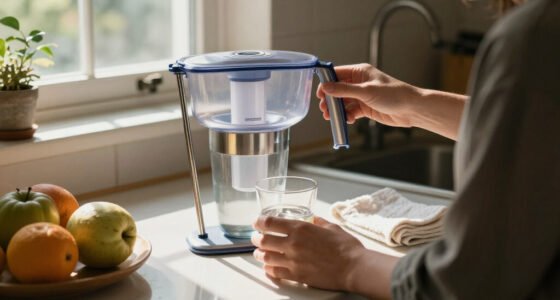
| Filters | Removing particles and, depending on certification, some germs | Many filters do not disinfect water by themselves |
| UV devices | Inactivating many germs in clear water when used as directed | Need power and clear water; leave no residual disinfectant for later storage |
For example, a household with firewood and a covered pot may find boiling practical, while a traveler with a small bottle may prefer tablets. A filter can clear grit before either step, but its label tells you what it is certified to reduce. Check the method’s limits before you depend on it. One method’s convenience does not make it a universal fix. Consider the whole job, too: a method that treats a batch effectively still needs fuel or power, enough time, and a clean way to store the result. Those practical constraints can determine whether the treatment stays reliable when conditions are difficult.
Use this simple sequence before you drink a stored supply
To disinfect stored water, check the source first, clear visible particles when needed, follow one suitable treatment’s directions, and protect the water afterward. That sequence helps you avoid a common mistake: treating water for germs when the real concern is chemical contamination, or undoing treatment with a dirty cup.
- Check official guidance. Read the current notice from your water utility or health authority. Confirm whether the water source is suitable for treatment.
- Inspect the water and container. If water looks cloudy, let particles settle, then pour it through a clean cloth or suitable filter. Pre-filtering can improve treatment, but it cannot make chemically contaminated water safe.
- Choose one appropriate treatment. Boil, use plain unscented bleach, use treatment tablets or drops, or use a suitable UV device only as directed by public-health guidance or the product label.
- Respect the time and conditions. Follow the exact dose, wait time, clarity instructions, and operating directions. Do not invent a dose when the product strength is unknown.
- Cool or transfer it safely. Use a clean, covered, food-grade container with a tight lid. Label it with the treatment date.
- Dispense without dipping. Pour water out rather than reaching in with hands or a cup.
Imagine a storm has knocked out power and left tap water cloudy. You check the utility notice first, let grit settle, then use the treatment the notice recommends. Afterward, you pour the batch into a clean, sealed container instead of leaving an open pot beside the sink. The sequence is simple, but each step protects the next one. The order matters: pre-filtering can help a treatment work as intended, while sealing and pour-only dispensing preserve the benefit once treatment is complete.
When the source is questionable, stop before treatment and find guidance. These steps address germs; they do not identify every hazard that might be in the water.
Boil water with the right timing and a clean landing place
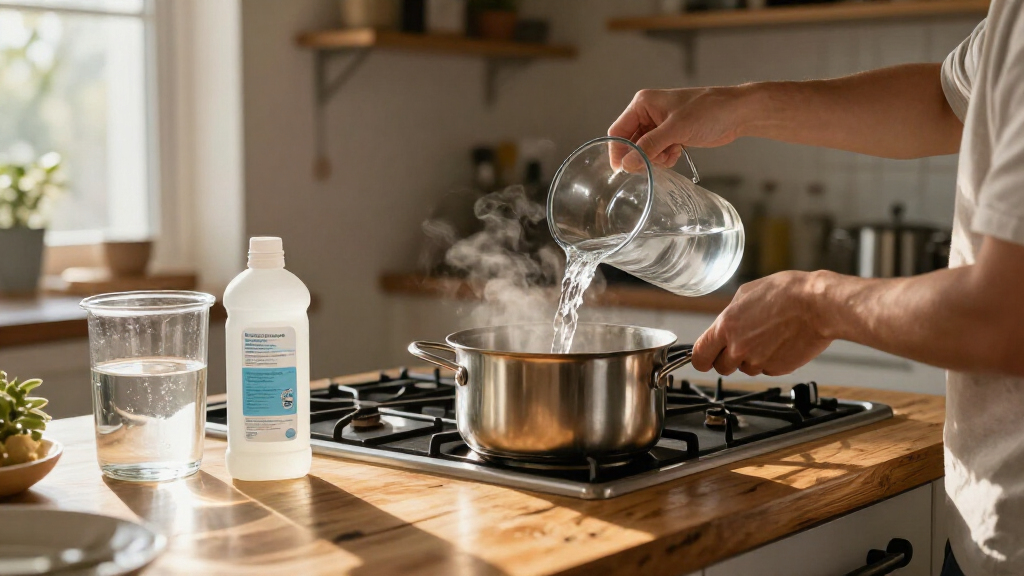
Bring water to a rolling boil for one minute at elevations up to 6,500 feet; above that, boil it for three minutes. Boiling is a widely recommended way to kill many disease-causing germs, including when water may be cloudy. It does not remove chemicals, salt, or heavy metals. [1]
A rolling boil means bubbles keep breaking across the surface, not just a few small bubbles gathering along the pot’s edge. If your home sits high in the mountains, elevation changes the timing. For instance, a family at 7,000 feet should use the three-minute instruction, then let the water cool before drinking or putting it away. Following the full time gives the water adequate exposure to heat; stopping at a simmer or cutting the time short makes the treatment less dependable.
Cooling and storage deserve as much care as the boil itself. A pot left uncovered near a dusty window or a busy prep table can pick up new contamination. Pour cooled water into a clean, sanitized, food-grade container, close the lid, and mark the date. If you need to move a large batch, use a clean funnel rather than a scoop that has been sitting beside the sink. The container is the handoff point: contamination introduced after boiling can undo the protection the heat provided.
Boiling also asks something of your setup: fuel, a stable pot, and a safe place to cool hot water. Keep the pot on a secure surface and out of a child’s reach. In an off-grid kitchen, a full kettle can do useful work, but don’t treat a familiar flame as permission to ignore burn risks or the water’s source. If fuel is scarce, plan the batch size so treatment and safe storage are manageable rather than boiling more than you can handle safely.
Use bleach only when the label or public-health advice gives the dose
Plain, unscented household bleach may disinfect drinking water in some situations, but the correct dose depends on the bleach’s strength and the water’s volume and condition. Follow current public-health instructions or the product label for the exact dose and waiting time. A generic recipe can be wrong when bleach formulations vary by market or change over time. [1]
Read the label before opening the bottle. Use only plain bleach without fragrances or added cleaners, and don’t use a product if you cannot confirm it is suitable for drinking-water treatment under the current guidance. For example, the bottle under the laundry sink may be scented or formulated with additives. Familiarity with the brand does not tell you its concentration or make it appropriate for water treatment. The concentration is part of the dose: the same measured amount of two different products can produce different results.
Measure the water volume and follow the stated waiting time carefully. Don’t estimate by glugging bleach into a bucket, and don’t shorten the wait because the water looks clear. If the water is cloudy, settle and pre-filter it first when guidance recommends that step. Keep bleach away from children, food, and other cleaners; never mix bleach with ammonia, acids, or other cleaning products.
If instructions are missing, unclear, or do not match the product you have, use another suitable method or ask the local health authority for current directions. In a power outage, a printed emergency handout can be more useful than a phone with a fading battery. Put the instructions beside your water supplies so the dose is not a guess made under pressure. This is a useful tradeoff to plan for: bleach is compact and does not require fuel, but only when you can verify the product and accurately follow instructions.
Treat cloudy water before you choose tablets, filters, or UV
Cloudy water can make some treatments less effective, so let particles settle and pre-filter before disinfecting when the method’s guidance calls for it. A clean cloth or suitable filter can remove visible grit, but it does not remove chemical contamination. Water that still looks cloudy after settling needs a method appropriate for its condition, not wishful thinking. [1]
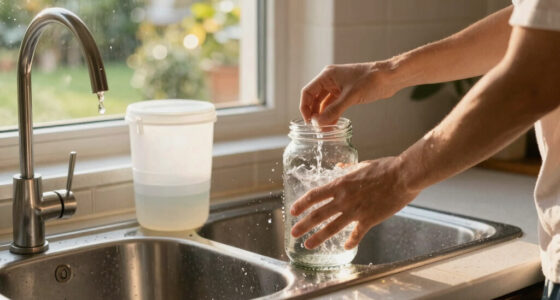
Picture a jar filled from a rain barrel after a windy night: leaf bits and fine silt drift through the water like smoke. Leave it undisturbed until heavier particles sink, then carefully pour the clearer water through a clean cloth or suitable filter. That extra step can improve treatment, though it does not guarantee that every germ or contaminant has gone. Particles can interfere with some treatments by shielding germs or blocking the path of UV light, so clarity is a condition for the method to work well, not proof that the water is safe.
Tablets and drops can suit travel or small batches, but use the label exactly, including the dose, wait time, and any directions for cloudy water. Filters vary too: one may catch particles while another is certified to reduce specific organisms. Look at the filter’s certification and claims rather than assuming that “filtered” means disinfected. A filter chosen only for taste or grit may leave the germs that prompted treatment in the first place.
UV devices can inactivate many germs when used as directed, but the water generally needs to be clear and the device needs power. UV leaves no residual disinfectant to protect water during later storage. A device may work well for a glass prepared on demand; for water stored in a tank or jug, that lack of ongoing protection makes clean handling especially important. This makes UV convenient for immediate use but less forgiving of dirty containers or repeated handling afterward.
Keep treated water safe with clean containers and careful hands
Disinfection can be undone by dirty hands, utensils, or containers. Store treated water in a clean, sanitized, food-grade container with a tight lid, and pour it out instead of dipping a cup or hand inside. This is the quiet part of safe water: the treatment may be finished, but the job of protecting the supply continues. [1]
Use a container meant for food or drinking water; don’t reuse a jug that held fuel, paint, or other non-food liquids. Chemical residue may remain even after rinsing. For instance, a spare container from the garage can look clean and still be the wrong place for a family’s drinking supply. Keep drinking-water containers separate from fuels, pesticides, and cleaning products. The distinction is about material and history, not just visible cleanliness: rinsing cannot reliably remove residues from a container that was never designed to hold drinking water.
Label each container with the treatment date and keep it sealed in a cool, dark place away from chemicals and direct sunlight. A tap or spigot can help you avoid removing the lid, provided the outlet stays clean. If you use a small jug, pour water into a cup instead of letting the cup touch the opening. Each opening or dip creates another chance for germs to enter, so a simple dispensing routine reduces repeated exposure.
Water’s safe storage period depends on its source, container, and local guidance. Follow advice from the relevant public-health agency rather than relying on a universal calendar. Replace water if a container leaks, its seal breaks, or its appearance or smell changes. A normal smell and clear appearance still do not prove safety, so a clean supply and reliable storage routine matter more than a quick sniff.
Know when stored water is too risky to salvage
Do not try to disinfect water when chemical contamination may be present or when official guidance says the supply is not safe to use. Boiling and common germ treatments do not remove fuel, pesticides, heavy metals, salt, or every chemical hazard. Use commercially sealed bottled water or another known-safe source, and follow local instructions. [1]
After a flood, a basement well may contain muddy water mixed with fuel from a tipped container. Boiling that water can kill many germs, but it will not remove the fuel. The same caution applies if a container once held chemicals, if a water tank has been exposed to pesticides, or if authorities issue a “do not drink” or “do not use” notice. The right move is to find safe water, not to keep adding treatments. More treatment is not automatically more protection when the method does not target the hazard.
Commercially bottled water is often a reliable emergency option when its seal is intact and no local advisory says otherwise. Check the cap and packaging before opening it, and keep unopened bottles away from sunlight and chemicals. If you need water for an infant or a person with a weakened immune system, ask a healthcare professional or public-health authority for guidance tailored to their needs.
When local instructions are available, let them guide each use: drinking, food preparation, brushing teeth, and washing may have different directions during an advisory. Disinfection means reducing disease-causing germs; it does not turn an unknown source into a known-safe one. That distinction is worth keeping on the pantry door beside the emergency water plan.
Frequently Asked Questions
Can I drink water that has been stored for a long time?
It depends on how the water was collected, treated, sealed, and stored. Follow local guidance, and replace water if the container leaks, its seal is broken, or the water’s appearance or smell changes. Clear water with no unusual smell is not proof that it is safe.
Does boiling make any water safe to drink?
No. Boiling for one minute at elevations up to 6,500 feet, or three minutes above that, kills many disease-causing germs. It does not remove fuel, pesticides, heavy metals, salt, or other chemical contamination.
Can I use bleach to disinfect stored water?
Plain, unscented household bleach may be suitable in some situations. Use the exact dose and waiting time from current public-health instructions or the product label, since bleach strength and formulation vary. Never mix bleach with ammonia, acids, or other cleaning products.
What should I do if my stored water is cloudy?
Let particles settle, then pour the clearer water through a clean cloth or suitable filter before disinfection when the method’s instructions call for pre-filtering. Cloudiness can make some treatments less effective. Pre-filtering removes visible particles but does not make chemically contaminated water safe.
Do water filters disinfect water?
Not necessarily. A filter may remove particles and some germs, but performance depends on its design and certification. Check what it is certified to reduce and whether you need a separate disinfection step.
What should I do during a boil-water advisory?
Follow the exact notice from your water utility or health authority. It should say which uses require boiled or otherwise treated water and when normal use can resume. If the notice says “do not drink” or “do not use,” don’t assume boiling will make the water safe.
Conclusion
Match the treatment to the hazard, follow current instructions, and protect the water after treatment. That habit matters more than relying on a method just because it is familiar. If chemicals may have reached the supply, use known-safe water instead.
A sealed jug in a cool, dark cupboard is a small reserve of calm: label it, keep it clean, and know where your instructions are before the lights go out.