
TL;DR
Listen free for 30 days with Audible
Thousands of audiobooks and originals — cancel anytime.
Start your free trialAs an affiliate, we earn on qualifying purchases.
Keeping food cold without a refrigerator is possible with simple methods like ice, underground storage, and evaporation cooling. Knowing what foods stay safe longer and how to use natural environments extends freshness and prevents spoilage.
When the power’s out or you’re off-grid, the fridge becomes a distant memory. But what if you still need to keep perishables fresh? The good news: you don’t always need electricity to keep food cold. With a little ingenuity and some natural tricks, you can extend shelf life and avoid food spoilage.
In this guide, you’ll learn practical ways to keep food cool without a fridge—techniques that work in everyday life, camping, or emergency scenarios. Think of it as turning your environment into a mini cooling system, using what’s around you to keep bacteria at bay and your food safe.
Use Your Environment: Find the Coolest Spot Outside Your Home
The first step is to leverage the natural cool spots around you. Basements, shaded areas, underground cellars, or even a creek or pond can act as a giant refrigerator.
For example, in a hot summer, a shaded corner under a tree or a well-ventilated cellar keeps food at a safe temperature longer than a sunny countertop. During a power outage, placing perishables in a cool, shaded creek or underground cave can buy you hours or even days.
Imagine you’re camping. Digging a shallow hole in the shaded earth and lining it with leaves or straw creates a natural cooler—think of it as a makeshift underground refrigerator. This method is simple and relies solely on the earth’s natural temperature, often around 50°F (10°C) or cooler in many regions.
Choosing the right spot involves understanding the environment: look for shade, low-lying areas, or places sheltered from sun and wind. These locations maintain a more consistent, cooler temperature, which is critical because fluctuations can cause food to spoil faster. Remember, the goal is to keep the temperature below 40°F (4°C), as this significantly slows bacterial growth. Using natural cool spots effectively means understanding the local climate and microclimates—what’s cool in the morning might warm up by afternoon, so timing and placement matter.

Maelstrom 30Can Collapsible Soft Cooler Bag, Leakproof Insulated Ice Chest
- Large Capacity: Holds 30 cans of 330ML drinks
- Insulated & Leakproof: Keeps items cold for 24 hours, waterproof design
- Multiple Pockets: Includes main, front, side, and back pockets
As an affiliate, we earn on qualifying purchases.
As an affiliate, we earn on qualifying purchases.
Master the Art of Insulation and Evaporation Cooling
Proper insulation is crucial because it acts as a barrier against heat transfer, which is the main enemy of cool storage. Thick blankets, straw, or sandbags around your containers act like a thermal shield, reducing the rate at which warmth penetrates. Layering these materials creates a buffer zone, allowing you to extend the cooling period—sometimes by several hours or more—especially important during power outages or in hot climates. The quality and thickness of insulation directly influence how long your food remains safe, so investing in good materials can pay off in increased safety margins.
Evaporative cooling leverages the principle that water evaporation absorbs heat, thus lowering temperature. In dry climates, porous clay pots or damp cloth coverings can significantly reduce internal temperatures. For example, hanging a damp cloth over a water-filled clay pot creates a cooling effect as water evaporates from the surface. This process can lower temperatures by up to 10°F (6°C), depending on humidity levels. The effectiveness hinges on the environment: in humid conditions, evaporation slows down, making this method less reliable.
Picture a traditional desert cooler: a clay pot kept moist by a steady trickle of water, which naturally cools the food inside without any electricity. In arid regions, this method can keep perishables fresh for days. However, in humid areas, the same technique might only provide a few hours of cooling. Understanding the trade-offs is essential: evaporative cooling is most effective when the air is dry and airflow is good, but less so in humid environments where water evaporation is hindered.
In summary, combining insulation and evaporative cooling can create a surprisingly effective natural refrigeration system. The key is to tailor the approach to your environment, using materials that maximize efficiency and understanding the limitations imposed by humidity and temperature fluctuations.
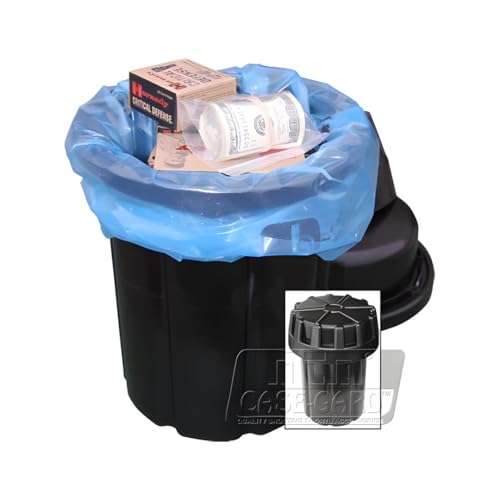
MTM SAC Survivor Ammo Can, Survival Gear, Time Capsule, Documents, USA Made, Black
- Three-piece underground storage system: Designed for secure underground storage
- Sealed bucket-style body and lid: Keeps items airtight and protected
- Includes Vapor Corrosion Inhibitor bag: Prevents corrosion inside the can
As an affiliate, we earn on qualifying purchases.
As an affiliate, we earn on qualifying purchases.
Use Ice and Cold Packs Wisely — How to Make Them Last Longer
Ice and gel packs are your best friends for short-term cooling. To maximize their lifespan, keep them in a well-insulated cooler, ideally a high-quality one with thick walls and tight seals. Proper insulation minimizes heat exchange with the outside environment, which is essential because every degree of temperature rise shortens the time your ice lasts. Using a cooler that seals tightly reduces airflow and prevents warm air from sneaking in, thus preserving cold temperatures longer.
Pre-chilling your ice packs or ice blocks in the freezer before use can dramatically increase their effectiveness. When you start with frozen packs, you’re giving your storage a head start, which can extend the cooling period by several hours. During use, avoid opening the cooler frequently—each opening introduces warm air, accelerating ice melt. Instead, plan ahead and open only when necessary.
In practical terms, a well-packed, insulated cooler can keep perishable foods safe for 24–48 hours in moderate weather, but this depends on outside temperature, initial ice amount, and insulation quality. To extend this window, supplement ice with frozen water bottles. These act as thermal buffers and can be refrozen if you have access to a freezer beforehand. Reusing bottles also helps conserve resources, making your cooling system more sustainable in off-grid scenarios.
Tradeoffs exist: while larger ice packs or more ice prolong cooling, they add weight and take up space. Balancing weight, convenience, and duration is key. Additionally, consider the environment: in very hot conditions, you might need to replace ice more frequently or find alternative cooling methods. Combining multiple strategies—like insulating well and pre-chilling—maximizes the chances of keeping food safe without electricity.

Arctic Air Pure Chill 2.0 Evaporative Air Cooler by Ontel – Powerful, Quiet, Lightweight and Portable Space Cooler with Hydro-Chill Technology For Bedroom, Office, Living Room & More,Blue
- Indoor & Outdoor Use: Cooling and humidifying with Hydro-Chill technology
- Compact & Portable: Space-saving, lightweight design for easy portability
- Energy Efficient: Operates on 8-10 watts for low power use
As an affiliate, we earn on qualifying purchases.
As an affiliate, we earn on qualifying purchases.

FOOD STORAGE AND PRESERVATION WITH CONTAINERS AND MYLAR BAGS:: Know The Best Containers And Treatment Methods For Long-Term Storage Of All Dry Foods To Prevent Food Contamination, Spoilage And Pests
As an affiliate, we earn on qualifying purchases.
As an affiliate, we earn on qualifying purchases.
College move-in / dorm season Picks
dorm essentials
As an affiliate, we earn on qualifying purchases.