
TL;DR

Get kitchen gear delivered free with Prime
- Fast, free delivery on millions of items
- Prime Video, Amazon Music and more included
- Member-only deals all year
Good Housekeeping reports that food safety expert Darin Detwiler advises discarding a whole loaf if any bread is moldy. Mold can spread through soft bread in microscopic threads that are not visible, so cutting away the affected area cannot guarantee the rest is uncontaminated. The report recommends a breadbox or paper bag for short-term storage and the freezer for longer storage.
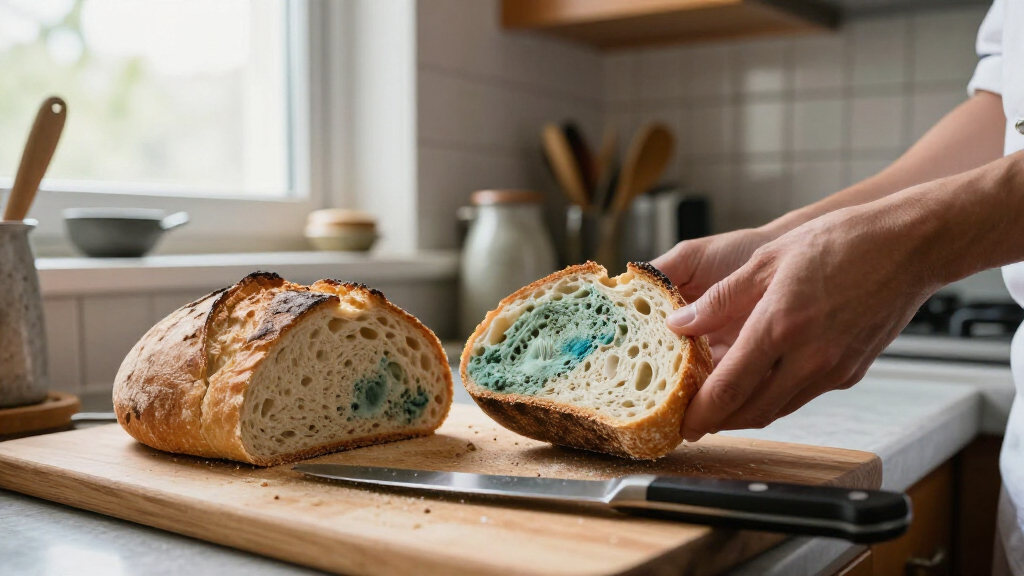
If one slice of bread is moldy, food safety expert Darin Detwiler advises discarding the entire loaf rather than cutting off the visible patch. A Good Housekeeping report says mold can send microscopic threads through soft, porous bread, meaning the parts that look clean may not be free of contamination, much like mold on a blueberry can raise questions about the rest.
Detwiler, a food safety expert and professor emeritus of food regulatory affairs, describes visible mold as a sign that contamination may extend beyond the surface. Mold can produce mycotoxins, and its microscopic threads can travel into bread where they cannot be seen with the naked eye. Removing a discolored or fuzzy section does not establish that the remaining bread is safe.
The advice applies to sliced bread as well as whole loaves, according to the report: if one slice shows mold, the rest may also have been exposed. Detwiler recommends putting the moldy bread in the trash or compost rather than trying to salvage clean-looking slices. The report says consuming or inhaling mold can be associated with problems including nausea, vomiting and breathing difficulties, and urges particular caution for people who are immunocompromised.
For bread that has not molded, the report recommends limiting moisture during storage. A breadbox or paper bag allows air to circulate, while the freezer is presented as an option for longer storage. The report advises against refrigeration, saying it can make bread stale faster than keeping it at room temperature.
Why Cutting Off Mold Is Not Enough
The practical issue is that visible mold is not a reliable boundary around contamination in a soft food. Bread’s porous structure lets mold threads spread below the surface, and a person cannot check their extent by looking at the loaf. That makes trimming unlike removing a clearly affected area from some harder foods: the report says cutting off the spot does not guarantee that the remainder is uncontaminated.
The report recommends discarding the loaf rather than salvaging the remaining bread, with particular caution for people whose immune systems are compromised. It also recommends storing bread in a way that limits moisture or freezing bread that will not be used soon.
Products Worth Considering

Vitamix 5200 Professional-Grade Blender, 64 oz. Container, Black

Le Creuset Enameled Cast Iron Round Bread Oven, 9.5-Inch, Cerise

Ninja Flip Toaster Oven & Air Fryer, Large Capacity, Stainless, SP151
As an affiliate, we earn on qualifying purchases.
How Mold Spreads Through Bread
The Good Housekeeping report focuses on the difference between visible surface growth and what may be present inside food. It quotes Detwiler explaining that mold’s threads move more readily through soft, porous foods such as bread than their appearance might suggest. Because the threads are microscopic, a clean-looking slice cannot be confirmed safe by sight alone.
The report’s comparison is specific to bread and should not be read as a universal rule for every food. Its advice is to discard a moldy loaf, whether the bread is unsliced or packaged in slices. For prevention, it distinguishes between short-term storage at room temperature in a container that allows airflow and freezing bread for longer-term keeping; it says refrigeration can speed staling.
“If we see [mold], it’s like the tip-of-the-iceberg sort of thing.”
— Darin Detwiler, food safety expert and professor emeritus of food regulatory affairs, as quoted by Good Housekeeping
What a Visible Patch Cannot Show
The supplied report does not identify a way for consumers to determine how far mold has spread within a particular loaf, or to confirm that slices that look clean are uncontaminated. It also does not give a specific shelf life for bread stored in a breadbox, paper bag or freezer. The described health effects are general risks in the report; it does not establish that every exposure will cause illness or specify the risk from a particular moldy slice.
The source material also does not provide details about the mold species, the amount present or individual exposure levels. Its practical recommendation remains to discard bread when mold appears, rather than attempting to judge safety based on the size of the visible spot.
Safer Storage for the Next Loaf
If mold appears, the report’s guidance is to discard the entire loaf. For bread still in good condition, store it in a breadbox or paper bag where air can circulate and moisture is less likely to build up. Freeze bread for longer storage; avoid the refrigerator if the goal is to prevent rapid staling.
The report provides general food-safety guidance, not a diagnosis or a product-specific assessment. Anyone who develops concerning symptoms after possible mold exposure, or who has particular health risks, can seek advice from a qualified health professional. The source does not describe a new regulatory action or a scheduled follow-up; its practical guidance is to check the loaf and adjust storage.
Key Questions
Should I throw away the whole loaf if one slice is moldy?
Yes, according to the Good Housekeeping report. Detwiler advises discarding the whole loaf because mold can spread through bread beyond the visible spot.
Can I cut the moldy part off and eat the rest?
The report says trimming does not guarantee that contamination has been removed. Mold’s microscopic threads can extend into soft bread where they cannot be seen.
Does this advice apply to pre-sliced bread?
Yes. The report says to discard the package if one slice is moldy, since mold threads may have reached other slices.
How should I store bread to help prevent mold?
The report recommends a breadbox or paper bag for airflow and keeping bread dry. It says to freeze bread for longer storage and notes that refrigeration can make it stale faster.
Source: rss