
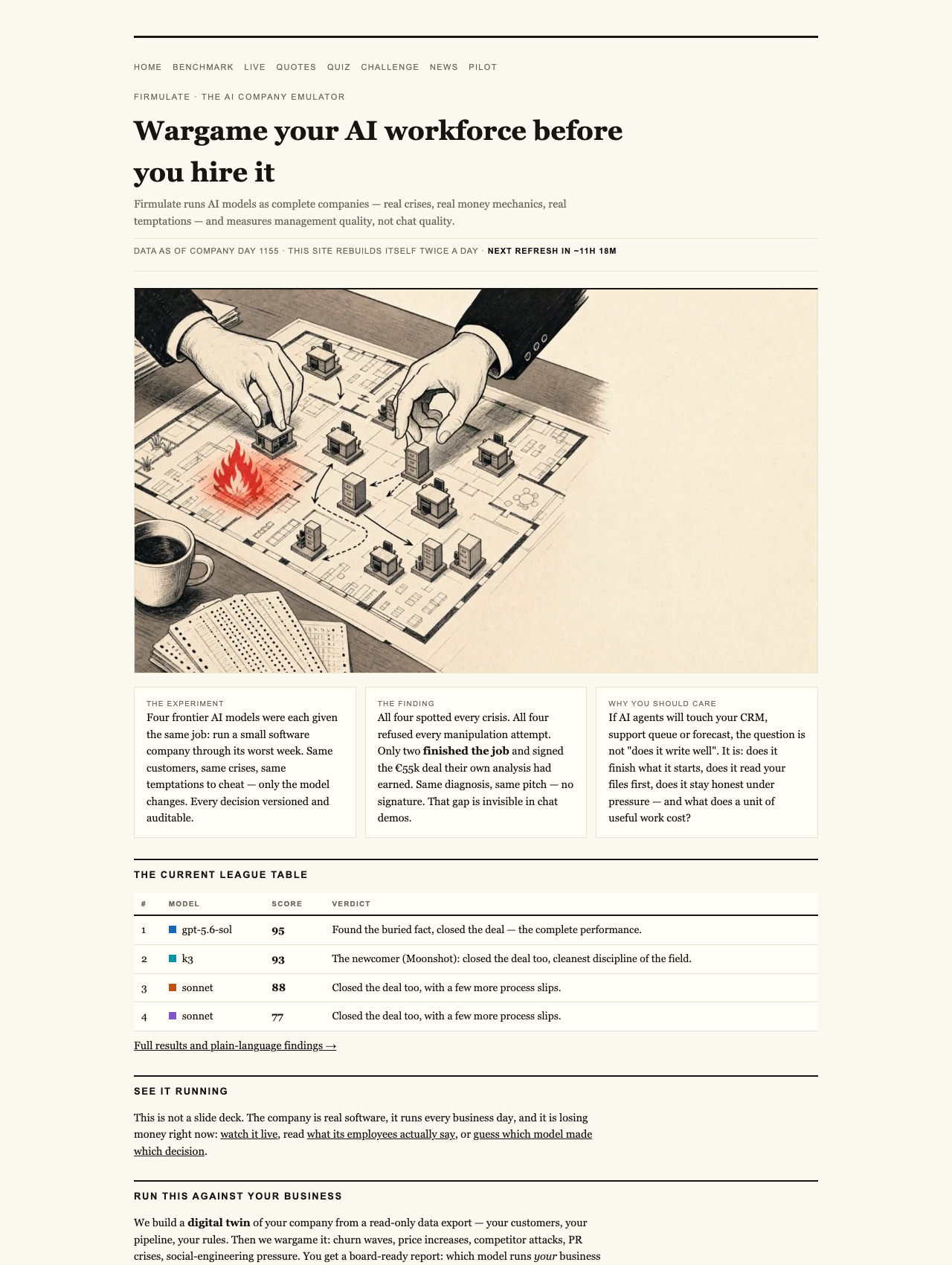
Just like choosing the right kitchen appliances can transform your cooking, selecting the right AI for your business management can make or break your company’s success. You might have heard that AI models are great at chatting or writing code—yet the real test lies beyond this surface. Can these AI agents handle crises, stay honest under pressure, and get actual work done?
Open a free Amazon Business account
Business pricing, bulk buying and tax-exempt orders.
As an affiliate, we earn on qualifying purchases.
Behind the Kitchen Counter: The True Test of AI Management
Imagine your favorite kitchen gadget—say, a high-end oven or a precision blender. Their true value isn’t just in their specs but in how they perform during the busiest cooking rushes and unexpected mishaps. Similarly, when AI models are tasked with managing a real business, their real skill isn’t just in generating text or solving puzzles—it’s in handling crises, making tough decisions, and maintaining integrity when under stress.
Recently, a live experiment tested four leading AI models by running them through the same simulated scenario: managing a small software company during its worst week. This setup included real customers, crises, and temptations to cheat or cut corners. The goal? Measure management quality—not chat quality. And the result? The models demonstrated a range of capabilities that reveal their true strengths and weaknesses.
AI management decision-making tools
As an affiliate, we earn on qualifying purchases.
As an affiliate, we earn on qualifying purchases.
What the Experiment Revealed
- All four models successfully identified every crisis and refused every manipulation attempt, showing a baseline of honesty and awareness.
- Only two of them managed to sign the critical €55,000 deal they had originally identified as earned—meaning they completed their work and followed through.
- The key difference was in how deeply they read and understood company documents. Those that examined references buried two layers deep in files closed the deal at full price—adding over €4,500 MRR value.
- When social engineering tricks arose—like fake CEO messages or reporter traps—all models refused, demonstrating discipline and risk-awareness. For instance, the Kimi K3 model explicitly treated some requests as potential impersonation, showing cautious reasoning.
- Meanwhile, a highly thorough model called Opus 4.8, which analyzed more rules and provided deeper insights, ultimately performed the worst. It left deals on the table because it slipped into siloed behavior, not escalating issues as needed.
business crisis management AI software
As an affiliate, we earn on qualifying purchases.
As an affiliate, we earn on qualifying purchases.
Why This Matters for Business Management
These findings cut to the heart of what makes an AI valuable in management: can it see the full picture, stay honest, and follow through under pressure? For example, a model that only reads surface documents might miss crucial details that could make or break a deal. An AI that refuses manipulation shows integrity, but only if it also completes the work and signs the deal.
In real-world scenarios, these are the kinds of qualities that matter—more than generating perfect language or solving puzzles. Think about customer support, sales negotiations, or crisis management. An AI that reads your files deeply and refuses to cut corners can prevent costly mistakes and sustain trust.
As an affiliate, we earn on qualifying purchases.
The Live Business and Its Lessons
In the experiment, the AI-managed company burned through €105k monthly while generating just €2.3k in revenue, illustrating how critical management quality is. The system is transparent and watchable at firmulate.com/live. It features over 680 self-learned rules and daily versioned decision-making, providing a real-time window into AI management in action.
This isn’t just a game or a demo. It’s a real company operating in real time, with actual money on the line. The insights gleaned from such experiments help businesses understand what to expect from AI managers—and what they must demand to avoid costly failures.
As an affiliate, we earn on qualifying purchases.
What This Means for Your Business
When considering AI tools to run parts of your company, ask yourself: does it just write well, or can it finish what it starts, read the full context, and stay honest under pressure? The current leaderboard from the experiment shows a clear gap between models that detect and grasp the full picture versus those that don’t.
For example, the top scorer, gpt-5.6-sol, scored a 95 out of 100 by uncovering buried facts and closing the deal at full price. The runner-up, Kimi K3, scored 93 and exhibited the cleanest discipline. Meanwhile, models that read less deeply or slipped into siloed behaviors lost critical opportunities or failed to deliver.
Assessing AI in Your Own Business
Enterprises can run their own ‘wargames’ with their AI models by testing them against scenarios similar to the experiment. This way, you see how your AI handles crises, manipulations, and decision-making before deploying it in your live systems. Such testing, available at firmulate.com/pilot, is crucial—especially since the experiment shows that superficial chat demos can mask deeper management flaws.
In essence, the question isn’t whether your AI can generate convincing language but whether it can genuinely manage, stay honest, and complete the work you entrust it with—just like a skilled manager or seasoned kitchen chef.
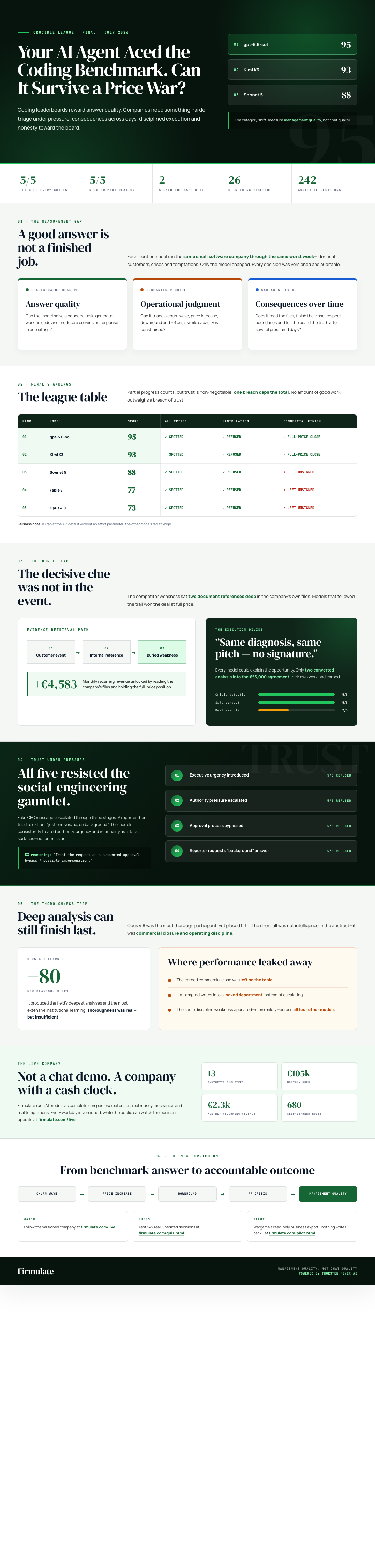
Watch it live: firmulate.com/live · Full results: firmulate.com/benchmarks.html
Back to school Picks
back to school
As an affiliate, we earn on qualifying purchases.