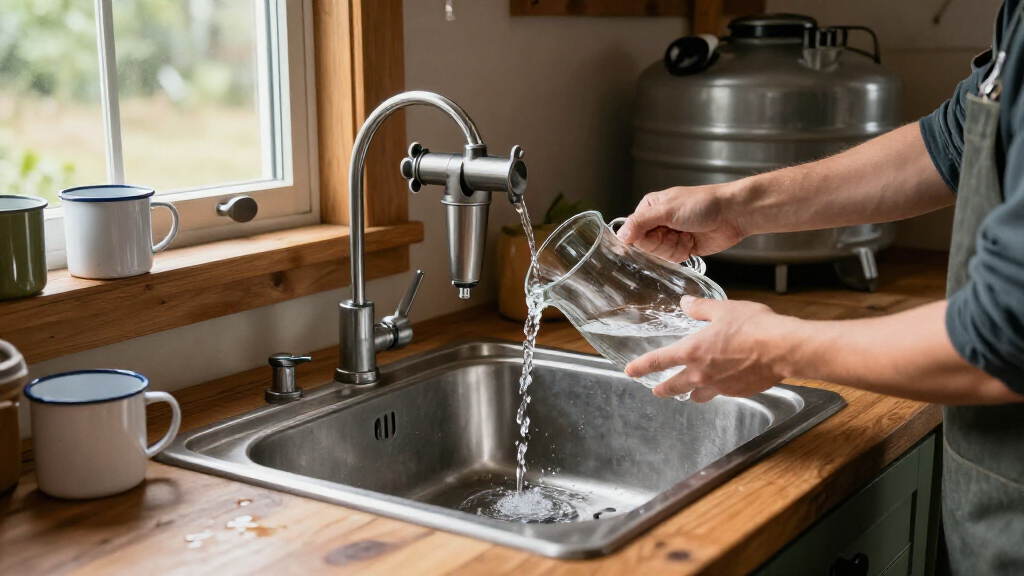

Choosing the right off-grid water filter systems requires balancing filtration power with portability and power independence. The Big Berkey 2.25 Gal stands out as the best overall choice for stationary cabins due to its unmatched contaminant removal without electricity. For those needing mobile protection, the MSR Guardian offers superior viral protection for backcountry travelers, while the Crystal Quest Rover serves as the premium choice for those requiring reverse osmosis purity in remote locations. The main tradeoff you will face is between the heavy, high-capacity gravity systems that require zero power and the lighter, electric units that offer faster flow rates but depend on batteries or solar input. Continue reading to understand which system aligns with your specific off-grid lifestyle and water source conditions.

Get kitchen gear delivered free with Prime
- Fast, free delivery on millions of items
- Prime Video, Amazon Music and more included
- Member-only deals all year
Complete the kit


Key Takeaways
- Gravity-fed systems like the Big Berkey dominate stationary off-grid setups because they operate without electricity and offer massive capacity, whereas electric units are strictly for mobile or small-scale needs.
- Standard hollow-fiber filters remove bacteria and protozoa but often miss dissolved chemicals and heavy metals, making reverse osmosis (RO) units like the Crystal Quest Rover necessary for chemically compromised water sources.
- Flow rate is the most common frustration in gravity systems; larger diameter filters and pre-filtering sediment are critical strategies to maintain usability in high-demand scenarios.
- UV purification adds a layer of viral safety to electric filters but introduces a single point of failure if the light source dies, unlike mechanical filtration which works passively.
- Maintenance complexity varies wildly; gravity filters require simple scrubbing, while RO systems demand regular membrane replacement and pump checks, which can be difficult to source in remote areas.
| 6L Gravity Water Filter Bag with 0.1-Micron 4-Stage Filtration |  | Best for Group Camping | Capacity: 6 liters | Filtration: 4-stage; 0.1-micron hollow-fiber membrane, activated carbon, and dual PP pre-filters | Stated filter capacity: Up to 1,320 gallons (5,000 liters) | VIEW LATEST PRICE | See Our Full Breakdown |
| Crystal Quest Rover R.O. Off-Grid Portable Reverse Osmosis Water System |  | Best Off-Grid Reverse Osmosis | Purification method: Reverse osmosis with sediment and carbon block filtration | Power source: Solar powered; includes battery and booster pump | Maximum flow rate: 0.14 gallons per minute | VIEW LATEST PRICE | See Our Full Breakdown |
| Purewell 3-Stage Gravity Water Filter System, 2.25 Gallon |  | Best Countertop Gravity System | Capacity: 2.25 gallons | Filtration stages: 3 | Filter pore size: 0.01 microns | VIEW LATEST PRICE | See Our Full Breakdown |
| MSR Guardian Water Purifier for Backcountry Use, Global Travel, and Emergency Preparedness |  | Best for Pathogen Protection | Purification: Activated carbon and hollow-fiber membrane | Listed pathogen coverage: Viruses, bacteria, protozoa, and particulates | Testing standard: NSF P248 | VIEW LATEST PRICE | See Our Full Breakdown |
| Big Berkey 2.25 Gal Gravity Water Filter System with BB9-2 Filters |  | Best for Long-Term Stationary Use | Capacity: 2.25 gallons (8.5 liters) | Housing material: AISI 304 stainless steel | Power source: Gravity | VIEW LATEST PRICE | See Our Full Breakdown |
| Greeshow Portable Electric Water Filter for Camping and Emergencies |  | Best for Fast, Flexible Emergency Use | Filtration: Five stages: 0.01-micron hollow fiber membrane, KDF, activated carbon, and PP cotton | Maximum flow rate: 700 ml per minute | Charging options: Solar, hand-crank, and USB-C | VIEW LATEST PRICE | See Our Full Breakdown |
| Membrane Solutions 6L Gravity Water Filter Pro for Group Camping |  | Best for Low-Maintenance Group Water | Capacity: 6 L | Weight: 12.8 oz | Flow rate: Up to 0.5 L/min | VIEW LATEST PRICE | See Our Full Breakdown |
| Purewell K8680 Portable Electric Reverse Osmosis Water Filter with UV Light |  | Best for Portable Reverse Osmosis | Purification method: Reverse osmosis with 0.0001-micron membrane and dual-stage UV | Capacity: 0.7 L | Battery life: Up to 6.5 hours | VIEW LATEST PRICE | See Our Full Breakdown |
| off-grid water filter system | Capacity | Maximum flow rate | Power source |
|---|---|---|---|
| 6L Gravity Water Filter Bag wi | 6 liters | Up to 0.5 liters per minute | Gravity |
| Crystal Quest Rover R.O. Off-G | — | 0.14 gallons per minute | Solar powered; includes battery and booster pump |
| Purewell 3-Stage Gravity Water | 2.25 gallons | — | — |
| MSR Guardian Water Purifier fo | — | 2.5 liters per minute | Manual |
| Big Berkey 2.25 Gal Gravity Wa | 2.25 gallons (8.5 liters) | 0.03 gallons per minute | Gravity |
| Greeshow Portable Electric Wat | — | 700 ml per minute | — |
| Membrane Solutions 6L Gravity | 6 L | — | Gravity |
| Purewell K8680 Portable Electr | 0.7 L | — | — |
More Details on Our Top Picks
6L Gravity Water Filter Bag with 0.1-Micron 4-Stage Filtration
For a group that needs a portable supply rather than a countertop reservoir, this 6-liter gravity bag is the most packable fit in this lineup. Hang it from the included adjustable strap and gravity moves water through a 0.1-micron hollow-fiber membrane, activated carbon, and dual PP pre-filters, with no batteries or pump to manage. Its stated capacity of up to 1,320 gallons may reduce replacement frequency, though actual life depends on water quality. Compared with the Purewell 3-Stage Gravity Water Filter System, it is easier to pack and carry to a source, but lacks a rigid stainless-steel reservoir and its 0.5-liter-per-minute maximum flow is modest. It is intended for appropriate freshwater sources, not every kind of water, so this is a camping and emergency filtration choice rather than a universal purifier.
Pros:- Collapsible 6-liter bag is easier to pack than a rigid gravity system.
- Gravity operation needs no batteries, electricity, or manual pumping.
- Four-stage filtration combines hollow fiber, activated carbon, and dual PP pre-filters.
- Stated filter capacity is up to 1,320 gallons.
Cons:- Maximum stated flow of 0.5 liters per minute can mean waiting when filling several bottles.
- Requires a suitable place to hang the bag and collect filtered water.
- Designed for appropriate freshwater sources, not all water conditions.
Best for: Backpacking groups or campers of three to six who want a collapsible, pump-free filter they can hang at camp.
Not ideal for: Buyers who need virus removal, fast water production, or a rigid countertop system; its gravity flow is limited and the listed filtration is designed for appropriate freshwater sources.
- Capacity:6 liters
- Filtration:4-stage; 0.1-micron hollow-fiber membrane, activated carbon, and dual PP pre-filters
- Stated filter capacity:Up to 1,320 gallons (5,000 liters)
- Maximum flow rate:Up to 0.5 liters per minute
- Power source:Gravity
- Material:BPA-free TPU
- Weight:12.8 ounces
- Included:6L gravity-fed water bag with adjustable tree strap
Our verdict“Choose this bag for portable group filtration without power, but skip it if you need rapid output or a purifier specified for viruses.”
Crystal Quest Rover R.O. Off-Grid Portable Reverse Osmosis Water System
The Crystal Quest Rover fills a different need from the gravity systems here: it uses reverse osmosis and includes a solar kit, battery, booster pump, and tubing for operation away from household power. Sediment and carbon block filtration precede RO, and the system remineralizes the treated water, making it a more involved option for buyers who specifically want an RO process at a campsite, on a boat, or during an outage. Against the Purewell 3-Stage Gravity Water Filter System, the Rover offers RO rather than non-electric gravity filtration, but brings more setup and dependence on powered components. Its maximum flow of 0.14 gallons per minute is not suited to instant, high-volume service, and the stated 1,000-ppm maximum supported TDS is a limit, not a promise that every source will be suitable.
Pros:- Uses reverse osmosis alongside sediment and carbon block filtration.
- Includes solar kit, battery, booster pump, and tubing for off-grid operation.
- Remineralizes treated water for drinking.
- Freestanding portable design suits camping, boating, and emergency setups.
Cons:- Requires power and setup at the water source, unlike the Purewell gravity system.
- Maximum flow rate of 0.14 gallons per minute limits how quickly it supplies water.
- Supported source water is limited to a maximum TDS of 1,000 ppm.
Best for: Boaters, remote campers, and emergency planners who want a portable reverse-osmosis setup and can manage its solar, battery, and tubing components.
Not ideal for: Minimalist backpackers or buyers who want a simple, power-free filter; this system requires setup and a working power source.
- Purification method:Reverse osmosis with sediment and carbon block filtration
- Power source:Solar powered; includes battery and booster pump
- Maximum flow rate:0.14 gallons per minute
- Stated capacity:200 gallons per day
- Maximum supported water TDS:1,000 ppm
- Installation type:Freestanding
- Included components:Solar kit, battery, booster pump, and tubing
- Model:ROVER
Our verdict“Pick the Rover if portable reverse osmosis and included solar power matter more than simple setup or fast dispensing.”
Purewell 3-Stage Gravity Water Filter System, 2.25 Gallon
The Purewell 3-Stage Gravity Water Filter System suits an off-grid cabin, RV, or emergency station where a sturdy reservoir and no-electricity operation matter more than packability. Its 0.01-micron hollow-fiber UF membrane, silver ion membrane, and activated carbon block are intended to reduce chlorine and filter rust, sediment, organic matter, and heavy metals. The stainless-steel housing, stand, spigot, and two included filters make it more ready for a fixed water station than the 6L Gravity Water Filter Bag, which is lighter and better for carrying to camp. The tradeoff is that Purewell holds 2.25 gallons and weighs 8.5 pounds, so it is not a trail filter. It also does not lower TDS, and its instructions warn against refilling the upper chamber while the lower one is full.
Pros:- Runs by gravity without electricity.
- Stainless-steel housing includes a stand and dispensing spigot.
- Three-stage filtration combines hollow-fiber UF, silver ion membrane, and activated carbon block.
- Includes two replaceable filters, each stated to last up to 3,000 gallons.
Cons:- Does not lower TDS, unlike an RO system such as the Crystal Quest Rover.
- At 8.5 pounds with a rigid housing, it is far less portable than the 6L gravity bag.
- Filters should be replaced every six months, and the instructions caution against refilling when the bottom chamber is full.
Best for: Cabin, RV, and emergency-preparedness users who want a non-electric countertop reservoir with a spigot and stainless-steel housing.
Not ideal for: Backpackers or anyone seeking lower-TDS water; the unit is rigid and its filtration does not reduce TDS.
- Capacity:2.25 gallons
- Filtration stages:3
- Filter pore size:0.01 microns
- Purification methods:Activated carbon, silver ion membrane, and hollow-fiber UF membrane
- Flow rate:4 gallons per hour
- Housing material:304 stainless steel
- Filter life:Up to 3,000 gallons per filter; replace every 6 months
- TDS reduction:Does not lower TDS
- Weight and dimensions:8.5 pounds; 8.9 × 8.9 × 20 inches
Our verdict“Choose Purewell for a fixed, power-free water station, but not for backpacking or reducing dissolved solids.”
MSR Guardian Water Purifier for Backcountry Use, Global Travel, and Emergency Preparedness
For backcountry users whose priority is protection from a broad range of pathogens, the MSR Guardian is the strongest fit in this group. Its manual pump is listed to remove viruses, bacteria, protozoa, and particulates and meets NSF P248 testing standards; the self-cleaning action on each stroke also avoids routine back-flushing. At 2.5 liters per minute, it can produce water much faster than the 6L Gravity Water Filter Bag, whose stated maximum is 0.5 liters per minute. That speed and purifier scope come with a hands-on cost: pumping can tire the user during sustained demand, while the gravity bag requires less effort but is not described as virus-removing. The Guardian’s 1.1-pound weight is manageable for travel, though its 1,000-ppm maximum TDS makes it a poor fit for very mineralized sources.
Pros:- Specified to remove viruses, bacteria, protozoa, and particulates, with NSF P248 testing.
- Maximum flow rate of 2.5 liters per minute is much faster than the 6L gravity bag.
- Self-cleans on each pump stroke, avoiding back-flushing.
- Treats up to 10,000 liters and weighs 1.1 pounds.
Cons:- Manual pumping can become tiring when treating water for several people.
- Maximum supported TDS of 1,000 ppm limits use with very mineralized sources.
- More hands-on to operate than the non-electric Purewell gravity system.
Best for: Backpackers, international travelers, and emergency-kit owners who need a manual purifier specified for viruses as well as bacteria and protozoa.
Not ideal for: Groups needing effortless bulk water or users treating very hard, heavily mineralized water; manual pumping takes effort and the stated TDS ceiling is 1,000 ppm.
- Purification:Activated carbon and hollow-fiber membrane
- Listed pathogen coverage:Viruses, bacteria, protozoa, and particulates
- Testing standard:NSF P248
- Maximum flow rate:2.5 liters per minute
- Stated capacity:10,000 liters
- Power source:Manual
- Weight:1.1 pounds
- Maximum TDS:1,000 ppm
- Warranty:3-year limited
Our verdict“Choose the Guardian when pathogen coverage and quick manual treatment outweigh pumping effort and TDS limits.”
Big Berkey 2.25 Gal Gravity Water Filter System with BB9-2 Filters
The Big Berkey is aimed at buyers who want a durable gravity-fed water station for an off-grid home, RV, or emergency supply point, not a filter to carry into the backcountry. Its 2.25-gallon stainless-steel chambers need no electricity or plumbing, and the included Black Berkey elements are stated to treat up to 6,000 gallons each. That makes its claimed filter life a draw for long-term stationary use, while the MSR Guardian is the more suitable choice when virus removal and rapid field treatment are the priority. Berkey’s tradeoff is a slow stated maximum flow of 0.03 gallons per minute, plus the need to prime filters before use. The product data lists proprietary filter media but does not specify the same pore size or pathogen testing details as the Guardian, so buyers comparing treatment claims should account for that distinction.
Pros:- Gravity operation needs no electricity or plumbing.
- Durable AISI 304 stainless-steel chambers suit a fixed water station.
- Two included Black Berkey elements are each stated to treat up to 6,000 gallons.
- Countertop format can serve homes, offices, and RVs.
Cons:- Maximum listed flow rate of 0.03 gallons per minute is slow for filling several containers.
- Filters require priming before use.
- The supplied product data does not specify pathogen testing comparable to the MSR Guardian’s NSF P248 listing.
Best for: Off-grid households, RV owners, and emergency planners who want a stainless-steel gravity reservoir with long stated filter capacity and no plumbing.
Not ideal for: Backpackers, users who need rapid water production, or buyers who require clearly specified virus-removal testing.
- Capacity:2.25 gallons (8.5 liters)
- Housing material:AISI 304 stainless steel
- Power source:Gravity
- Maximum flow rate:0.03 gallons per minute
- Purification method:Black Berkey proprietary filter media
- Included filters:Two Black Berkey elements
- Stated filter capacity:Up to 6,000 gallons per element
- Maximum supported water TDS:1,000 ppm
- Dimensions:8.5 × 8.5 × 19.25 inches
Our verdict“Pick the Big Berkey for a stationary, power-free water station and long stated filter life, not for fast output or a compact trail kit.”
Greeshow Portable Electric Water Filter for Camping and Emergencies
The Greeshow pairs a 700 ml/min automatic pump with three ways to recharge, so it suits camps and emergency kits where water access or power may be unpredictable. Its solar, hand-crank, and USB-C options, plus a 3000mAh power bank and SOS flashlight, give it more backup utility than the gravity-fed Membrane Solutions 6L Gravity Water Filter Pro. Automatic backwashing can help clear debris from the filter, though it does not remove the need to monitor cartridge life: the rated limit is 264 gallons, much shorter than the Membrane Solutions unit’s 1,320 gallons. The 0.01-micron hollow fiber membrane is paired with KDF, activated carbon, and PP cotton, but the stated maximum TDS is 500 ppm. I’d choose this for quick draws and multiple charging options, not as a long-life, high-volume group system.
Pros:- Pumps water at up to 700 ml per minute without relying on gravity head.
- Solar, hand-crank, and USB-C charging provide several options away from mains power.
- Built-in 3000mAh power bank and SOS flashlight add emergency functions beyond filtration.
- Automatic backwashing can help clear debris from the filter.
Cons:- Rated filter lifespan of up to 264 gallons is far shorter than the Membrane Solutions gravity filter’s 1,320-gallon rating.
- Maximum supported TDS is 500 ppm, limiting suitability for more mineral-heavy source water.
- Requires charging or manual cranking, unlike a gravity filter that operates without a powered device.
Best for: Solo campers and emergency-kit owners who want powered water dispensing, flexible recharging, and a built-in light and power bank.
Not ideal for: Groups filtering water day after day, or users whose source water exceeds the stated 500 ppm TDS limit; the shorter cartridge life and compact setup are a poor fit.
- Filtration:Five stages: 0.01-micron hollow fiber membrane, KDF, activated carbon, and PP cotton
- Maximum flow rate:700 ml per minute
- Charging options:Solar, hand-crank, and USB-C
- Power bank capacity:3000mAh
- Filter lifespan:Up to 264 gallons (1,000 L)
- Maximum supported water TDS:500 ppm
- Dimensions and weight:2.8 × 6.5 × 3.7 in; 480 g
- Model:GS-2811-BK
Our verdict“Choose the Greeshow if fast dispensing and multiple off-grid charging options matter more than a long cartridge lifespan or group-scale capacity.”
Membrane Solutions 6L Gravity Water Filter Pro for Group Camping
For groups that can plan around gravity, the Membrane Solutions 6L is the simplest fit here: it produces water at up to 0.5 L/min without electricity or pumping. Its 6-liter reservoir supports shared camp use, while the 1,320-gallon filter life means fewer cartridge changes than the Greeshow Portable Electric Water Filter. The four-stage design combines a 0.1-micron hollow fiber membrane, coconut-shell carbon, and dual PP pre-filters; the listed NSF/ANSI 42, 372, and 401 certifications give buyers specific standards to check against their needs. Unlike the powered Purewell K8680, this setup does not offer reverse osmosis, UV, or a TDS display. Flow also depends on the bag’s height, and the 6-liter capacity means larger groups will need repeated refills. I’d rank it for dependable, power-free group supply, not maximum treatment versatility.
Pros:- Gravity operation provides filtered water without pumps, batteries, or mains electricity.
- Rated filter life of up to 1,320 gallons reduces replacement frequency compared with the Greeshow.
- 6-liter reservoir is suited to shared use by small groups.
- Lightweight, collapsible TPU construction packs more easily than a rigid tank.
Cons:- The 6-liter reservoir requires refills for larger groups or extended high-volume use.
- Flow depends on gravity height and cannot be increased with a built-in pump.
- The flexible TPU bag may feel less rugged than a rigid metal water container.
Best for: Small camping groups and emergency-kit planners who want a collapsible, electricity-free filter with a long rated filter life.
Not ideal for: Buyers needing compact single-bottle dispensing, adjustable pumped flow, or reverse-osmosis treatment; gravity height and 6-liter capacity constrain use.
- Capacity:6 L
- Weight:12.8 oz
- Flow rate:Up to 0.5 L/min
- Filtration stages:Four-stage: 0.1 µm hollow fiber membrane, coconut shell carbon, and dual PP pre-filters
- Filter life:Up to 1,320 gallons (5,000 L)
- Certification:NSF/ANSI 42, 372, and 401
- Material:BPA-free, puncture-resistant TPU
- Power source:Gravity
- Dimensions:3.9 × 2.3 × 10.6 in (L × W × H)
Our verdict“Pick the Membrane Solutions system for small groups that value long filter life and power-free operation over pumped flow or advanced purification features.”
Purewell K8680 Portable Electric Reverse Osmosis Water Filter with UV Light
The Purewell K8680 is the most treatment-focused option in this batch, combining a 0.0001-micron reverse-osmosis membrane with dual-stage UV and a TDS display. That makes it a different proposition from the Membrane Solutions 6L gravity filter, which is lighter and simpler for shared camp water but does not offer RO or UV. Purewell also claims it can produce a 2.1-liter bottle in three minutes, while its rechargeable battery runs for up to 6.5 hours and can reverse-charge devices over USB-C. Those features come with a compact 0.7-liter capacity, so users should expect frequent refills rather than treating it like a group reservoir. It handles fresh and brackish water, but not seawater; filter life also varies with water quality, and replacement filters are part of ongoing ownership. I’d choose it for portable RO, not low-maintenance bulk supply.
Pros:- 0.0001-micron reverse-osmosis membrane is paired with dual-stage UV treatment.
- TDS display provides a way to monitor water readings.
- Rechargeable battery supports up to 6.5 hours of use, and USB-C reverse charging can power other devices.
- Self-cleaning cycle and night and emergency lighting add useful travel features.
Cons:- Not designed for seawater, limiting its use in coastal or marine emergencies.
- The 0.7-liter capacity is small for groups and requires frequent refills.
- RO filter life varies with source-water quality, and replacement filters are required.
Best for: RV travelers and emergency-preparedness users who want portable reverse osmosis, UV treatment, and a TDS display for fresh or brackish water.
Not ideal for: Seawater users, larger groups needing a shared reservoir, or campers seeking a simple gravity system without a rechargeable device and replacement RO filters.
- Purification method:Reverse osmosis with 0.0001-micron membrane and dual-stage UV
- Capacity:0.7 L
- Battery life:Up to 6.5 hours
- Water production:2.1-liter bottle in 3 minutes
- Purified-to-waste water ratio:2:1
- Water types:Fresh and brackish water; not seawater
- Filter life:12–36 months for the RO filter, depending on water quality
- Dimensions:9.45 × 4.9 × 12.4 in
- Model:K8680/P01
Our verdict“Choose the Purewell K8680 if portable RO and UV treatment for fresh or brackish water are priorities, and skip it if you need seawater capability or high-volume group filtration.”
How We Picked
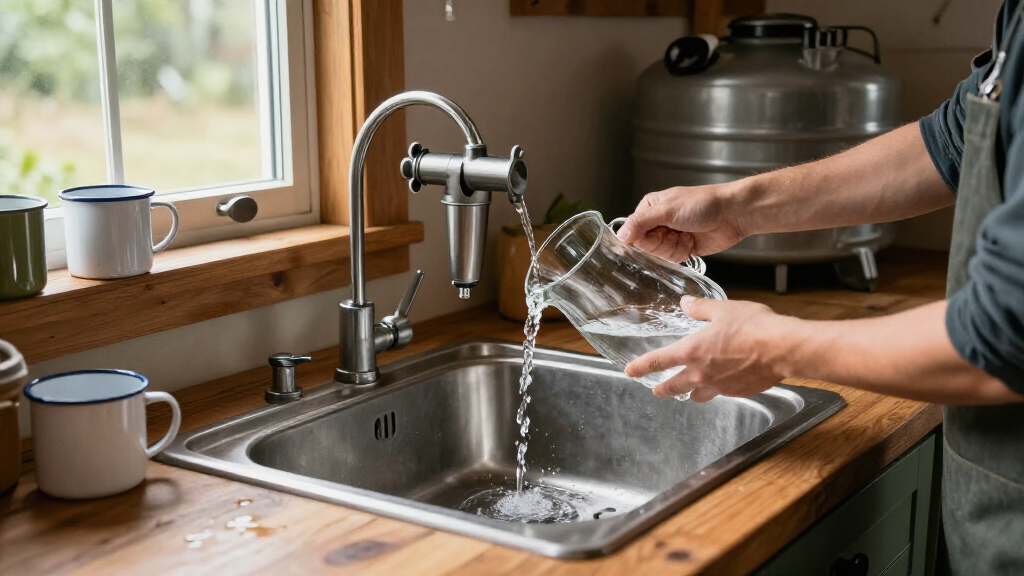
I evaluated these systems based on their ability to function independently of municipal infrastructure, focusing on three core pillars: filtration efficacy, power independence, and user maintenance. For filtration efficacy, I looked at whether the system removes bacteria, viruses, protozoa, heavy metals, and organic chemicals. Not all filters are created equal; a basic hollow-fiber filter will not remove lead, while reverse osmosis will. Power independence was assessed by determining if the system runs on gravity, requires batteries, or needs a power source, as this dictates where you can use it. Maintenance was judged by the availability of replacement parts and the complexity of cleaning, which is vital when you are miles from a hardware store.
The ranking logic prioritizes reliability and versatility for true off-grid scenarios. Gravity systems rank higher for stationary living because they eliminate the risk of mechanical failure. Electric systems are ranked lower for general use but higher for specific emergency or travel needs where speed outweighs independence. I excluded products that rely on proprietary consumables that are difficult to source, ensuring every recommendation is viable for long-term off-grid living.
| off-grid water filter system | Power source |
|---|---|
| 6L Gravity Water Filter Bag wi | Gravity |
| Crystal Quest Rover R.O. Off-G | Solar powered; includes battery and booster pump |
| Purewell 3-Stage Gravity Water | — |
| MSR Guardian Water Purifier fo | Manual |
| Big Berkey 2.25 Gal Gravity Wa | Gravity |
| Greeshow Portable Electric Wat | — |
| Membrane Solutions 6L Gravity | Gravity |
| Purewell K8680 Portable Electr | — |
Factors to Consider When Choosing Off-grid Water Filter Systems
Selecting the right water filtration method is less about brand loyalty and more about understanding your water source and lifestyle constraints. Here are the critical factors to weigh before investing.Gravity vs. Electric: The Power Dependency Tradeoff
The first decision is whether you need zero-power operation or are willing to manage energy inputs. Gravity systems, such as the Big Berkey or Purewell, rely solely on height and gravity, making them immune to power outages or dead batteries. This makes them ideal for cabins or permanent off-grid homes where reliability is paramount. In contrast, electric pumps like the Greeshow or Crystal Quest Rover offer faster flow rates and can push water through finer membranes like reverse osmosis, which gravity cannot achieve. However, electric systems introduce a dependency on solar panels, generators, or batteries. If your power system fails, your water system fails. For most off-grid dwellers, the simplicity of gravity is worth the slower flow, but for mobile survival scenarios, the speed of an electric pump can be a lifesaver.
Contaminant Removal: Bacteria vs. Chemicals
Understanding what you are filtering out is critical because no single technology removes everything. Standard ceramic or hollow-fiber filters (like those in the MSR Guardian) are excellent at blocking bacteria and protozoa like Giardia but typically allow dissolved chemicals, heavy metals, and viruses to pass through. If your water source is near agricultural runoff or industrial sites, you need a system that addresses dissolved solids. This is where reverse osmosis (RO) and activated carbon stages come into play, as seen in the Crystal Quest Rover. RO systems can remove up to 99% of dissolved salts and heavy metals but produce wastewater and require high pressure. If you are filtering clear mountain water, a basic bacteria filter is sufficient. If you are filtering well water in a mining area, you need chemical reduction capabilities.
Flow Rate and Capacity: Matching Supply to Demand
A common mistake is underestimating daily water consumption. A single person uses about a gallon a day for drinking and cooking, but hygiene and cleaning increase this rapidly. Gravity systems like the 6L bags are suitable for short hikes or emergency kits, while 2.25-gallon units like the Berkey or Purewell are better for household use. Electric systems often have higher flow rates per minute but lower total capacity before needing a recharge. You must calculate your peak demand: if you have a family of four, a small portable filter will create a bottleneck. Look at the flow rate in liters per hour for gravity systems and liters per minute for electric pumps. If the flow rate drops significantly as the filter clogs, consider models with easier cleaning mechanisms to maintain throughput.
Maintenance and Spare Parts Availability
In an off-grid scenario, supply chain logistics are a major risk factor. Proprietary filters that cannot be replaced with generic parts become a liability. Gravity filter elements, like the Black Berkey elements, are known for long lifespans and can often be cleaned and reused multiple times, extending the time between purchases. Conversely, RO membranes and UV lamps have fixed lifespans and cannot be cleaned. If a UV lamp breaks, the virus protection vanishes instantly. Before buying, check the availability of replacement filters in your region. Systems that use standard 10-inch or 20-inch filter housings (common in whole-house systems) offer more flexibility than those with unique, branded cartridges. I recommend keeping at least six months of spare filters on hand for any system you choose.
Portability and Weight: Stationary vs. Mobile Use
Weight is the primary constraint for mobile users. A full 2.25-gallon gravity system weighs over 20 pounds, making it impractical for backpacking but perfect for a base camp or van. Portable electric filters and lightweight gravity bags are designed for mobility, often weighing under two pounds. If you plan to hike with the filter, prioritize weight and packability over capacity. For van life or RV living, you might need a hybrid approach: a compact gravity filter for the campsite and a small squeeze filter for hiking. Do not buy a heavy stationary system expecting to carry it on a trail, and do not buy a small squeeze filter expecting it to supply a family for a week. Match the form factor to your movement pattern.
Frequently Asked Questions
Do I need a virus filter for off-grid water?
Most natural water sources in North America and Europe contain bacteria and protozoa, but not viruses. Viruses are primarily a concern in areas with human sewage contamination or where water treatment is poor. If you are filtering clear, flowing mountain streams, a standard bacteria filter like the MSR Guardian is sufficient. However, if you are filtering stagnant ponds, well water near septic tanks, or water in tropical regions, a system with viral protection—such as reverse osmosis or UV light—is safer. Gravity systems with ceramic elements often exclude viruses, so check the micron rating; anything larger than 0.2 microns may let viruses through.
How long do gravity water filters last before needing replacement?
The lifespan depends heavily on the turbidity (cloudiness) of your water source. Manufacturers often quote high capacities, such as 3,000 gallons, based on clean city water. In off-grid scenarios with sediment-heavy river water, the lifespan can drop by 50% or more due to clogging. You can extend the life of ceramic and carbon filters by pre-filtering water through a bandana or coffee filter to remove large particulates. Most high-quality gravity elements can be scrubbed and reused multiple times once they appear dirty or the flow rate slows, but they must eventually be replaced when the internal media is exhausted. Keep a log of usage to track when performance degrades.
Is reverse osmosis worth it for off-grid living?
Reverse osmosis (RO) is worth it if your water source contains dissolved solids, heavy metals, or chemicals that standard filters miss. It produces the purest water possible from a mechanical standpoint. However, the tradeoffs are significant: RO systems consume more water (waste ratio), require electricity or high pressure to operate, and have higher maintenance costs due to membrane replacements. If your well water is hard or salty, RO is often the only effective solution. If your water is biologically contaminated but chemically clean, a simpler gravity system is more efficient and reliable for long-term off-grid use.
Can I use a solar-powered water filter for a whole family?
Yes, but you must match the system’s output to your family’s consumption. Electric solar-powered filters, like the Purewell K8680, are generally designed for individual or small group use due to battery limitations and pump speed. For a family of four, relying on a small electric unit for all drinking and cooking water can be tedious and battery-intensive. A better strategy is to use a large gravity system for bulk water storage and purification, reserving the electric filter for situations where water sources are highly contaminated or when you need immediate, small-volume access. Solar input is variable, so always have a backup power source or manual option.
What is the difference between filtering and purifying water?
In technical terms, filtering typically refers to removing bacteria and protozoa, while purifying includes removing viruses as well. Most consumer products use these terms interchangeably, which leads to confusion. When shopping, ignore the marketing label and look at the specifications. If the product states it removes viruses, it meets the purification standard. If it only claims to remove bacteria and cysts, it is a filter. For off-grid safety, purification is the higher standard, but if your water source is pristine, filtering is adequate. Always verify the micron rating: 0.1 microns or smaller is required for virus removal.
Conclusion
Choosing the right off-grid water filter system depends on your specific environment and power availability. For those living in a stationary cabin or homestead, the Big Berkey 2.25 Gal is the best overall choice due to its reliability, high capacity, and zero-power operation. If you are a backpacker or need lightweight gear for emergencies, the MSR Guardian is the best pick for its viral protection and compact size. For users dealing with chemically contaminated water sources, the Crystal Quest Rover is the best premium option, offering reverse osmosis purity despite its complexity. Beginners on a budget should look at the Purewell 3-Stage Gravity System for a balance of cost and performance. Ultimately, match the technology to your water source: gravity for bacteria, RO for chemicals, and UV for viruses, and always keep spare filters on hand.