

Off-grid water filtration systems vary most in how much water they produce, what power they need, and how much maintenance they demand. My best overall pick is the OutbackWater Emergency Drinking Water Filter System, a gravity-fed option listed at 24 gallons per day that avoids reliance on electricity. The ITEHIL Portable Electric Water Filter stands out for solar charging, while the Katadyn TRK Drip Ceradyn offers a non-electric gravity setup for buyers prioritizing established camping-style equipment. The main tradeoff is between steady household-scale output and portable systems that can work away from a fixed setup but may need pumping, charging, or more frequent attention. Read on for the full comparison and guidance on matching a system to your water source and daily needs.

Get kitchen gear delivered free with Prime
- Fast, free delivery on millions of items
- Prime Video, Amazon Music and more included
- Member-only deals all year
Complete the kit


Key Takeaways
- Gravity systems lead this lineup for routine off-grid use: the OutbackWater options list 24 gallons per day, while gravity-fed designs avoid depending on a charged battery or grid power.
- Power flexibility distinguishes the portable electric picks: ITEHIL adds solar charging, while Thmomex and BKLES pair solar with hand-crank charging or a hand pump, offering alternatives when sunlight or battery power is limited.
- Hand-pump filters favor mobility over hands-off volume: Trailgo Pro and Polerden suit portable use, but manual operation is a different daily workload from gravity-fed filtration.
- Large-capacity claims need context: the Practical Survival kit lists a 1,800-gallon capacity, but buyers still need to check replacement parts, the meaning of that capacity, and what contaminants the filter addresses.
- Not all gravity systems serve the same setting: the 3-gallon all-glass purifier with wooden stand is geared toward a stationary setup, while the Uzima UZ-2 and Katadyn TRK Drip are framed for camping and portable use.
| OutbackWater Emergency Drinking Water Filter System, Gravity-Fed, 24 GPD |  | Best for High-Volume Off-Grid Water | Purification method: Nanofiltration | Filtration stages: 4 | Stated capacity: Up to 24 gallons per day | VIEW LATEST PRICE | See Our Full Breakdown |
| ITEHIL Portable Electric Water Filter with Solar Charging | 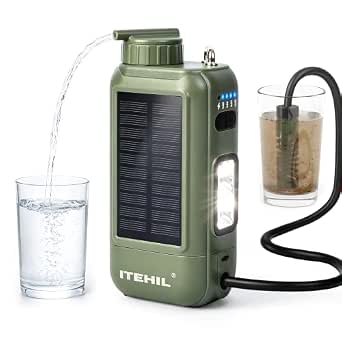 | Best Compact Option with Backup Power | Filtration precision: 0.01 microns | Purification method: Ahlstrom filter and hollow fiber membrane | Battery capacity: 5,200 mAh | VIEW LATEST PRICE | See Our Full Breakdown |
| Outback Water Gravity-Fed Water Filtration System, 24 GPD | | Best Bucket-Based Emergency Setup | Filtration stages: 4: pre-filter net, pre-filter sleeve, nano pre-filter, and multi-media cartridge | Purification method: Nanofiltration | Stated capacity: Up to 24 gallons per day | VIEW LATEST PRICE | See Our Full Breakdown |
| Katadyn TRK Drip Ceradyn Gravity Water Filter |  | Best for Long-Life, Field-Cleanable Filtration | Filter technology: Silver-impregnated ceramic | Pore size: 0.2 micron | Filter elements: 3 | VIEW LATEST PRICE | See Our Full Breakdown |
| Trailgo Pro Portable Hand-Pump Water Filter for Camping |  | Best for Fast, Small-Batch Field Filtering | Purification method: Three-stage PP cotton and ultrafiltration | Filtration accuracy: 5 µm pre-filter and 0.01 µm ultrafiltration | Maximum flow rate: 1.5 liters per minute | VIEW LATEST PRICE | See Our Full Breakdown |
| OffGrid Portable Electric Water Filter, 0.01 Micron, 6-Stage | 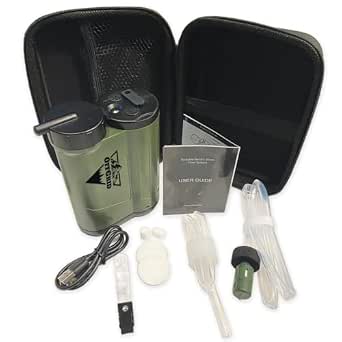 | Best Compact Electric Pick | Filtration stages: 6 | Purification method: Activated carbon and ultrafiltration | Filter capacity: Up to 3,000 liters | VIEW LATEST PRICE | See Our Full Breakdown |
| Thmomex 3-in-1 Portable Electric Water Filter with Solar and Hand-Crank Charging |  | Best for Power Flexibility | Filtration system: 8-stage system with PP cotton, activated carbon, and ultrafiltration | Filtration pore size: 0.01 μm | Filter capacity: Up to 5,000 liters | VIEW LATEST PRICE | See Our Full Breakdown |
| BKLES 3-in-1 Portable Water Filter System with Solar Charging and Hand Pump |  | Best Backup-Power Pick | Filtration: Six-stage system with dual 0.01-micron ultrafiltration membranes | Purification methods: Ultrafiltration, PP cotton, KDF, activated carbon, and coconut activated carbon fibers | Operation: Electric pump and hand pump | VIEW LATEST PRICE | See Our Full Breakdown |
| Polerden Portable Hand-Pump Water Filter for Camping |  | Best Manual High-Flow Pick | Filtration stages: 3 | Filtration method: Mineral prefilter, PP cotton filter, and ultrafiltration membrane | Power source: Manual | VIEW LATEST PRICE | See Our Full Breakdown |
| Practical Survival Gravity Water Filtration System, 6-Piece Kit, 1,800-Gallon Capacity |  | Best Passive Off-Grid System | Purification method: Hollow fiber membrane | Filter capacity: 1,800 gallons | Bag capacity: Two 6-liter bags | VIEW LATEST PRICE | See Our Full Breakdown |
| 3-Gallon All-Glass Gravity-Fed Water Purifier with Wooden Stand |  | Best for Off-Grid Home Use | Capacity: 3 gallons | Construction: All glass | Purification method: Granular activated carbon | VIEW LATEST PRICE | See Our Full Breakdown |
| Uzima UZ-2 Gravity-Fed Camping Water Filter |  | Best for Small-Group Camping | Model: UZ-2 | Purification method: Hollow fiber membrane | Operation: Manual, gravity-fed | VIEW LATEST PRICE | See Our Full Breakdown |
| off-grid water filtration system | Weight | Purification method | Dimensions | Filter capacity |
|---|---|---|---|---|
| OutbackWater Emergency Drinkin | 6 pounds | Nanofiltration | 12 × 12 × 24 inches | — |
| ITEHIL Portable Electric Water | — | Ahlstrom filter and hollow fiber membrane | 3.2 × 2.4 × 7 inches | Up to 1,000 liters (265 gallons) |
| Outback Water Gravity-Fed Wate | 7 pounds | Nanofiltration | — | — |
| Katadyn TRK Drip Ceradyn Gravi | Approximately 3.3 kg | — | — | Up to 150,000 liters, depending on water quality |
| Trailgo Pro Portable Hand-Pump | 4 pounds | Three-stage PP cotton and ultrafiltration | 10 × 3.5 × 13.5 inches | Up to 3,000 liters |
| OffGrid Portable Electric Wate | 14.4 ounces | Activated carbon and ultrafiltration | 4 × 2.5 × 5.5 inches | Up to 3,000 liters |
| Thmomex 3-in-1 Portable Electr | 360 g | — | — | Up to 5,000 liters |
| BKLES 3-in-1 Portable Water Fi | 450 g (0.99 lb) | — | — | — |
| Polerden Portable Hand-Pump Wa | 4 pounds | — | 13.5 × 3.5 × 10 inches | — |
| Practical Survival Gravity Wat | Approximately 1.5 lb | Hollow fiber membrane | 8 × 1.5 × 1.5 inches | 1,800 gallons |
| 3-Gallon All-Glass Gravity-Fed | — | Granular activated carbon | 12.4 × 12.4 × 12.4 inches | Up to 6,000 gallons |
| Uzima UZ-2 Gravity-Fed Camping | — | Hollow fiber membrane | 10 × 10 × 17 inches | — |
More Details on Our Top Picks
OutbackWater Emergency Drinking Water Filter System, Gravity-Fed, 24 GPD
For an off-grid household that needs more than drinking water for one outing, this gravity-fed system rated for up to 24 gallons per day offers useful daily capacity without a power source. Its four-stage design is intended for lakes, rivers, streams, wells, and rainwater, while the included containers and connectors make it a more complete setup than a simple pump filter. Compared with the Katadyn TRK Drip Ceradyn, which has a slower stated output of about four liters per hour, the OutbackWater is aimed at producing a larger daily supply. The tradeoff is that its documentation does not detail which contaminants the stages remove, so I would verify suitability against the source water and intended use. It also needs regular manual filling and a stable place for gravity to work.
Pros:- Gravity-powered operation requires no electricity, pump, or batteries.
- Stated capacity of up to 24 gallons per day suits ongoing off-grid use.
- Designed for several natural and stored water sources, including rainwater.
- Six-pound weight and included containers and connectors support portability and setup.
Cons:- The upper chamber must be filled manually, and the system needs gravity and a suitable setup location.
- The provided product information does not specify contaminant removal details.
- Its 12 × 12 × 24-inch footprint is less convenient to pack than a compact hand-pump filter.
Best for: Cabin and emergency-preparedness users who want a non-electric system with stated capacity for household-scale daily water needs.
Not ideal for: Buyers who need clearly listed contaminant-reduction claims or a filter they can use while moving between water sources.
- Purification method:Nanofiltration
- Filtration stages:4
- Stated capacity:Up to 24 gallons per day
- Power source:Gravity-powered
- Maximum supported TDS:500 ppm
- Dimensions:12 × 12 × 24 inches
- Weight:6 pounds
- Included components:Filters, spigot, containers, connectors, gaskets, and manual
Our verdict“Choose this OutbackWater system for higher-volume, stationary off-grid filtration, but verify its contaminant claims before relying on it for a particular source.”
ITEHIL Portable Electric Water Filter with Solar Charging
The ITEHIL suits people who collect water away from camp and want filtration without stopping to pump by hand. Its 700 ml-per-minute flow rate, compact body, USB-C charging, and solar charging make it more mobile than the countertop OutbackWater gravity systems, which need a container and a fixed spot for water to drip through. The 5,200 mAh battery and power-bank and light functions add emergency utility beyond filtration. That flexibility comes with dependence on a charged battery; solar charging speed varies with sunlight, so it is not a power-free alternative to gravity models. The product lists 0.01-micron filtration and a filter life of up to 1,000 liters, but replacement is recommended every six months, with timing affected by water quality. I would check source-water suitability before relying on its filtration claims.
Pros:- USB-C and solar charging give more than one way to recharge.
- Stated flow rate of 700 ml per minute supports quicker filling than slow gravity drip systems.
- Power-bank and light functions add practical emergency-kit uses.
- Compact design includes a backpack hook.
Cons:- Operation depends on battery charge, unlike the gravity-powered OutbackWater and Katadyn systems.
- Solar charging time depends on available sunlight.
- Filter replacement is recommended every six months, and actual interval varies with water quality.
Best for: Hikers, campers, and mobile emergency-kit owners who want powered filtration, charging flexibility, and a built-in light in one compact device.
Not ideal for: Households seeking a stationary, high-volume daily water supply or users unwilling to manage battery charge and periodic filter replacement.
- Filtration precision:0.01 microns
- Purification method:Ahlstrom filter and hollow fiber membrane
- Battery capacity:5,200 mAh
- Charging options:USB-C and solar
- Flow rate:700 ml per minute
- Filter capacity:Up to 1,000 liters (265 gallons)
- Maximum supported TDS:1,000 ppm
- Dimensions:3.2 × 2.4 × 7 inches
Our verdict“Pick the ITEHIL for portable, rechargeable water processing and backup functions, not as a substitute for a large gravity-fed household system.”
Outback Water Gravity-Fed Water Filtration System, 24 GPD
This Outback Water model is a straightforward fit for emergency storage and off-grid sites where a five-gallon bucket setup is easier to manage than a more elaborate powered unit. Its four-stage arrangement combines a net, sleeve, nano pre-filter, and multi-media cartridge, with a stated output of up to 24 gallons per day and no electricity, pump, plumbing, or installation required. It shares the daily capacity and gravity operation of the other OutbackWater model in this list, but specifies its filter stages and bucket capacity more clearly. That makes the setup easier to understand, though the manual refilling is a real workload: a five-gallon container may need repeated filling to reach the stated daily output. Compared with the Katadyn, this system claims greater daily capacity, while the Katadyn provides a stated ceramic pore size and field-cleanable elements.
Pros:- Works without electricity, pumps, batteries, plumbing, or installation.
- Four filter stages are identified in the product data.
- Stated capacity reaches up to 24 gallons per day.
- Five-gallon container format is suited to emergency and off-grid setups.
Cons:- The upper chamber must be refilled manually.
- The five-gallon container may require frequent refills at the stated daily output.
- The product information does not give a specific contaminant-removal list.
Best for: Preparedness-minded households and cabin owners who want a freestanding, bucket-based gravity system with specified filter stages.
Not ideal for: Users who need unattended high-volume operation, detailed contaminant-removal certification, or minimal container refilling.
- Filtration stages:4: pre-filter net, pre-filter sleeve, nano pre-filter, and multi-media cartridge
- Purification method:Nanofiltration
- Stated capacity:Up to 24 gallons per day
- Container capacity:5 gallons
- Power source:Gravity-powered
- Maximum supported TDS:500 ppm
- Weight:7 pounds
- Warranty:1 year
Our verdict“Choose this model for a simple bucket-based emergency station with stated high daily capacity, provided frequent manual refills fit your routine.”
Katadyn TRK Drip Ceradyn Gravity Water Filter
The Katadyn is the most maintenance-oriented gravity option here: its three silver-impregnated ceramic elements can be field-cleaned and are rated for up to 150,000 liters, depending on water quality. That long stated capacity may appeal to cabin, boat, and camp owners who prefer reusable elements over the ITEHIL’s replaceable cartridge or the Trailgo’s 3,000-liter rating. It also operates without electricity or pumping and holds 10 liters, making it useful for a small group. The compromise is pace: output is approximately four liters per hour, well below the Outback Water systems’ stated daily capacity. Its 0.2-micron ceramic elements are specified for sediment, bacteria, and protozoa, but water quality affects performance and element life. I would favor it for steady, modest demand rather than rapid household replenishment.
Pros:- Gravity operation needs no electricity or pumping.
- Ceramic elements can be field-cleaned and reused.
- Stated filter capacity is up to 150,000 liters, depending on water quality.
- Ten-liter container supports shared use at camp or in a cabin.
Cons:- Approximately four liters per hour is slow beside the Outback Water systems’ stated daily capacity.
- Filter capacity and effectiveness depend on water quality.
- At about 3.3 kg, it is heavier than the six-pound OutbackWater system.
Best for: Cabin, boat, and camp users who value reusable, field-cleanable ceramic elements and can work with a slow, steady output.
Not ideal for: Large households needing rapid daily replenishment or anyone who cannot wait for gravity filtration at roughly four liters per hour.
- Filter technology:Silver-impregnated ceramic
- Pore size:0.2 micron
- Filter elements:3
- Output:Approximately 4 liters per hour
- Container capacity:10 liters
- Filter capacity:Up to 150,000 liters, depending on water quality
- Weight:Approximately 3.3 kg
- Origin:Made in Switzerland
Our verdict“Choose the Katadyn for a durable, cleanable gravity filter at a fixed site, but skip it if your daily water demand calls for faster output.”
Trailgo Pro Portable Hand-Pump Water Filter for Camping
Where the Outback Water and Katadyn systems rely on gravity, the Trailgo gives the user direct control over the flow: its hand pump is rated for up to 1.5 liters per minute, making it better suited to filling bottles at a stream than maintaining a stationary water reserve. The three-stage arrangement pairs a 5-micron pre-filter with 0.01-micron ultrafiltration, and the kit includes tubing, clamps, a reusable pre-filter, and a carry bag. That makes it a more complete field kit than the ITEHIL if you do not want a battery-dependent device. The tradeoff is effort: pumping takes time and energy, especially when collecting larger quantities. Its 3,000-liter rated capacity is also far below the Katadyn’s stated maximum, so this is a portable, small-batch choice rather than a long-life household station.
Pros:- Hand operation requires no electricity or batteries.
- Rated flow of up to 1.5 liters per minute supports field bottle filling.
- Three-stage design includes a 5-micron pre-filter and 0.01-micron ultrafiltration.
- Kit includes tubing, clamps, a reusable pre-filter, instructions, and a carry bag.
Cons:- Manual pumping takes effort and is impractical for large daily water volumes.
- Rated filter capacity of up to 3,000 liters is much lower than the Katadyn’s stated maximum.
- At four pounds, it is heavier than the compact ITEHIL device.
Best for: Campers and outdoor users who want a battery-free filter for collecting small batches from streams or lakes.
Not ideal for: Households filtering large daily volumes or users who want hands-free operation and a longer stated filter capacity.
- Purification method:Three-stage PP cotton and ultrafiltration
- Filtration accuracy:5 µm pre-filter and 0.01 µm ultrafiltration
- Maximum flow rate:1.5 liters per minute
- Filter capacity:Up to 3,000 liters
- Power source:Hand operated
- Weight:4 pounds
- Dimensions:10 × 3.5 × 13.5 inches
- Included components:Filter body, pre-filter, inlet and outlet tubes, clamps, instructions, and carry bag
Our verdict“Pick the Trailgo for portable, battery-free water collection at camp, but choose a gravity system for larger quantities or hands-free operation.”
OffGrid Portable Electric Water Filter, 0.01 Micron, 6-Stage
The OffGrid Portable Electric Water Filter suits campers who want powered water collection in a small package: at 14.4 ounces, it is lighter than the Polerden hand-pump model and includes a carry case for keeping the kit together. Its stated flow rate of 1 liter per minute is useful for filling a bottle without prolonged manual pumping, while the rechargeable battery, power indicator, LED light, and compass add convenience away from a vehicle.
The tradeoff is reliance on a charge; unlike the Practical Survival gravity filter, it cannot keep filtering passively while water drains. The listing names several filter materials and a 0.01-micron rating, but does not specify which contaminants are removed, so I would not choose it on the strength of a broad purification claim alone. Its 3,000-liter capacity is also below the Thmomex’s stated 5,000 liters.
Pros:- Compact 14.4-ounce design includes a carry case.
- Electric pumping avoids repeated hand-pump effort.
- Rechargeable battery has remaining-power indicator lights.
- Built-in LED light and compass add useful outdoor tools.
Cons:- Needs recharging during extended use.
- Product description does not specify which contaminants the filter removes.
- Stated 3,000-liter capacity is lower than the Thmomex model’s stated capacity.
Best for: Solo campers and day hikers who want a lightweight electric filter for treating lake or stream water and can recharge between trips.
Not ideal for: Extended trips without reliable charging, or buyers who need a clearly documented contaminant-removal list before choosing a treatment method.
- Filtration stages:6
- Purification method:Activated carbon and ultrafiltration
- Filter capacity:Up to 3,000 liters
- Maximum flow rate:1 liter per minute
- Power source:Rechargeable
- Dimensions:4 × 2.5 × 5.5 inches
- Weight:14.4 ounces
- Maximum supported TDS:1,000 ppm
Our verdict“Choose this compact electric option for short outings where low weight and powered pumping matter more than off-grid operation without recharging.”
Thmomex 3-in-1 Portable Electric Water Filter with Solar and Hand-Crank Charging
The Thmomex K8120 stands out for trips where a dead battery should not end water collection. It accepts USB-C, solar, and hand-crank power, giving it more ways to run than the rechargeable-only OffGrid filter. Its 27-ounce pouch, two straws, and 360-gram body also make it a more complete carry kit for campers who want to filter and collect water without packing a separate container.
The stated 5,000-liter capacity is the largest in this group, and the washable filter core may help reduce replacement needs. Still, the 800-milliliter-per-minute flow rate is below the Polerden’s claimed maximum, and manual cranking is a fallback rather than effortless power. The filtration claims lack independent test details in the supplied product information, so buyers who need documented performance should compare it with the Practical Survival gravity system’s stated bacteria and parasite claims.
Pros:- USB-C, solar, and hand-crank power options offer flexibility.
- Stated filter capacity reaches up to 5,000 liters.
- Washable filter core may reduce reliance on replacement cartridges.
- Includes a 27-ounce pouch, two straws, and built-in LED light.
Cons:- Still relies on charging or manual cranking to operate.
- Filtration claims are not accompanied by independent testing details in the supplied product information.
- Maximum stated flow rate is lower than the Polerden’s 3-liter-per-minute maximum.
Best for: Campers and emergency-kit planners who want multiple ways to power a portable filter and value an included water pouch.
Not ideal for: Buyers who need independently documented filtration performance or prefer a completely passive, no-power gravity setup.
- Filtration system:8-stage system with PP cotton, activated carbon, and ultrafiltration
- Filtration pore size:0.01 μm
- Filter capacity:Up to 5,000 liters
- Maximum flow rate:800 ml per minute
- Power sources:USB-C, solar, and hand crank
- Water pouch capacity:27 ounces
- Weight:360 g
- Maximum supported TDS:500 ppm
Our verdict“Pick the Thmomex if you want a portable powered filter with several charging routes and accept the need to verify its filtration claims for your water source.”
BKLES 3-in-1 Portable Water Filter System with Solar Charging and Hand Pump
The BKLES 3-in-1 gives buyers both an electric pump and a manual hand-pump fallback, plus solar and USB-C charging. That makes it a more adaptable choice than the rechargeable-only OffGrid when a charging plan is uncertain. Its dual 0.01-micron ultrafiltration membranes sit within a six-stage system, and the built-in SOS lighting and reverse charging add emergency functions that the Polerden hand-pump filter does not provide.
Its main appeal is contingency planning, not long-term throughput: the listed 240-liter capacity is far below the stated capacities of the Thmomex and OffGrid models. The flow-rate information also varies across the listing, which makes planning filling time less certain. At 450 grams, it is portable, but buyers who do not need lights, device charging, or multiple power modes may get a simpler off-grid setup from the Practical Survival gravity filter, which needs no battery or pumping.
Pros:- Can run with an electric pump or manual hand pump.
- Supports solar and USB-C charging.
- Dual 0.01-micron ultrafiltration membranes are part of a six-stage system.
- Includes SOS lighting and mobile-device reverse charging.
Cons:- Listed capacity of 240 liters is much lower than the Thmomex and OffGrid models.
- Maximum flow-rate figures vary across the listing.
- Replacement filters are required.
Best for: Campers assembling an emergency water kit who want electric pumping with a manual backup and built-in SOS lighting.
Not ideal for: Frequent users who need high stated filter capacity or a consistent, clearly specified flow rate.
- Filtration:Six-stage system with dual 0.01-micron ultrafiltration membranes
- Purification methods:Ultrafiltration, PP cotton, KDF, activated carbon, and coconut activated carbon fibers
- Operation:Electric pump and hand pump
- Power and charging:Battery powered; solar and USB-C charging
- Listed capacity:240 liters
- Maximum flow rate:700 milliliters per minute
- Weight:450 g (0.99 lb)
- Maximum supported TDS:500 ppm
Our verdict“Choose the BKLES for emergency-kit versatility and manual backup, not for high-volume water treatment.”
Polerden Portable Hand-Pump Water Filter for Camping
The Polerden hand-pump filter is the straightforward choice for users who want to avoid batteries altogether. Its manual operation keeps it usable when charging is unavailable, unlike the electric OffGrid and Thmomex models. The listed 3-liter-per-minute maximum flow could also make it useful when a group needs water more quickly, though the lower rated flow is 1.5 liters per minute, so I would not plan around the maximum as a steady rate.
This is a less packable option than the compact electric filters: it weighs 4 pounds and measures 13.5 by 3.5 by 10 inches. Its replaceable prefilter and ultrafiltration membrane offer a serviceable design, but the listed capacity is only 5 liters, which is not directly comparable to the liter-based cartridge capacities of the Thmomex or OffGrid. The product information also gives limited detail about specific contaminants removed, so buyers should match its documented claims to their water source.
Pros:- Manual operation does not require charging or a power source.
- Maximum stated flow rate is 3 liters per minute.
- Replaceable prefilter and ultrafiltration membrane support component changes.
- BPA- and BPS-free plastic construction.
Cons:- Four-pound weight and larger dimensions are less suited to lightweight backpacking.
- Rated flow is 1.5 liters per minute, below the stated maximum.
- Listed capacity is 5 liters and product information gives limited contaminant-removal detail.
Best for: Car campers and small groups who want a manual filter, do not want to manage batteries, and can carry a heavier unit.
Not ideal for: Backpackers prioritizing low pack weight, or buyers who need a clearly stated long-term cartridge capacity and contaminant-removal profile.
- Filtration stages:3
- Filtration method:Mineral prefilter, PP cotton filter, and ultrafiltration membrane
- Power source:Manual
- Maximum flow rate:3 liters per minute
- Listed capacity:5 liters
- Dimensions:13.5 × 3.5 × 10 inches
- Weight:4 pounds
Our verdict“Choose Polerden for battery-free water pumping at a campsite, but skip it if pack weight or clearly documented filter capacity is a priority.”
Practical Survival Gravity Water Filtration System, 6-Piece Kit, 1,800-Gallon Capacity
The Practical Survival gravity system is the most self-reliant option here when you have a place to hang the dirty-water bag. Gravity does the work, so there is no battery to charge and no hand pump to operate; that makes it a better fit for a stationary camp than the powered OffGrid or Thmomex filters. The kit includes two 6-liter bags, connectors, a cleaning plunger, and a carry bag, giving users a ready setup for collecting and filtering water in batches.
Its stated performance targets are more specific than the other products in this group: the listing reports removal of over 99.99% of specified bacteria and parasites, plus microplastic filtration down to 0.1 micron. The tradeoff is setup dependence: without a suitable hanging point, its passive design is less convenient than the Polerden pump. Its 0.6-gallon-per-minute flow rate is also slower than the Polerden’s maximum claim, though it avoids pumping effort.
Pros:- Gravity-fed operation requires no battery and no pumping.
- Includes two 6-liter bags, connectors, a cleaning plunger, and carry bag.
- Product data specifies bacteria and parasite reduction claims.
- Filters microplastics down to 0.1 micron according to the product data.
Cons:- Requires a suitable hanging point for gravity operation.
- Listed flow rate of 0.6 gallons per minute is slower than the Polerden’s maximum claim.
- Batch setup is less convenient than a compact filter for drinking while on the move.
Best for: Campers, cabin users, and emergency planners who can hang a water bag and want batch filtration without batteries or manual pumping.
Not ideal for: Hikers who need an immediate drink while moving, or users without a stable hanging point for the dirty-water bag.
- Purification method:Hollow fiber membrane
- Filter capacity:1,800 gallons
- Bag capacity:Two 6-liter bags
- Flow rate:0.6 gpm
- Microplastic filtration:Down to 0.1 micron
- Weight:Approximately 1.5 lb
- Dimensions:8 × 1.5 × 1.5 inches
- Bottle compatibility:Standard soda or water bottle threads
Our verdict“Pick this system for a fixed camp or emergency station where passive batch filtering matters more than instant, on-the-go access.”
3-Gallon All-Glass Gravity-Fed Water Purifier with Wooden Stand
For an off-grid kitchen or cabin, this SHITOUKA purifier favors a steady countertop supply over packability. Its 3-gallon glass tank and gravity-fed carbon filter need no electricity or plumbing, so it can serve water without adding another powered appliance. The transparent vessel makes the remaining supply easy to see, and its wooden stand raises the tap for filling containers. Compared with the Uzima UZ-2, it holds substantially more water and suits a shared indoor setup, while the Uzima’s smaller plastic design is better suited to portable use and has a stated bacteria-protection figure. This model’s carbon filtration is described as reducing chlorine, sediment, and most impurities while retaining minerals; the provided details do not specify pathogen performance. Its main compromises are the fragile glass construction and missing filter-replacement details, which make transport and long-term upkeep harder to plan.
Pros:- Gravity operation needs no electricity, plumbing, or installation
- Three-gallon capacity suits shared indoor use better than the 1-liter Uzima UZ-2
- Clear glass makes the water level visible
- Wooden stand is included, and the filter is described as retaining minerals
Cons:- Glass tank is more vulnerable to impact than the Uzima UZ-2’s plastic construction
- Filter replacement details are not provided, making maintenance planning uncertain
- The supplied description does not state a specific pathogen-removal performance
Best for: Cabin residents or off-grid households who want a visible, countertop water reserve without electricity or plumbing.
Not ideal for: Campers who need a rugged, packable filter or buyers seeking clearly specified bacteria protection and filter-replacement guidance.
- Capacity:3 gallons
- Construction:All glass
- Purification method:Granular activated carbon
- Power requirement:None
- Dimensions:12.4 × 12.4 × 12.4 inches
- Filter capacity:Up to 6,000 gallons
- Stand material:Wood
- Brand:SHITOUKA
Our verdict“Choose this for a stationary off-grid kitchen that values a larger glass reservoir, but not for rough travel or clearly documented pathogen protection.”
Uzima UZ-2 Gravity-Fed Camping Water Filter
The Uzima UZ-2 is the more travel-oriented choice here: its freestanding plastic build and gravity-fed hollow fiber membrane make it a fit for camps where electricity is unavailable and a hand-pump setup is unnecessary. A stated maximum flow rate of 1 liter per minute can make small-batch filtering less of a wait, while the listed 99.999% bacteria protection gives buyers a specific performance claim to compare against the SHITOUKA glass purifier, whose supplied details do not quantify pathogen removal. That does not make the UZ-2 a high-volume household system. Its 1-liter capacity means frequent refilling for groups, and gravity operation still requires manual setup and patience. The included filter cleaner is useful for upkeep, but the product data does not describe broader contaminant reduction, so buyers should match its stated capabilities to their water source rather than assume it handles every concern.
Pros:- Gravity-fed operation requires no electricity
- Hollow fiber membrane is described as protecting against 99.999% of bacteria
- Maximum flow rate is listed as 1 liter per minute
- Includes a filter cleaner and water tap
Cons:- One-liter capacity requires frequent refilling for groups
- Manual gravity operation needs setup and does not provide powered, on-demand flow
- Provided product data does not specify performance against contaminants beyond bacteria
Best for: Solo campers or pairs who need a portable, non-electric gravity filter with a stated bacteria-protection claim.
Not ideal for: Families or cabin households needing a larger water reserve, or buyers who need documented reduction of contaminants beyond the stated bacteria claim.
- Model:UZ-2
- Purification method:Hollow fiber membrane
- Operation:Manual, gravity-fed
- Maximum flow rate:1 liter per minute
- Capacity:1 liter
- Dimensions:10 × 10 × 17 inches
- Material:Plastic
- Bacteria protection:99.999%
- Included components:Filter, water tap, filter cleaner
Our verdict“Pick the UZ-2 for small camping groups that prioritize portability and a stated bacteria claim over the SHITOUKA’s larger stationary capacity.”

How We Picked
I ranked these off-grid water filtration systems by how well their stated design fits life without dependable utilities. I weighed power independence, listed output or capacity, portability, ease of daily operation, and the likely burden of upkeep. I also looked at whether a system appears better suited to a fixed household station, a camp, or emergency carry use. A high capacity or a solar feature only helps if it matches the water demand and conditions where the system will run.
The ranking favors practical fit over feature count. Gravity-fed systems rank highly for repeat water production without powered components; portable electric and manual options rank higher for mobility and varied charging or operating methods. I treated manufacturer-provided specifications as claims to verify rather than proof of contaminant removal, since filter performance depends on the exact tested claims, replacement schedule, and source water. Product names and listed features alone do not establish that any system makes unsafe water safe to drink.
| off-grid water filtration system | Purification method |
|---|---|
| OutbackWater Emergency Drinkin | Nanofiltration |
| ITEHIL Portable Electric Water | Ahlstrom filter and hollow fiber membrane |
| Outback Water Gravity-Fed Wate | Nanofiltration |
| Katadyn TRK Drip Ceradyn Gravi | — |
| Trailgo Pro Portable Hand-Pump | Three-stage PP cotton and ultrafiltration |
| OffGrid Portable Electric Wate | Activated carbon and ultrafiltration |
| Thmomex 3-in-1 Portable Electr | — |
| BKLES 3-in-1 Portable Water Fi | — |
| Polerden Portable Hand-Pump Wa | — |
| Practical Survival Gravity Wat | Hollow fiber membrane |
| 3-Gallon All-Glass Gravity-Fed | Granular activated carbon |
| Uzima UZ-2 Gravity-Fed Camping | Hollow fiber membrane |
Factors to Consider When Choosing Off-grid Water Filtration Systems
Before choosing among these systems, I would start with the water source and the daily routine—not the filter’s headline feature. A unit that suits a cabin can be awkward on a trail, and a portable pump may be a poor fit for serving several people every day.
Match the Filter to the Water Source
Water from a treated municipal supply, a clear well, a lake, and a flood-affected source can present very different risks. Identify the contaminants you need to address before buying, then check the system’s documented performance claims for those specific contaminants. A micron rating by itself does not tell you whether a filter removes viruses, chemicals, or dissolved substances. Do not assume that clear-looking water is safe, or that boiling and filtration solve the same problems. If the source is uncertain, use current public-health guidance or qualified water testing to decide what treatment steps are appropriate.
Estimate Daily Demand, Not Just Maximum Output
Work out how much drinking and cooking water your household needs on an ordinary day, then leave room for guests, hot weather, and slower filtering conditions. A listed gallons-per-day figure is not the same as water available instantly; gravity systems may need time to process each batch. A small portable filter can be convenient for one or two people but frustrating when everyone needs water at once. Consider whether you can store treated water safely between batches. A larger system may be worthwhile for steady household use, while a compact unit can make more sense when carried weight matters more.
Choose a Power Plan You Can Maintain
Electric filtration can reduce manual effort, but batteries need charging and may lose usefulness during prolonged cloudy weather or equipment failure. Solar charging helps only when the panel, sunlight, and charging time suit your location; a hand crank or pump may offer a backup but requires physical work. Gravity systems avoid electrical dependence, though they rely on a suitable elevated setup and enough time for water to pass through. Think through a multi-day outage, not only a typical sunny day. A reliable off-grid plan may pair a main system with a separate backup method rather than expecting one device to handle every condition.
Check Replacement Filters and Maintenance
Before purchase, find out which cartridges or elements fit the system, how their service life is measured, and whether replacements are realistically available where you live. Capacity figures can refer to estimated gallons before replacement, but actual life may change with sediment and source-water quality. Ask whether parts can be cleaned, whether the housing needs special handling, and how the unit should be stored between uses. Neglecting maintenance can reduce flow or compromise the treatment process. Keep spare consumables and follow the maker’s instructions rather than relying on a generic replacement interval.
Prioritize Portability or a Fixed Station
A glass reservoir and stand can work well in a cabin or kitchen area, but fragile materials and a fixed footprint make them poor choices for backpacking or frequent relocation. Pump and compact electric models are easier to move, though their smaller scale can mean more effort or limited batch output. For a vehicle-based setup, check packed dimensions, hose length, and whether the unit can be secured during travel. For a stationary home, consider access for filling, cleaning, and collecting filtered water. Choose around where the system will live most of the time, not an occasional use case.
Treat Filtration Claims as a Verification Task
Marketing terms such as multi-stage, purifier, or ultra-fine do not replace independent test documentation. Look for the exact model’s claims, the test standard used, and the organisms or substances covered. Also check whether performance applies to the full system or only one filter element. Some water problems call for a combination of filtration and disinfection, while others need a treatment approach beyond the listed device. If the source may contain chemical contamination or salt, confirm that the system is designed for that issue before relying on it.
Frequently Asked Questions
Is a gravity-fed system a better choice than an electric filter for a cabin?
For a cabin with a steady need for drinking water, gravity filtration can be a practical choice because it does not depend on a battery or outlet. Its tradeoff is time: you need to fill it, give water time to pass through, and have room for the unit and clean-water storage. Electric models may reduce waiting or manual work, but they add charging needs and more components to manage. Compare the expected daily volume and power situation before deciding. If both power and water supply are unreliable, plan a separate backup treatment method.
Can a portable filter make water from any lake or stream safe to drink?
No single portable filter should be assumed to handle every possible contaminant. Performance varies by model and by the specific organisms or substances tested, and a micron rating does not describe every treatment capability. Water may also contain chemical contamination that a basic portable filter does not address. Check the exact model’s documentation against the source-water risks, and follow local health guidance when contamination is possible. When you cannot verify the source or the filter’s coverage, use a suitable additional treatment method rather than relying on appearance.
How much water capacity should I plan for during an outage?
Start by estimating drinking and cooking needs for each person, then account for pets, guests, and days when you cannot collect or treat more water. A system’s daily output is only part of the plan: you also need containers to store treated water and a safe way to keep it clean. Leave a margin for slower flow caused by sediment or reduced filter performance as the element ages. If you depend on a system for several people, consider how long a batch takes rather than looking only at its advertised capacity. Keep an alternate source or treatment plan for interruptions.
Should I choose a system with solar charging or a manual backup?
Solar charging can reduce dependence on household electricity, but it relies on adequate sun, compatible charging equipment, and time to replenish power. A crank or hand pump can work when sunlight is poor, though it may be tiring and slow for larger water needs. Gravity filtration avoids that power question but requires a stationary setup and patience while water processes. Choose the backup method you could realistically use during a long outage, not just the one that sounds most versatile. For critical supplies, a second independent treatment method can reduce reliance on any single device.
What should I verify before relying on a filter for emergency drinking water?
Confirm the exact contaminants the model is documented to reduce, its replacement-element schedule, and whether spare parts are accessible. Read the setup and cleaning instructions, then check that you have the containers, hoses, or charging gear needed to operate it. Store the system and replacement parts as directed, since freezing, drying, or long periods without use may affect some components. Keep a separate emergency treatment option that suits your likely water source. If a public-health authority issues guidance for a specific contamination event, follow that advice instead of assuming your filter addresses it.
Conclusion
For a dependable fixed off-grid setup, I would start with the OutbackWater Emergency Drinking Water Filter System as the best overall pick because its listed 24-gallon-per-day output and gravity-fed design suit routine use without electricity. For best value, I would compare the Practical Survival Gravity Water Filtration System and its stated 1,800-gallon capacity against replacement availability and verified performance claims; capacity alone should not decide the purchase. The best premium fit is the 3-Gallon All-Glass Gravity-Fed Water Purifier for buyers who want a dedicated stationary water station and accept its bulk and breakage risk. Beginners may find a gravity setup easier to understand than a multi-power electric unit, while campers should look more closely at the Katadyn TRK Drip Ceradyn or Uzima UZ-2. For users who need portable power options, the ITEHIL, Thmomex, and BKLES models offer different charging or manual backup approaches; select only after confirming their treatment claims match your source water.