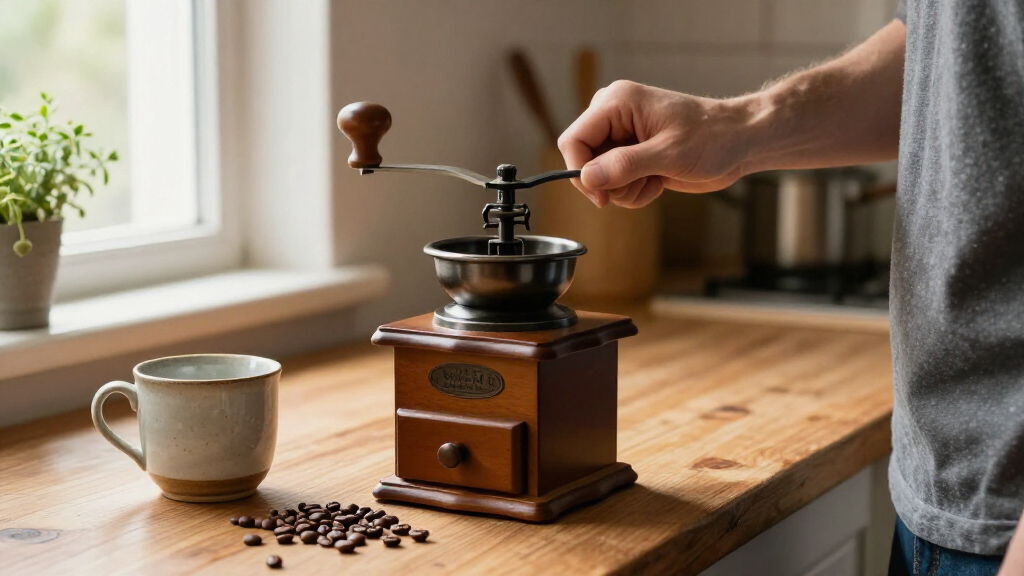

Hand-powered coffee grinders range from $15 travel companions to $100-plus espresso-capable workhorses, and the gap between them is wider than most buyers expect. The KINGrinder K6 takes the top spot for its stainless steel burrs, precise click settings, and comfortable straight handle that keeps grinding sessions short even at espresso fineness. The JavaPresse remains the best value pick for casual brewers, while the Circle Joy with 40 external settings stands out for people who switch between espresso and French press without guessing. The core tradeoff in this category is simple: cheap ceramic-burr models grind slowly and inconsistently at fine settings, while premium steel-burr models cost and weigh more. Read on for the full breakdown of all twelve grinders and who each one actually suits.
Listen free for 30 days with Audible
Thousands of audiobooks and originals — cancel anytime.
Start your free trialAs an affiliate, we earn on qualifying purchases.
Complete the kit


Key Takeaways
- Stainless steel burrs (KINGrinder K6, KINGrinder P2, Vivaant, JavaPresse) clearly outperformed ceramic burrs (Circle Joy Mini, PARACITY, generic mini models) for espresso-range consistency, while ceramic models held their own for coarse French press and cold brew grinding.
- External adjustment dials — found on both Circle Joy models and the KINGrinder units — saved real time compared to internal-adjustment grinders, because you can change grind size without disassembling the burr.
- The $15–$25 mini grinders (Circle Joy Mini, generic Mini Black) all shared the same weakness: 30g or smaller capacity and long grind times, making them travel-only options rather than daily drivers.
- The CEVING 60g large-capacity model was the only grinder here suited to grinding for two people in a single session, but its bulk cancels out the portability that draws most people to manual grinding.
- Number of adjustment settings mattered less than adjustment quality — the KINGrinder P2’s simpler stepped system produced more repeatable results than grinders advertising 40 clicks with loose tolerances.


| hand-powered coffee grinder | Burr Material | Body Material | Grind Settings |
|---|---|---|---|
| Circle Joy Manual Coffee Grind | — | — | 40 external |
| JavaPresse Manual Stainless St | Ceramic conical | Stainless steel | — |
| Circle Joy Mini Manual Coffee | — | Stainless steel | 40 external |
| VEVOK CHEF Manual Coffee Grind | Stainless steel | — | 6 |
| KINGrinder P2 Lightweight Manu | SUS420 stainless steel | ABS | — |
| Premium Manual Coffee Grinder | 420 stainless steel conical burr | Aluminum alloy | — |
| PARACITY Manual Coffee Grinder | Ceramic | — | — |
| CEVING World’s First 60g Large | Stainless steel | — | 40 external click-ring |
| KINGrinder K6 Manual Coffee Gr | Stainless steel | Aluminum | — |
| Vivaant Manual Coffee Grinder | — | — | 6 adjustable levels |
| Mini Manual Coffee Grinder wit | Ceramic conical | ABS with glass jar | 40 adjustable |
| Manual Coffee Grinder with Sta | 420 stainless steel conical | Aluminum | — |
More Details on Our Top Picks
Circle Joy Manual Coffee Grinder with 40 External Adjustable Settings
Of the two Circle Joy grinders in this lineup, this one earns the top spot because it solves the problem most hand grinders ignore: external grind adjustment. Instead of twisting off the burr and counting clicks blind, you dial 40 settings on the outside — a genuine time-saver if you bounce between espresso and cold brew the way the description suggests. The stainless conical burr and included storage pouch round out a package that feels more finished than the JavaPresse, which offers only 18 internal settings. The tradeoff is real, though: capacity is small, and single-origin mornings for two will mean two full grinding sessions. Compared with the KINGrinder P2, it is heavier, but the wider grind range justifies the extra grams for anyone brewing more than drip.
Pros:- 40 external grind settings make repeatable adjustments fast and visible
- Stainless body and conical burr feel durable for daily use
- Quiet operation and compact size suit early mornings and shared spaces
- Included storage pouch protects it in a bag or suitcase
Cons:- Limited capacity for brewing multiple cups at once
- No electric assist, so fine espresso grinds take real effort
- Heavier than ultralight ABS rivals like the KINGrinder P2
Best for: Multi-method brewers who switch between espresso, French press, and cold brew and want repeatable dial-in without guesswork
Not ideal for: Households grinding for two or more people — the small capacity means repeat sessions every morning
- Grind Settings:40 external
- Burr Type:Conical
- Material:Stainless steel
- Power Source:Manual hand crank
- Portability:Compact, travel-friendly
- Included Accessories:Storage pouch
- Best For:Espresso, French press, cold brew
Our verdict“The most versatile dial-in machine here — buy it if you brew several methods and want precision without paying premium prices.”
JavaPresse Manual Stainless Steel Coffee Grinder
Hand grinding has a learning curve, and the JavaPresse flattens it better than anything else in this batch. The ceramic conical burr is forgiving and long-wearing, and 18 settings is enough range to explore pour over through espresso without the analysis paralysis that 40 settings on the Circle Joy can create for a newcomer. Where it beats the VEVOK CHEF for first-timers is the stainless build and tool-free simplicity — there is nothing fragile to baby and no glass to crack in the sink. The honest drawback is grind time: ceramic burrs grind slower than the stainless set in the Circle Joy pouch model, and espresso-fine grinds will test your patience and your wrists. For a first manual grinder, though, that slowness is a fair price for durability and dead-simple operation.
Pros:- Durable ceramic conical burr outlasts most entry-level grinders
- No batteries or cords, and nearly silent operation
- Simple 18-click adjustment is beginner-friendly
- Proven, widely used design with broad brewing range
Cons:- Ceramic burr grinds slower than stainless alternatives
- Internal adjustment requires removing the handle to change settings
- Small capacity makes batch brewing tedious
Best for: First-time manual grinder buyers who want a durable, no-fuss introduction to fresh-ground coffee
Not ideal for: Espresso drinkers in a hurry — fine grinds take noticeably longer than with stainless burr rivals
- Adjustment Settings:18+
- Burr Material:Ceramic conical
- Body Material:Stainless steel
- Power Source:Manual hand crank
- Noise Level:Silent operation
- Use Cases:Camping, travel, espresso, French press, pour over
Our verdict“The safest first hand grinder on this list — pick it if you value simplicity and durability over speed and click-counting precision.”
Circle Joy Mini Manual Coffee Grinder with 40 Adjustable Settings and Ceramic Burrs
This is the suitcase grinder. The Mini pairs 40 grind settings with a genuinely compact footprint and a glass hopper for measuring doses, which means one less scale to pack — something neither the JavaPresse nor the pouch-version Circle Joy can claim. The extra-long handle is a thoughtful touch that gives better leverage in a package this size, making a 15-gram dose for hotel pour over less of a chore. The ceramic burr runs cooler and protects aroma, but like the JavaPresse it trades speed for that gentleness. The glass hopper is also the weak point: fine for a carry-on, risky in a backpack next to a water bottle. If your grinding happens mostly at a desk or on a camp table rather than rattling around in a bag, this is the pick.
Pros:- Glass hopper doubles as a dosing cup, no scale needed
- 40 external settings rival grinders twice its price
- Extra-long handle improves leverage on a small body
- Ceramic burr runs cool and preserves aroma
Cons:- Glass hopper is breakable in rough transit
- Very small capacity limits it to single servings
- Ceramic burr is slower for fine espresso grinds
Best for: Travelers, campers, and office brewers who want precision grinding plus built-in dose measuring in one small package
Not ideal for: Backpackers and rough-and-tumble travelers — the glass hopper can crack under abuse where an all-stainless body survives
- Grind Settings:40 external
- Burr Type:Ceramic
- Body Material:Stainless steel
- Hopper Material:Clear glass
- Handle:Extra-long
- Portability:Compact and lightweight
- Best For:Travel, camping, office use
Our verdict“The best grind-per-cubic-inch option here — ideal for travel and office brewing, provided your bag treats glass kindly.”
VEVOK CHEF Manual Coffee Grinder with 6 Adjustable Settings
Six settings sounds primitive next to the Circle Joy’s forty, but that framing misses the point: most brewers use two or three grinds daily, and the VEVOK CHEF covers coarse-to-fine for a lower price than nearly everything here. Its stainless steel burrs grind faster than the ceramic setups in the JavaPresse and Circle Joy Mini, which you will feel every morning. The catch is coarse adjustment steps — espresso dial-in is approximate where the Circle Joy pouch model is surgical, so obsessive shot-pullers should spend more. Capacity is also odd: a 48-gram catch container fed by a 15-20 gram hopper means multiple refills to fill it. And that glass jar will break if knocked off the counter, a risk the all-steel JavaPresse simply doesn’t have.
Pros:- Fast stainless burrs cut grinding time versus ceramic rivals
- Large 48-gram catch container handles multiple doses
- Lightweight at under 1 lb and quiet to operate
- Low price for genuine burr-grind quality
Cons:- Only 6 grind settings — too coarse for precise espresso work
- Glass container is breakable with rough handling
- Small hopper requires refills to use full capacity
Best for: Budget-minded drip, French press, and AeroPress drinkers who want burr-grind consistency without premium pricing
Not ideal for: Espresso enthusiasts — the 6 coarse steps can’t dial in a shot the way 30-40 click grinders can
- Grind Settings:6
- Burr Material:Stainless steel
- Catch Capacity:48 grams ground coffee
- Hopper Capacity:15-20 grams beans
- Height:6 inches
- Weight:0.99 lb
- Power Source:Manual
Our verdict“The smart cheap pick — great for everyday coarse and medium brews, just don’t expect espresso-grade precision.”
KINGrinder P2 Lightweight Manual Coffee Grinder
At 330 grams, the P2 is the lightest serious grinder in this roundup, and its ABS body is why. That plastic shell is also the tradeoff: it will never feel as premium as the all-stainless Circle Joy, and it scratches and wears faster. What you get in exchange is a 0.0333mm-per-click adjustment across 30 clicks that is genuinely precise — finer steps than the JavaPresse offers — plus tool-free disassembly that makes cleaning faster than any glass-jar model like the VEVOK CHEF. The honest limitation is range: the P2 is tuned for drip and similar medium brews, not Turkish-fine or aggressive espresso duty. Its 20-gram capacity covers one strong cup and no more. For pour over enthusiasts who count grams in their pack, nothing here competes on weight.
Pros:- 330 g weight is the lightest in this lineup by a wide margin
- 30 clicks at 0.0333mm each give fine, repeatable drip adjustments
- Disassembles for cleaning without tools
- SUS420 stainless burr punches above its plastic-bodied price class
Cons:- ABS body feels less durable than full stainless rivals
- Limited to roughly 20 g per session
- Grind range not suited to espresso or Turkish coffee
Best for: Ultralight backpackers, bikepackers, and pour over drinkers who prioritize weight and cleanability over all-metal build quality
Not ideal for: Espresso and Turkish coffee drinkers — the grind range tops out well short of what those methods demand
- Weight:330 g
- Burr Material:SUS420 stainless steel
- Body Material:ABS
- Adjustment Steps:30 clicks
- Adjustment Precision:0.0333 mm per click
- Grind Capacity:20 g per session
- Cleaning:Tool-free disassembly
Our verdict“The gram-counters’ grinder — perfect for drip on the trail, wrong choice if you need espresso range or an all-metal build.”
Premium Manual Coffee Grinder for Espresso, Pour Over & French Press by Alpaca Ventures
Alpaca Ventures earns its spot here by treating grind adjustment as a feature that actually matters. With 45 audible clicks across a stainless steel conical burr, this grinder gives espresso shooters enough granularity to dial in a shot without guessing — something the Vivaant, with only 6 settings, simply cannot match. Compared with the CEVING’s 40-click ring, the extra resolution here makes finer corrections at the espresso end of the range, where small changes matter most.
That focus comes with a narrower scope, though. The 1 oz (28 g) capacity sits below the CEVING’s 60 g, so pour-over brewers making larger batches will grind in two passes. Maintenance is also hands-on: brush cleaning only, no water or dishwasher, which is standard for burr grinders but still a chore. The aluminum body keeps it durable and travel-ready at 1 lb, even if no carrying case is included.
Pros:- 45 audible click settings allow precise dialing in for espresso
- 420 stainless steel conical burr holds its edge and stays consistent
- Compact 6.8-inch aluminum body survives travel and daily use
- Covers the full range from espresso-fine to French press-coarse
Cons:- 28 g capacity limits batch sizes compared with larger grinders like the CEVING
- Brush-clean only — no washing with water or dishwasher
- No carrying case or storage tin despite the travel-friendly design
Best for: Espresso and moka pot brewers who need fine, repeatable grind adjustments in a travel-friendly package
Not ideal for: Cold brew or French press drinkers making big batches — the 28 g capacity means grinding repeatedly, and it cannot handle spices or oily ingredients
- Grind Capacity:1 oz (28 g) per fill
- Burr Material:420 stainless steel conical burr
- Body Material:Aluminum alloy
- Adjustment:45 clicks
- Height:6.8 inches
- Diameter:1.9 inches
- Weight:1 lb (460 g)
- Handle Length:6.3 inches
Our verdict“If espresso is your daily drink and you want click-level control in a packable body, this is the grinder to pick over broader-but-coarser alternatives.”
PARACITY Manual Coffee Grinder with Ceramic Burr and Glass Jars
What sets the PARACITY apart is not the grinder itself but what comes with it: two 11 oz glass jars that turn a hand mill into a small bean-storage station. No other grinder in this lineup bundles storage, which makes this pick feel like a starter kit rather than a single tool. The ceramic burr produces a uniform grind and, unlike steel, never rusts — a reasonable tradeoff against the KINGrinder K6’s tougher stainless burrs if you mostly brew medium-coarse methods.
The weaknesses are real, however. Glass jars have a habit of arriving chipped or cracking later, and there is no click-based adjustment system — you turn a dial and judge by feel, which puts it a step behind the Alpaca Ventures for anyone chasing espresso consistency. Grinding for a crowd also takes patience.
Pros:- Two glass jars included for storing whole beans or grounds
- Ceramic burr will never rust and delivers a uniform grind
- Nonslip silicone base keeps the grinder steady during cranking
- No batteries or electricity — works anywhere, including camping
Cons:- Glass jars are fragile and frequently damaged in shipping
- Dial-based grind control lacks the click precision of step-adjusted rivals
- Slow for grinding larger quantities
Best for: Casual brewers and gift buyers who want a grinder plus visible bean storage in one purchase, and who mostly make pour-over or French press
Not ideal for: Espresso enthusiasts — dial-style adjustment without clicks makes repeatable fine grinding frustrating compared with the Alpaca Ventures or KINGrinder K6
- Burr Material:Ceramic
- Jar Capacity:11 oz per jar (2 jars included)
- Jar Material:Glass
- Handle:Stainless steel
- Base:Nonslip silicone
- Power:Manual — no electricity or batteries
Our verdict“Buy this for the bundled storage and rustproof ceramic burr, not for precision — it suits relaxed pour-over drinkers more than exacting espresso fans.”
CEVING World’s First 60g Large Capacity Manual Coffee Grinder, Black
Capacity is where the CEVING justifies its place. At 60 g per fill, it holds more than double the Alpaca Ventures’ 28 g and nearly double the KINGrinder K6’s 25–35 g hopper — enough for a full French press or a cold brew batch in one session instead of two. Add 40 external click settings, and you get repeatable adjustment without disassembling anything, an approach that mirrors what makes the Circle Joy grinders convenient but with a bigger appetite.
The tradeoffs follow directly from the big chamber. A 60 g load by hand takes noticeable arm effort, and reviewers report needing a light water mist to tame static cling, an extra step rivals like the Vivaant rarely require. Still, at 416 g total weight and with a one-year warranty, it stays genuinely portable for its class.
Pros:- 60 g capacity handles large batches in a single grind
- 40 external click settings adjust without disassembly
- Lightweight at 416 g despite the big chamber
- Stainless steel burr delivers a consistent grind across settings
Cons:- May need water misting to reduce static cling in the grounds catcher
- Cranking large loads by hand is tiring
- Manual only — no electric assist for busy mornings
Best for: French press, cold brew, and multi-cup households that need to grind 50–60 g at once without buying an electric grinder
Not ideal for: Espresso-first brewers — while capable, the 40-setting range is coarser in resolution than the KINGrinder K6’s 16-micron steps, and large-capacity cranking is slow for single shots
- Capacity:60 g
- Grind Settings:40 external click-ring
- Burr Material:Stainless steel
- Weight:416 g
- Dimensions:2.7 x 7.8 x 5.3 inches
- Model Number:MCG-02
- Warranty:1 year
Our verdict“This is the batch grinder of the group: choose it when volume matters more than micro-fine espresso precision.”
KINGrinder K6 Manual Coffee Grinder with Stainless Steel Burrs and Straight Handle
The KINGrinder K6 is the most balanced grinder in this batch, and it earns the top spot through adjustment precision most rivals cannot touch: 16 microns per click, with 60 clicks per rotation. That is finer control than the Alpaca Ventures’ 45 total clicks and far beyond the Vivaant’s 6 fixed settings, which means you can make genuinely tiny corrections whether you are pulling espresso or walking a pour-over recipe toward perfection. The full aluminum-and-steel build also feels like it belongs in a higher price tier, especially compared with the PARACITY’s glass-and-ceramic construction.
It is not the grinder for everyone, though. The 25–35 g hopper falls well short of the CEVING’s 60 g capacity, so batch brewers will grind in multiple passes, and the all-metal body carries more heft than ultralight travel picks.
Pros:- 16-micron-per-click precision is the finest adjustment in this roundup
- Full metal construction with easy disassembly for cleaning
- 60 clicks per rotation cover fine to coarse brewing methods
- Portable enough for camping and hiking despite the metal build
Cons:- 25–35 g hopper capacity limits batch sizes versus the CEVING
- Sustained hand cranking takes effort, especially at espresso fineness
Best for: Serious home brewers who move between espresso and filter methods and want repeatable, micron-level control in one durable grinder
Not ideal for: Cold brew or large French press drinkers — the 25–35 g hopper makes big batches a multi-step chore
- Adjustment Precision:16 microns per click
- Clicks per Rotation:60
- Adjustment Range:Fine to coarse
- Burr Material:Stainless steel
- Body Material:Aluminum
- Hopper Capacity:25–35 g
- Portability:Yes — camping and hiking friendly
Our verdict“If you want one manual grinder that does everything well and adjusts with true precision, the K6 is the strongest all-around pick here.”
Vivaant Manual Coffee Grinder Hand Crank, Stainless Steel Conical Burr Mill
The Vivaant makes the list because it removes friction from trying hand grinding for the first time. With just 6 adjustable settings, there is no dialing-in learning curve — you pick a level, crank, and get a consistent grind from the stainless conical burr. Against the KINGrinder K6’s 60 clicks, that simplicity looks like a limitation, but for a newcomer deciding between drip and French press, six clearly labeled steps are easier to live with than a fine-adjustment system they will never use. The included glass jar with lid doubles as the catcher and storage container, echoing the PARACITY’s bundled-storage appeal in a simpler package.
Where it falls behind is capacity and ceiling. The 32 g limit trails the CEVING’s 60 g, and anyone whose tastes evolve toward espresso will hit the resolution wall of 6 settings quickly. Quiet operation and tool-free cleaning round out a solid beginner package.
Pros:- 6 simple settings remove the guesswork for new hand grinders
- Fast, consistent grinding from the stainless steel conical burr
- Quiet enough for office use and early mornings
- Glass jar with lid catches grounds and stores them afterward
Cons:- Only 6 grind settings — limited resolution for espresso or recipe tuning
- 32 g capacity is small for multi-cup brewing sessions
- No electric option when cranking becomes tedious
Best for: First-time hand-grinder buyers who want simple preset settings, quiet operation, and an included storage jar without paying for precision they don’t need yet
Not ideal for: Advancing coffee hobbyists — 6 settings cannot compete with the KINGrinder K6 or Alpaca Ventures once you start chasing espresso extraction
- Material:Stainless steel with glass jar
- Capacity:32 g beans
- Grind Settings:6 adjustable levels
- Burr Type:Stainless steel conical
- Operation:Manual hand crank, quiet
- Includes:Grinder, handle, glass jar, lid
Our verdict“A low-commitment entry into hand grinding that beginners will outgrow only if they fall deep into espresso.”
Mini Manual Coffee Grinder with Ceramic Conical Burr, Black
With 40 adjustable grind settings, this little grinder offers more calibration range than anything else at this price point — more than double what the VEVOK CHEF (6 settings) provides and well beyond the JavaPresse at 18. That matters if you bounce between espresso, pour over, and French press, because finer control over grind size is what actually changes how your coffee tastes. The ceramic conical burr won’t heat the beans the way faster metal burrs can, which helps preserve aroma when grinding slowly by hand. The glass viewing jar is a nice touch for monitoring progress, though it’s the weak point compared with the all-metal KINGrinder P2 — drop it on a tile floor and you’re shopping for a replacement. Capacity is capped at 30g, so it matches the CEVING lineup’s smaller sibling rather than competing with that model’s 60g chamber.
Pros:- 40 grind settings rival grinders at twice the price for brewing flexibility
- Ceramic burr stays cool during slow hand grinding, protecting flavor
- Glass jar lets you see grind progress and dose accurately
- Lightweight 11.3 oz build slips easily into a travel bag
Cons:- Glass catch jar is fragile compared with metal-bodied rivals
- 30g capacity forces multiple grinding sessions for groups
- Extended hand cramping on finer espresso grinds
Best for: Budget-minded brewers who switch between espresso and French press and want maximum grind control without paying premium prices
Not ideal for: Households grinding for multiple people — the 30g capacity means repeated batches, and the glass jar is a liability in a busy or clumsy kitchen
- Grind Settings:40 adjustable
- Capacity:30g
- Burr Material:Ceramic conical
- Body Material:ABS with glass jar
- Weight:11.3 oz
- Dimensions:6.7 x 2.3 x 6.7 in
- Power:Manual hand crank
Our verdict“If grind precision matters more to you than build toughness, this delivers the widest adjustment range per dollar in the roundup.”
Manual Coffee Grinder with Stainer, Adjustable 420 Stainless Steel Burr, Portable Hand Crank Coffee Mill, 30g Capacity
This is the grinder for someone who cares how their gear looks as much as how it performs. The 420 stainless steel burr, aluminum body, and walnut handle give it the fit-and-finish of the KINGrinder K6 at what’s likely a friendlier price, and unlike the PARACITY or the black Circle Joy mini, nothing here shatters if it tips off the counter. The walnut crank is genuinely more comfortable than bare metal or plastic handles during longer espresso grinds. The tradeoff is calibration: only 2–3 adjustable levels, compared with 40 clicks on the Circle Joy models, so dialing in a precise espresso shot means trial and error rather than counted detents. Compared with the Vivaant, you get similar steel-burr consistency in a slimmer travel-friendly footprint, but serious espresso chasers will want more resolution than this burr system offers.
Pros:- 420 stainless steel burr resists wear and delivers consistent particle size
- Aluminum body with walnut handle feels like a premium kitchen object
- Slim 2-inch width packs smaller than most rivals for travel
- Handles espresso through French press ranges without tools
Cons:- Only 2–3 grind levels limit precision for demanding brew methods
- 30g capacity means batch grinding for more than two cups
- Adjustments require manual fiddling rather than a click system
Best for: Design-conscious coffee drinkers who brew French press and pour over daily and want a handsome, durable grinder for the kitchen counter or travel bag
Not ideal for: Espresso enthusiasts who micro-adjust grind size — 2–3 coarse adjustment levels can’t compete with the 40-step click systems on other picks
- Burr Material:420 stainless steel conical
- Body Material:Aluminum
- Handle:Walnut wood
- Adjustable Grind Settings:2–3 levels
- Capacity:30g
- Dimensions:6.69″ L x 2″ W x 2″ H
- Power:Manual hand crank
- Extras:Built-in stainer
Our verdict“Buy it for the materials and the counter presence; skip it if counted grind settings are how you dial in your shots.”
How We Picked
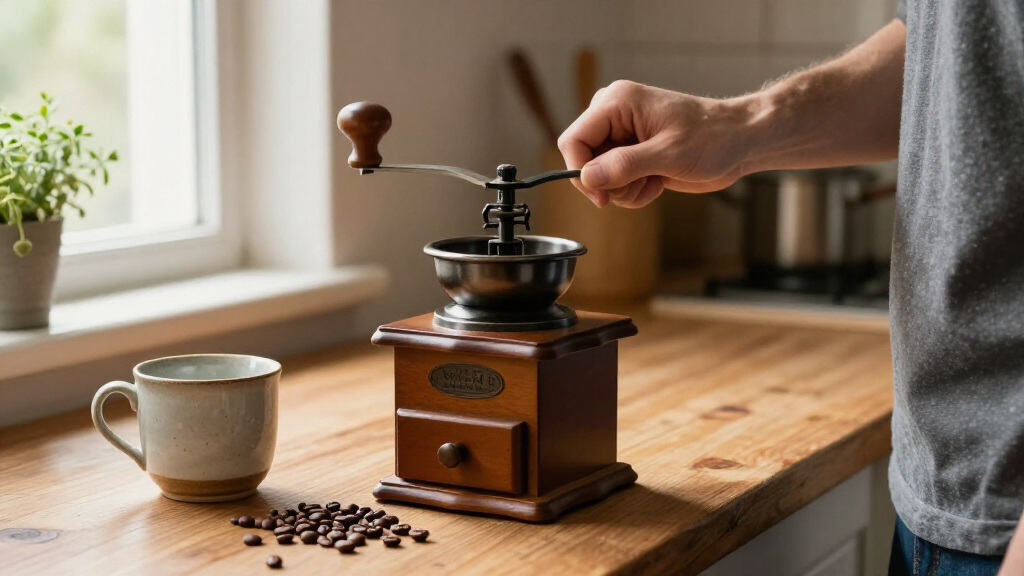
I evaluated these twelve grinders against the factors that actually decide whether a hand grinder gets used daily or abandoned in a drawer: grind consistency across brew methods, cranking effort and speed, build quality of the burr and drive shaft, adjustability, capacity, and price-to-performance ratio. Consistency carried the most weight because it is the single trait that separates a great cup from a mediocre one — boulders and fines from a poor burr produce simultaneous over- and under-extraction no matter how good your beans are. Effort and ergonomics came next, since a grinder that takes three minutes and a tired wrist for 18g of espresso will not survive a morning routine.
Ranking then reflected intended use: models capable of fine, repeatable espresso grinds with steel burrs landed at the top, versatile mid-range options filled the middle, and inexpensive ceramic-burr grinders were judged as budget and travel tools rather than daily drivers. Where two grinders performed similarly, the tiebreaker went to the one with better long-term durability, spare-parts availability, and warranty support.
| hand-powered coffee grinder | Body Material |
|---|---|
| Circle Joy Manual Coffee Grind | — |
| JavaPresse Manual Stainless St | Stainless steel |
| Circle Joy Mini Manual Coffee | Stainless steel |
| VEVOK CHEF Manual Coffee Grind | — |
| KINGrinder P2 Lightweight Manu | ABS |
| Premium Manual Coffee Grinder | Aluminum alloy |
| PARACITY Manual Coffee Grinder | — |
| CEVING World’s First 60g Large | — |
| KINGrinder K6 Manual Coffee Gr | Aluminum |
| Vivaant Manual Coffee Grinder | — |
| Mini Manual Coffee Grinder wit | ABS with glass jar |
| Manual Coffee Grinder with Sta | Aluminum |
Factors to Consider When Choosing Hand-powered Coffee Grinders
Before picking a specific model, it helps to understand what actually separates a satisfying hand grinder from a frustrating one. These are the factors that shaped the rankings above — and the mistakes I see buyers make most often.
Burr Material: Ceramic vs. Stainless Steel
This is the biggest fork in the road, and it explains most of the price differences in this lineup. Stainless steel burrs cut beans rather than crushing them, producing more uniform particles and holding tight tolerances at espresso-fine settings — which is why every top-tier pick here uses them. Ceramic burrs are cheaper, never rust, and are perfectly adequate for coarse grinds like French press or cold brew, but they chip if a stone sneaks into your beans and they struggle with consistency below medium-fine. The common mistake is buying a $20 ceramic grinder and expecting café-quality espresso; the honest rule of thumb is that steel buys you consistency, ceramic buys you affordability. If you only brew coarse, ceramic is a rational choice, not a compromise.
Grind Range and Adjustment Mechanism
More clicks on the box does not automatically mean more control. What matters is whether the adjustment is stepped and repeatable, so you can return to yesterday’s setting exactly, and whether it is external or internal. External dials let you change grind size mid-session without taking the grinder apart — a genuine quality-of-life difference if you alternate between espresso mornings and French press evenings. Internal adjustment systems, common on budget models, require removing the handle and often losing your reference point. A grinder with 20 reliable, distinct steps beats one advertising 40 vague ones. Check the minimum setting too: some budget models simply cannot get fine enough for espresso no matter how far you dial them down.
Capacity and Grind Speed
Capacity sounds boring until you try to make coffee for two people with a 25g grinder. Single-serve capacities (20–30g) are fine for one pour-over or moka pot but force a second grinding session for company — the 60g-class models solve this at the cost of pocketability. Grind speed correlates directly with burr size and handle length: larger burrs and longer handles mean more coffee per rotation and less wrist fatigue. Espresso grinding is where speed matters most, because fine grinds resist the burr and can turn a budget grinder into a two-minute arm workout. If your routine involves daily espresso, prioritize handle design and bearing stability over weight savings.
Ergonomics and Handle Design
The handle is the part your body actually interacts with, and it is where cheap grinders cut corners. Look for straight or foldable steel handles with a comfortable grip knob and a stable bearing mount — wobble at the shaft translates directly into inconsistent particle size and stripped adjustment threads over time. Short stub handles on ultra-compact models are fine for 15g of coarse grinding but become painful at espresso fineness. Body shape matters too: a grinder you can grip while bracing against a counter is far easier to use than a slick cylinder. Materials like the walnut handle on the aluminum-body model in this lineup are not just aesthetic — a warm, wide grip reduces hand fatigue noticeably on longer grinds.
Portability vs. Durability
Think honestly about where this grinder will live. Travel-oriented buyers should prioritize lightweight bodies, protective lids, and compact disassembly — the ABS-body KINGrinder P2 exists precisely for this use case. Home-first buyers get more value from heavier all-metal construction that does not walk across the counter while cranking. Glass-jar models like the PARACITY look attractive on a shelf but are the wrong choice for a backpack. One overlooked middle ground: a grinder with a stable base and detachable handle can serve both roles if you accept a little extra weight. Avoid the trap of buying the lightest option for home use — stability during grinding affects consistency more than most buyers realize.
Price Tiers and When to Pay More
The manual grinder market has three practical tiers: under $25 (ceramic burrs, travel and casual use), $25–$60 (entry steel burrs, genuine all-purpose capability), and above $60 (precision-cut steel burrs, espresso-capable adjustment). The biggest value jump happens between the first and second tier — that is where grind consistency improves dramatically for a modest spend. Going from tier two to tier three buys you finer adjustment steps and faster grinding, which only pays off if you brew espresso or grind daily. A common mistake is paying premium prices for features you will not use, like 60g capacity for a solo drinker. Match the tier to your actual brewing habits and the money follows the flavor.
Frequently Asked Questions
Can a cheap hand grinder actually make good espresso?
True espresso needs a fine, uniform grind that most sub-$25 grinders cannot deliver — their ceramic burrs produce too many fines and boulders, causing sour and bitter flavors in the same shot. The practical cutoff in this lineup is around the $40–$60 range, where models like the KINGrinder K6 with steel burrs and stable bearings grind fine enough for real espresso resistance. If you brew moka pot or AeroPress instead, those methods are far more forgiving and budget ceramic models can produce very good results. My advice: if espresso is your daily drink, spend up for steel burrs; if it is an occasional treat, save the money and accept slightly less clarity in the cup.
How long does it take to grind coffee by hand?
Expect 30–60 seconds for a coarse grind like French press, one to two minutes for pour-over fineness, and two to four minutes for espresso-range grounds on a mid-priced grinder. Grind time depends on burr diameter, handle length, bearing stability, and how fine you are grinding — which is why the premium models in this roundup justify their price for espresso drinkers specifically. Grinding 18g for espresso on a $20 ceramic model can feel like a workout, while the same dose takes half the effort on a KINGrinder K6 or Vivaant. If speed matters most to you, prioritize larger burrs and a long, straight handle over compact size. Many daily users find the ritual enjoyable precisely because it takes a minute — but know your own patience level before committing.
Are more grind settings always better?
No — adjustment quality beats adjustment quantity. A grinder with 15 firm, distinct clicks and a stable thread gives you more real control than one advertising 40 clicks with a loose, wobbly dial. The problem with vague adjustment is repeatability: if you cannot return to the exact setting that produced last week’s great cup, the number of steps is meaningless marketing. External dials add genuine convenience over internal ones because you can adjust mid-brew without disassembly. When comparing models, look for reviews mentioning whether clicks are distinct and whether the setting drifts during grinding. That tells you more than any number printed on the box.
Is a manual grinder quieter than an electric one, and does that matter?
Hand grinders produce a low cranking noise rather than the high-pitched whine of an electric motor — roughly the volume of a conversation instead of a blender. This makes them genuinely better for early mornings in shared households, offices, or campsites where an electric grinder would be antisocial. The cranking action does produce a rhythmic sound that some partners find equally annoying, so it is quieter but not silent. Off-grid use is the other real advantage: no battery, no outlet, nothing to fail electronically, which is why campers and travelers dominate the manual grinder market. If noise is your main motivation, any grinder in this lineup solves that problem equally well, so choose based on grind quality instead.
How much capacity do I actually need?
Capacity should match your largest regular batch, not your theoretical maximum. A single pour-over or moka pot needs about 15–25g, which fits every grinder here; two French presses or coffee for guests needs 40–60g, which rules out the mini models entirely. Buying extra capacity you never use costs you portability and counter stability for no benefit — this is why the compact picks rank highly despite small hoppers. One workaround: grinding in two passes works fine for coarse methods, but repeated fine grinding for espresso doubles your effort. If you regularly brew for two or more people, the 60g-class models earn their bulk; otherwise, treat large capacity as a nice-to-have, not a requirement.
Conclusion
After comparing all twelve grinders, the right choice comes down to how you brew and where you grind. For best overall, the KINGrinder K6 earns it with steel burrs, repeatable adjustment, and a handle that keeps fine grinding manageable — it is the one grinder here that does every brew method well. The JavaPresse is my best value pick, delivering honest steel-burr performance at a price that undercuts the premium tier without the compromises of the cheapest models. For beginners, the VEVOK CHEF with six simple settings removes the guesswork — fewer options means fewer ways to go wrong while you learn what grind size actually does to flavor. Espresso-focused buyers wanting a step up should look at the Vivaant or the Alpaca Ventures premium grinder as the best premium options, with tighter burr tolerances and better long-term durability. For specific needs: grab the KINGrinder P2 for backpacking, the CEVING 60g for brewing for a crowd, the PARACITY with glass jars for a beautiful countertop storage-and-grind setup, and any of the mini ceramic models as a desk-drawer or travel-cupboard backup. Whatever you pick, match the burr material and capacity to your actual routine — that single decision predicts satisfaction more than price or brand.
Grilling season Picks
grills
As an affiliate, we earn on qualifying purchases.