
TL;DR

Get kitchen gear delivered free with Prime
- Fast, free delivery on millions of items
- Prime Video, Amazon Music and more included
- Member-only deals all year
A Veranda writer says cape plumbago has begun producing blooms and new growth in her front-door containers after planting this spring. The South African shrub is presented as a low-maintenance option for sunny, warm locations, but the writer’s early results do not establish that it is foolproof or suitable for every climate.
A Veranda writer says her newly planted cape plumbago has begun producing fresh flowers and shoots in front-door containers, offering an early test of the South African shrub as a sun-loving, relatively low-maintenance choice for warm-climate gardens. The results are preliminary: she planted it only a few weeks earlier and has not yet seen how it will perform through summer or into fall.
The writer, a beginner gardener, chose Plumbago auriculata after looking for a flowering plant that could handle heat and sun without frequent watering. She describes the shrub as deer-resistant and versatile, with clusters of blue flowers that attract pollinators. It can grow as a rambling shrub, be trained as a climber or be kept in a container, according to the report.
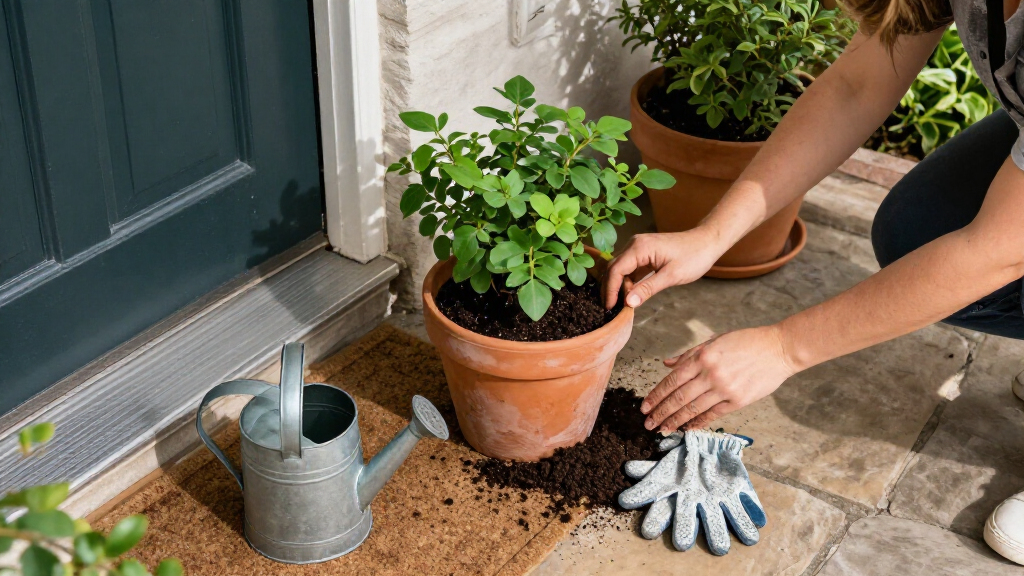
For her planting, she bought two one-gallon plants and four pint-sized plants, along with potting mix. She removed some old soil and previous plant material from her pots, loosened the plants’ roots, and set them into holes about twice the size of each root ball. She backfilled with potting mix and applied a balanced slow-release fertilizer near the plants, taking care not to put it directly against their stems.
After several weeks, she observed new blooms almost daily and shoots beginning to rise and spill over the containers. Steady local rain meant she had used a garden hose only once. The article says plumbago is generally watered one or two times a week depending on how dry the soil surface is; that is guidance, not a record of the writer’s watering schedule under different weather conditions.
A Container Option for Sunny Entrances
Cape plumbago may interest people seeking color at an entryway without a plant that needs constant attention. Its ability to grow in containers and its reported tolerance of heat make it a potential fit for sunny porches in suitable climates. Its flowers also provide a garden feature that the report says is attractive to pollinators.
The account is useful as an early, practical example, but it is not a controlled comparison or proof that the plant is maintenance-free. Rainfall, container size, local temperatures, soil and exposure can all affect watering and growth. Readers should treat the writer’s early success as an encouraging observation rather than a guarantee that plumbago will thrive without care.
Products Worth Considering

Vitamix 5200 Professional-Grade Blender, 64 oz. Container, Black

Traeger Woodridge Pro Wood Pellet Grill and Smoker, 970 sq. in.

Traeger Westwood Wood Pellet Grill and Smoker, 653 sq. in., WiFIRE
As an affiliate, we earn on qualifying purchases.
Warm-Climate Growing Conditions
The report says cape plumbago is suited to USDA hardiness zones 8–11 and may tolerate winter temperatures that dip to roughly 20–25 degrees Fahrenheit. Those figures do not mean every plant will withstand those temperatures in every setting; local conditions and protection can influence how a container plant fares. A potted plant may also be more exposed to cold than one growing in the ground.
The author’s planting followed a casual discussion with coworkers and her own research. She selected plumbago for its sun and heat tolerance and its relatively modest water needs. At the time she wrote, she planned to monitor the pots through summer, considering additional fertilizer or pruning if needed. She had also bought obelisks for the plants to climb, anticipating that they could eventually reach at least six feet, the potential size cited in the article.
Summer Growth Has Yet to Be Tested
The report covers only the first few weeks after planting. It does not establish whether the containers will keep flowering through fall, reach the cited potential height, or require further fertilizer and pruning. The writer says she will monitor the plants as the season continues.
Her watering experience also reflects a rainy stretch in her location. The article does not give a specific rainfall total, a soil-moisture measurement or a comparison with other plants. The exact care needed will vary by climate and growing conditions, so the label “foolproof” in the original headline should not be taken as a tested horticultural finding.
The Writer Will Track the Season
The writer plans to watch the containers through summer and decide whether they need more fertilizer or pruning to encourage growth. She hopes the plants will continue flowering into fall and is preparing to train their upward growth on obelisks. Those outcomes have not yet been reported.
For readers considering the shrub, the immediate next step is to check whether local conditions suit a plant described as best for zones 8–11, then monitor soil moisture rather than relying on a fixed watering schedule. The writer’s account will be a more complete test once she reports on the plants’ performance later in the growing season.
Key Questions
What is cape plumbago?
Cape plumbago, or Plumbago auriculata, is a flowering shrub native to South Africa. The report describes it as a plant with blue flower clusters that can grow in containers, as a shrub or with climbing support.
How often should cape plumbago be watered?
The article gives a general guideline of one or two waterings a week, adjusted according to how dry the soil is at the top. The writer used her hose only once over several weeks because her area had steady rain, so that experience is not a schedule for drier conditions.
Can cape plumbago grow in a pot by a front door?
Yes. The writer planted cape plumbago in front-door containers and observed new blooms and shoots after a few weeks. That is an early personal report, not a guarantee of the same results in other locations or containers.
Is cape plumbago hardy in cold weather?
The report says it thrives in USDA zones 8–11 and can tolerate temperatures around 20–25 degrees Fahrenheit. Cold tolerance may vary with local conditions, and the article does not report how the writer’s potted plants will fare over winter.
Has the writer proved that plumbago is foolproof?
No. She reports promising early flowering and growth, but the plants had been in place for only a few weeks. Their performance through summer and fall, and the care they will need, remain unknown.
Source: veranda.com