
TL;DR

Get kitchen gear delivered free with Prime
- Fast, free delivery on millions of items
- Prime Video, Amazon Music and more included
- Member-only deals all year
Knife maintenance for off-grid living means keeping the blade clean, fully dry, lightly protected, and sharp enough to cut without excess force. Inspect the whole knife, touch up the edge with controlled strokes, and store it dry; a small stone, cloth, brush, and food-safe mineral oil can cover much routine care.
Inspect the blade, handle, pivot, lock, fasteners, and sheath, not just the edge.
Wash or wipe after food, sap, soil, salt, or acid; dry the whole knife before storage.
Touch up when cutting takes more force or stops feeling clean, using light, consistent strokes.
Use a food-safe protective oil sparingly on food knives, and match handle and sheath care to their materials.
Do not pry, twist, or strike with a knife that was not designed for those jobs; stop using damaged tools.
Keep your knife ready for off-grid work
A clean, dry, well-maintained knife cuts with better control. A simple routine and a few compact tools can keep it dependable without powered equipment.
Build a simple care routine
Follow the same sequence after each job, adapting it to what the knife touched.
Check the edge, tip, handle, fasteners, pivot, lock, and sheath for damage or looseness.
Remove food, sap, soil, salt, or acid, then dry the blade and joints fully.
Use light, consistent strokes when cutting takes more force or stops feeling clean.
Apply a thin food-safe oil film when appropriate and store the knife dry and secured.
Choose steel for your setting
Corrosion resistance buys time, but every knife still needs suitable care.
| Knife or steel | Useful strength | Care tradeoff |
|---|---|---|
| Stainless steel | Better corrosion resistance | Clean and dry after salt, acid, or moisture |
| Carbon steel | Often easy to sharpen to a keen edge | Needs prompt drying and more frequent protection |
| Folding knife | Compact for carry and small chores | Pivot and lock need inspection and cleaning |
| Fixed blade | Simple construction for kitchen or camp use | Handle and sheath materials shape care |
Keep the edge working
Routine touch-ups usually take less work and remove less steel than correcting a badly dull edge.
Start with the basics
A small stone, cloth, brush, and food-safe mineral oil cover much routine care.
Use controlled strokes
Match the existing bevel, work steadily, and finish by removing the burr.
Respect the knife’s limits
Do not pry, twist, or strike with a knife not designed for those jobs.
Build a six-step routine that keeps your knife ready
Knife maintenance for off-grid living works best as a short routine: inspect, clean, dry, touch up, protect, and store. The order matters. Inspection catches a loose handle or damaged lock before you put force on the knife; cleaning removes substances that can corrode steel or contaminate food; drying prevents leftover moisture from lingering in joints and sheaths. Touching up and protecting the blade preserve useful performance, while dry storage keeps the care you just took from being undone. After you slice onions for supper or trim twine by the woodpile, a minute spent on care can prevent a small problem from becoming a repair or a risky cut later.- Inspect the edge, tip, handle, fasteners, pivot, and sheath for damage or looseness. A blade can be sharp and still be unsafe if its handle or lock is failing.
- Clean away food, sap, soil, and other residue with a cloth or brush and suitable washing. Grit can scratch a blade or jam a folding pivot, while food residue can dry onto the edge.
- Dry the entire knife, including around a folding knife’s pivot and handle joints. Water trapped out of sight can cause corrosion even when the blade faces look clean.
- Touch up the edge with light, controlled strokes when it starts to cut poorly. Restoring an edge early usually takes less work and removes less steel than correcting a badly dulled one.
- Protect the blade with a thin food-safe mineral oil film when appropriate. A light coat helps during storage without transferring a greasy layer to food or a cutting board.
- Store it somewhere dry, secured, and accessible to responsible users. Storage is part of maintenance: a damp drawer or sheath can undo careful drying.
Products Worth Considering

Vitamix 5200 Professional-Grade Blender, 64 oz. Container, Black

Instant Pot Vortex Plus 6-Quart Air Fryer

KitchenAid Artisan 5-Quart Tilt-Head Stand Mixer, Almond Cream
As an affiliate, we earn on qualifying purchases.
Choose steel and a knife that suit your daily work
The right knife is the one whose shape, steel, and construction fit your work and the care you can provide. Stainless steels usually resist corrosion better, which can be useful when a knife is shared or the kitchen is damp. Carbon steels are often straightforward to sharpen and can take a keen edge, but they ask for more attention after wet or acidic work. Neither label tells the whole story: heat treatment, blade geometry, and intended use affect how an edge performs and how easily it can be maintained. Judge the complete knife rather than buying on a steel name alone.| Choice | Useful strength | Care tradeoff |
|---|---|---|
| Stainless steel | Better resistance to corrosion in damp or busy kitchens | Can still stain or rust after salt, acid, or prolonged moisture |
| Carbon steel | Often easy to sharpen and maintain a keen working edge | Needs prompt drying and more frequent protection |
| Folding knife | Compact for carry and small chores | Pivot and lock need inspection and cleaning |
| Fixed blade | Simple construction for steady kitchen or camp use | Handle and sheath materials affect cleaning and storage |
Clean and dry the blade before moisture settles in
Cleaning and drying promptly is the simplest way to reduce corrosion and keep a knife hygienic. Residue matters because it can hold moisture against the steel, and salt or acidic juices can make corrosion more likely. Remove food, sap, soil, and damp residue after the task, then dry the blade completely, including around the handle and any folding pivot. Stainless steel resists rust better than many carbon steels, but that resistance is a buffer against neglect, not a substitute for cleaning. If you cut tomatoes at lunch, rinse or wipe the blade soon after rather than leaving red juice to dry near the edge. Acidic residue left in place can mark steel and make later cleaning harder. After a muddy garden chore, brush off grit before washing so you do not drag particles across the blade. Use a cloth for the broad faces and take care around the edge; a brush can help clear a folding knife’s pivot without putting fingers near the cutting edge. For a folding knife, clean only as its maker recommends: forcing water or cleaner into an assembly that does not drain well can leave moisture trapped inside. Dry the knife before it goes into its sheath. Leather can hold moisture against steel, so a wet sheath and blade make poor storage partners. Wooden handles also need sensible care: avoid soaking them, since swelling and repeated drying can loosen or damage the finish. Use products suited to each material rather than treating the whole knife as bare steel. If your knife has manufacturer care instructions, follow them, especially for special coatings, handle materials, or locking mechanisms.Sharpen with light strokes before the edge gets badly dull
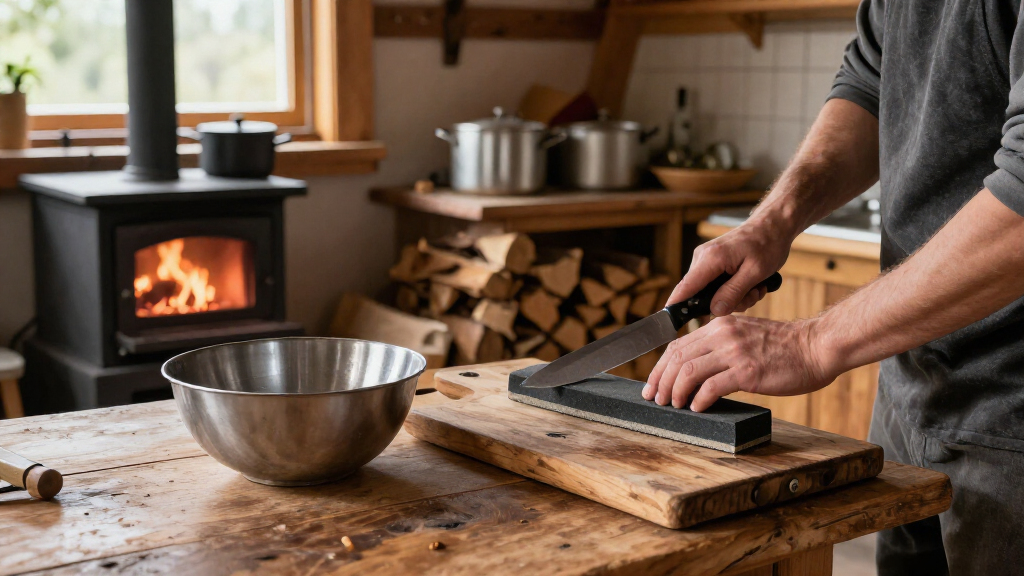
A knife is ready for a touch-up when it needs more pressure or stops cutting cleanly; you do not need to wait for a fixed calendar date. Cutting poorly often tempts you to push harder, which reduces control and can make a slip more likely. Routine sharpening removes metal, so light, controlled maintenance preserves more blade than aggressive grinding. A small whetstone, ceramic rod, or suitable field sharpener can handle many ordinary edge corrections when you use it steadily; the tradeoff is that stones offer more control but require practice, while some quick tools are easier to use but remove steel less gently.- Set up securely: place a stone on a stable surface where it cannot slide. If the sharpener shifts, your attention goes to controlling it instead of controlling the edge.
- Match the bevel: follow the angle already on the knife as closely as you can. Changing the angle unnecessarily can make the edge harder to maintain and may remove more material than needed.
- Use light strokes: work both sides as appropriate for the edge and the sharpener. Pressure can feel productive, but it makes it easier to round the bevel or create an uneven edge.
- Remove the burr: finish with gentle alternating strokes or a suitable strop. A small burr is raised metal from sharpening; leaving it can make an edge feel sharp briefly but perform inconsistently.
- Check safely: make a controlled cut in paper or a small piece of food; never run a finger along the edge.