
Editorial update log
November 19, 2026:
Deal update: RoundupForge price history now flags ASIN B0018VL3JW on amazon.com as below its typical tracked range. RF labels the deal as typical.
Exact pricing remains intentionally gated through the live Grimfaste price module in the article.
Among handheld knife sharpeners, I’d put the Work Sharp Guided Field Knife Sharpener first for its guided, versatile approach, while the Wüsthof Two-Stage Handheld Sharpener is a straightforward kitchen pick and the Smith’s DCS4 suits portable touch-ups. The main tradeoff is between fast, simple sharpening and the greater control or broader knife compatibility offered by more involved designs. Some models focus on kitchen knives, while others add scissor, serrated-knife, or field-tool support. My ranking weighs ease of use, sharpening control, versatility, and practical drawbacks. Read on for the full breakdown and help matching a sharpener to your knives.

Get kitchen gear delivered free with Prime
- Fast, free delivery on millions of items
- Prime Video, Amazon Music and more included
- Member-only deals all year
Complete the kit


Key Takeaways
- The Work Sharp Guided Field Knife Sharpener leads for versatility: its guided format makes it a stronger all-around choice than compact touch-up tools, though it is less of a simple kitchen-drawer solution.
- Kitchen-focused sharpeners are easier to choose than they are to interchange: the Wüsthof and Henckels options suit routine kitchen use, but neither should be assumed to handle every blade style.
- Angle control is a meaningful separator: the Sharp Pebble’s adjustable-angle design offers more input for users who care about sharpening geometry, while basic pull-through models favor simplicity.
- Extra blade compatibility often comes with compromises: combo sharpeners from Smith’s, AccuSharp, and Linatikou add scissor or serrated-blade support, but buyers should check which stages suit their specific blades.
- Portability and kitchen convenience point to different picks: the Smith’s DCS4 and Work Sharp Pivot suit compact kits, while larger multi-stage designs make more sense for a set place in the kitchen.
| Smith’s DCS4 4-Inch Diamond Combination Sharpener |  | Best Compact Field Sharpener | Brand: Smith’s | Model: DCS4 | Stone length: 4 inches | VIEW LATEST PRICE | See Our Full Breakdown |
| Work Sharp Guided Field Knife Sharpener |  | Best for Guided Field Sharpening | Brand: Work Sharp | Model: WSGFS221 | Sharpening stages: 5 | VIEW LATEST PRICE | See Our Full Breakdown |
| Smith’s JIFF-S Knife and Scissors Sharpener |  | Best for Knives and Scissors | Brand: Smith’s | Model: JIFF-S | Knife sharpening blades: Two crossed, reversible, replaceable carbide blades | VIEW LATEST PRICE | See Our Full Breakdown |
| Wüsthof Two-Stage Handheld Knife Sharpener, Black |  | Best for a Stable Countertop Setup | Brand: Wüsthof | Type: Two-stage handheld knife sharpener | Sharpening stages: Carbide abrasive wheels and ceramic slats | VIEW LATEST PRICE | See Our Full Breakdown |
| Henckels Handheld Knife Sharpener | 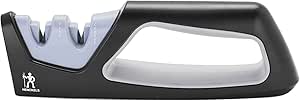 | Best for Left- or Right-Handed Use | Brand: Henckels | Type: Manual pull-through handheld knife sharpener | Sharpening stages: 2 | VIEW LATEST PRICE | See Our Full Breakdown |
| KITCHELLENCE 3-Stage Kitchen Knife Sharpener with Cut-Resistant Glove |  | Best for Guided Kitchen Maintenance | Brand: KITCHELLENCE | Model: KS37 P | Stages: 3 | VIEW LATEST PRICE | See Our Full Breakdown |
| Sharp Pebble 3-Stage Adjustable Angle Knife Sharpener |  | Best for Adjustable Angles | Brand: Sharp Pebble | Sharpening stages: 3 | Adjustable angles: 12°, 15°, 18°, 21°, 24° | VIEW LATEST PRICE | See Our Full Breakdown |
| AccuSharp Knife and Tool Sharpener, Blaze Orange |  | Best for Straight and Serrated Blades | Brand: AccuSharp | Model: 014 | Blade material: Tungsten carbide | VIEW LATEST PRICE | See Our Full Breakdown |
| AccuSharp Gourmet 15-Degree Handheld Knife Sharpener |  | Best for 15-Degree Gourmet Knives | Brand: AccuSharp | Model: AS129C | Knife angle: 15 degrees | VIEW LATEST PRICE | See Our Full Breakdown |
| AccuSharp Knife and Scissor Sharpener Combo |  | Best for Mixed Kitchen and Yard Tools | Brand: AccuSharp | Model: AS12-BRK | Included components: Knife sharpener and scissor sharpener | VIEW LATEST PRICE | See Our Full Breakdown |
| AccuSharp Handheld Carbide Knife Sharpener, 2-Pack, White |  | Best Two-Pack for Everyday Kitchens | Brand: AccuSharp | Model: 066C | Quantity: 2 | VIEW LATEST PRICE | See Our Full Breakdown |
| Linatikou 4-Stage Manual Knife and Scissor Sharpener |  | Best for Kitchen Knives and Scissors | Brand: Linatikou | Sharpening stages: 4 | Sharpening materials: Tungsten carbide, diamond, and ceramic | VIEW LATEST PRICE | See Our Full Breakdown |
| AccuSharp Knife Sharpener for Straight and Serrated Knives, White |  | Best for Fast, Simple Edge Restoration | Brand: AccuSharp | Model: ACCU-001C | Blade material: Diamond-honed tungsten carbide | VIEW LATEST PRICE | See Our Full Breakdown |
| Smith’s CCKS 2-Step Knife Sharpener |  | Best Compact Pick for Outdoor Carry | Brand: Smith’s | Model: CCKS | Sharpening stages: 2 | VIEW LATEST PRICE | See Our Full Breakdown |
| Work Sharp Pivot Portable Knife Sharpener |  | Best Compact Sharpener for Curved Blades and Field Tools | Brand: Work Sharp | Model: WSEDCPVT | Material: Carbide | VIEW LATEST PRICE | See Our Full Breakdown |
| handheld knife sharpener | Brand | Dimensions | Model | Weight |
|---|---|---|---|---|
| Smith’s DCS4 4-Inch Diamond Co | Smith’s | — | DCS4 | — |
| Work Sharp Guided Field Knife | Work Sharp | 9.53 × 5.42 × 1.12 in | WSGFS221 | 135 g (4.6 oz) |
| Smith’s JIFF-S Knife and Sciss | Smith’s | — | JIFF-S | — |
| Wüsthof Two-Stage Handheld Kni | Wüsthof | 9 × 1 × 1 in | — | 238 g |
| Henckels Handheld Knife Sharpe | Henckels | 8.5 × 7.7 × 2 in | — | 8 ounces |
| KITCHELLENCE 3-Stage Kitchen K | KITCHELLENCE | 8.3 × 2.2 × 3.4 in | KS37 P | 180 g |
| Sharp Pebble 3-Stage Adjustabl | Sharp Pebble | 9.84 × 0.79 × 1.97 in | — | 1.5 oz |
| AccuSharp Knife and Tool Sharp | AccuSharp | 8.6 × 3.9 × 0.78 in | 014 | — |
| AccuSharp Gourmet 15-Degree Ha | AccuSharp | 2.38 × 0.75 × 5.5 in | AS129C | — |
| AccuSharp Knife and Scissor Sh | AccuSharp | 9 × 4 × 1 in | AS12-BRK | 3.2 oz |
| AccuSharp Handheld Carbide Kni | AccuSharp | 7.5 x 0.87 x 9 in | 066C | 0.09 kg |
| Linatikou 4-Stage Manual Knife | Linatikou | 7.87 x 1.77 x 2.17 in | Ks-4in1-blk | 3.2 oz |
| AccuSharp Knife Sharpener for | AccuSharp | 9 x 4 x 1 in | ACCU-001C | 1.6 oz |
| Smith’s CCKS 2-Step Knife Shar | Smith’s | 2.33 x 2.71 in | CCKS | Under 2 oz |
| Work Sharp Pivot Portable Knif | Work Sharp | 2.75 x 0.75 x 2.35 in | WSEDCPVT | 1.2 oz |
More Details on Our Top Picks
Smith’s DCS4 4-Inch Diamond Combination Sharpener
The Smith’s DCS4 is the most field-oriented choice here: its coarse and fine diamond surfaces handle different sharpening needs, while the handle encloses the stones for transport. That makes it more adaptable away from a work surface than the Wüsthof Two-Stage Handheld Knife Sharpener, which is designed for pull-through use on a flat counter. Small micro-tool pads and grooves also give it a role beyond kitchen knives, including fish hooks and pointed tools. The tradeoff is that sharpening is done by hand on a short, four-inch tool, so it asks for more control than a guided pull-through model. Choose it for compact versatility, not as a stationary kitchen sharpener or a dedicated scissors option like the Smith’s JIFF-S.
Pros:- Coarse and fine diamond surfaces support two-stage sharpening
- Micro-tool pads and grooves accommodate fish hooks and pointed tools
- Stones store inside the handle for compact transport
- Rubber grip and thumb guard support a more controlled hold
Cons:- Handheld sharpening requires more user control than a guided pull-through
- The four-inch stones offer less working area than a full-size sharpening setup
Best for: Campers, anglers, and outdoor users who want a compact sharpener for knives plus small pointed tools
Not ideal for: Home cooks who want a guided pull-through sharpener that stays stable on a countertop
- Brand:Smith’s
- Model:DCS4
- Stone length:4 inches
- Sharpening surfaces:Coarse and fine
- Abrasive material:Monocrystalline diamonds
- Handle:Rubber grip with thumb guard
- Storage:Stones store inside the handle
- Additional features:Micro-tool pads, sharpening grooves, and lanyard loop
Our verdict“Choose the Smith’s DCS4 if portable diamond sharpening and small-tool capability matter more than countertop stability.”
Work Sharp Guided Field Knife Sharpener
The Work Sharp Guided Field Knife Sharpener offers the broadest edge-maintenance toolkit in this group, pairing coarse and fine diamond plates with ceramic rods and a leather strop. Its 20° and 25° guides help keep the blade angle consistent, a useful advantage over the Smith’s DCS4, which relies more on the user’s hand for control. The extra surfaces support repair, honing, serrations, and polishing, while a hook groove and broadhead wrench add outdoor utility. The tradeoff is that its five-stage setup takes more steps and attention than the simple two-stage Wüsthof or Henckels pull-through models. It remains manual, too, and the supplied product information gives conflicting warranty terms, so I would check coverage before relying on it for long-term support.
Pros:- Diamond plates, ceramic rods, and leather strop cover repair through polishing
- Built-in 20° and 25° guides support repeatable bevel angles
- Compact, lightweight design suits field carry
- Hook groove, broadhead wrench, and lanyard hole add outdoor utility
Cons:- Five stages require more time and handling than a two-stage pull-through
- Manual sharpening depends on steady user technique
- Warranty information is inconsistent, and abrasives are excluded from the listed limited lifetime coverage
Best for: Hunters and outdoor users who want guided angle options and several edge-care stages in one portable manual tool
Not ideal for: Kitchen users seeking a quick, low-step pull-through sharpener or buyers who need unambiguous warranty terms
- Brand:Work Sharp
- Model:WSGFS221
- Sharpening stages:5
- Abrasives:220- and 600-grit diamond plates, ceramic rods, and leather strop
- Angle guides:20° and 25°
- Weight:135 g (4.6 oz)
- Dimensions:9.53 × 5.42 × 1.12 in
- Power:Manual; no batteries or cords required
- Warranty information:Product information lists a limited lifetime warranty; description also states 3 years
Our verdict“Pick the Work Sharp if you want guided, multi-stage field maintenance and are comfortable sharpening by hand.”
Smith’s JIFF-S Knife and Scissors Sharpener
The Smith’s JIFF-S earns its place by handling two common household tasks in one compact tool: its crossed carbide blades sharpen straight-edge knives, and a floating ceramic rod sharpens scissors for either hand. That makes it a more useful match for mixed kitchen drawers than the Wüsthof Two-Stage Handheld Knife Sharpener, which focuses on knife edges alone. The knife slot is designed for fast results in three or four strokes, and reversible, replaceable carbide blades offer a way to extend the sharpener’s working life. The main compromise is control: its preset angle cannot be adjusted to suit every blade, and the knife slot is specified for straight edges. Skip it if you need serrated-knife capability or prefer the more varied sharpening surfaces of the Work Sharp Guided Field Knife Sharpener.
Pros:- Knife slot is designed to sharpen in three or four strokes
- Ceramic rod works with right- and left-handed scissors
- Crossed carbide blades are reversible and replaceable
- Full-length finger and thumb guard helps protect hands
Cons:- Knife slot is specified for straight-edge blades
- Preset angle may not suit every knife
- Carbide knife sharpening provides less stage variety than the Work Sharp’s diamond, ceramic, and strop system
Best for: Households that regularly sharpen straight-edge kitchen knives and right- or left-handed scissors with one tool
Not ideal for: Owners of serrated knives or blades that need a user-selected sharpening angle
- Brand:Smith’s
- Model:JIFF-S
- Knife sharpening blades:Two crossed, reversible, replaceable carbide blades
- Knife sharpening angle:Preset fixed angle
- Scissors sharpener:Floating round ceramic rod
- Scissors compatibility:Right- and left-handed scissors
- Safety feature:Full-length finger and thumb guard
- Included components:Knife and scissors sharpener
Our verdict“Choose the JIFF-S if you want a straightforward knife sharpener that also accommodates scissors.”
Wüsthof Two-Stage Handheld Knife Sharpener, Black
The Wüsthof Two-Stage Handheld Knife Sharpener is a straightforward choice for cooks who want coarse sharpening followed by fine honing without a collection of loose stones or rods. Its preset 34° angle guides the blade through both stages, while the nonslip base and ergonomic handle give it a more anchored countertop feel than the portable Smith’s DCS4. Compared with the Henckels Handheld Knife Sharpener, Wüsthof’s product information specifies carbide wheels and ceramic slats, making its two stages easy to distinguish. The tradeoff is less flexibility: this is a manual pull-through tool with a fixed angle, not a field sharpener or a multi-surface system like the Work Sharp. It also needs a flat work surface, so it is better suited to a regular kitchen spot than to packing away for outdoor use.
Pros:- Carbide wheels and ceramic slats provide coarse and fine stages
- Preset 34° angle guides the blade through sharpening
- Nonslip base supports stable use on a flat surface
- Ergonomic handle supports controlled pull-through sharpening
Cons:- Fixed 34° angle offers less flexibility than the Work Sharp’s two guide angles
- Requires a flat work surface
- Manual pull-through design is less suited to field sharpening than the Smith’s DCS4
Best for: Home cooks who want a stable, two-stage countertop sharpener with a preset guide angle
Not ideal for: Campers, users who need variable angle options, or anyone without a flat surface for sharpening
- Brand:Wüsthof
- Type:Two-stage handheld knife sharpener
- Sharpening stages:Carbide abrasive wheels and ceramic slats
- Preset angle:34°
- Dimensions:9 × 1 × 1 in
- Weight:238 g
- Material:Synthetic
- Warranty:Lifetime warranty against manufacturer defects
Our verdict“Choose the Wüsthof if you want a stable, fixed-angle two-stage sharpener for a kitchen counter.”
Henckels Handheld Knife Sharpener
The Henckels Handheld Knife Sharpener keeps the process simple: two ceramic stages, a contoured handle, and a rubberized base make it a practical fit for routine kitchen touch-ups. Its explicit left- and right-handed use suits shared kitchens, while the safety grip and nonslip base offer a steady setup. Compared with the Wüsthof Two-Stage Handheld Knife Sharpener, Henckels also uses a two-stage pull-through layout but specifies coarse and fine ceramic grits rather than carbide wheels followed by ceramic slats. That focused design is easier to understand than the five-stage Work Sharp, though it lacks the latter’s angle guides and field-tool features. The tradeoff is limited flexibility: it still requires manual pull-through sharpening, and the supplied details do not specify a preset angle or support for scissors and small tools.
Pros:- Coarse and fine ceramic stages provide two sharpening steps
- Designed for left- and right-handed use
- Contoured handle and safety grip support controlled handling
- Rubberized nonslip base helps stabilize the sharpener
Cons:- Manual pull-through sharpening requires the user to draw the blade through the slots
- No angle guide is specified, unlike the Work Sharp’s guided setup
- The supplied product details do not identify a scissors or small-tool sharpening feature
Best for: Shared kitchens where left- and right-handed cooks want a simple two-stage ceramic pull-through sharpener
Not ideal for: Outdoor users or cooks seeking adjustable angle guidance, scissors sharpening, or specialized tool features
- Brand:Henckels
- Type:Manual pull-through handheld knife sharpener
- Sharpening stages:2
- Grits:Coarse and fine ceramic
- Material:Plastic
- Dimensions:8.5 × 7.7 × 2 in
- Weight:8 ounces
- Handedness:Suitable for left- and right-handed use
- Model number:11299-401
Our verdict“Choose the Henckels for uncomplicated ceramic sharpening in a kitchen shared by left- and right-handed cooks.”
KITCHELLENCE 3-Stage Kitchen Knife Sharpener with Cut-Resistant Glove
The KITCHELLENCE suits home cooks who want a three-step routine without choosing an angle or handling a loose sharpening stone. Its slots are intended to straighten, sharpen, and polish kitchen knife blades, while the non-slip base and included glove add practical safeguards during manual pulls. Compared with the Sharp Pebble, it is simpler: there are no adjustable angle settings or stated pocket-knife compatibility, but the glove is a useful extra for cautious users. The tradeoff is a kitchen-focused format that requires drawing blades through fixed slots, so it offers less control over the sharpening process than an angle-adjustable sharpener. I would skip it for serrated knives or other blade types unless their compatibility is confirmed.
Pros:- Three stages cover straightening, sharpening, and polishing.
- Non-slip base helps keep the sharpener steady during manual pulls.
- Ergonomic handle is designed for left- or right-handed use.
- Includes a cut-resistant glove.
Cons:- Designed for kitchen knives; compatibility with other blade types is not specified.
- Manual slot sharpening offers less angle control than the Sharp Pebble’s adjustable system.
Best for: Home cooks who want a straightforward three-slot sharpener, a stable base, and an included cut-resistant glove for routine kitchen-knife upkeep.
Not ideal for: Owners of pocket, hunting, or serrated knives, and anyone who wants adjustable sharpening angles or more hands-on control.
- Brand:KITCHELLENCE
- Model:KS37 P
- Stages:3
- Material:ABS plastic
- Included component:Cut-resistant glove
- Dimensions:8.3 × 2.2 × 3.4 in
- Weight:180 g
Our verdict“Choose the KITCHELLENCE for simple kitchen-knife upkeep with added hand protection, but skip it if you need broad blade compatibility or angle adjustment.”
Sharp Pebble 3-Stage Adjustable Angle Knife Sharpener
The Sharp Pebble earns its place for buyers who want a handheld sharpener with five selectable angles, from 12° to 24°. That range gives it broader stated use across straight-edge kitchen, pocket, and hunting knives than the kitchen-focused KITCHELLENCE, while its coarse, medium, and fine stages separate sharpening from finishing. The choice comes with limits: it handles straight-edge blades only, so it cannot cover serrated knives or scissors, and sharpening still depends on manual pulls. Its slim, light form is easy to store, though the listed dimensions make it a narrow tool rather than a broad, substantial base. This is the more adaptable pick for angle-conscious users, but not the simplest all-purpose choice in this group.
Pros:- Five angle settings span 12°, 15°, 18°, 21°, and 24°.
- Coarse, medium, and fine stages support sharpening through finishing.
- Listed for straight-edge kitchen, pocket, and hunting knives.
- ABS and rubber construction pairs an ergonomic design with a lightweight format.
Cons:- Not suitable for serrated knives or scissors.
- Manual operation requires pulling the blade through the stages.
- Its narrow, light design may feel less substantial than a broad-base kitchen sharpener.
Best for: Owners of straight-edge kitchen, pocket, or hunting knives who want to select among several sharpening angles in a compact manual tool.
Not ideal for: Cooks who regularly sharpen serrated knives or scissors, or anyone seeking powered sharpening or a wide, heavy base.
- Brand:Sharp Pebble
- Sharpening stages:3
- Adjustable angles:12°, 15°, 18°, 21°, 24°
- Grit types:Coarse, medium, fine
- Blade compatibility:Straight-edge blades only
- Material:ABS plastic and rubber
- Dimensions:9.84 × 0.79 × 1.97 in
- Weight:1.5 oz
Our verdict“Pick the Sharp Pebble if angle choice and straight-edge blade versatility matter more than serrated-knife compatibility.”
AccuSharp Knife and Tool Sharpener, Blaze Orange
This AccuSharp stands out for covering both straight and serrated knives in a compact handheld format. Its reversible, diamond-honed tungsten carbide blades can be flipped to extend their usable life, and the full-length finger guard adds protection while sharpening. Compared with the Sharp Pebble, it gives up adjustable angles and separate coarse-to-fine stages, but it accepts serrated blades that the Sharp Pebble does not. Its main limitation is the coarse sharpening approach: it is better suited to restoring an edge than refining it to a finer finish. The ambidextrous handle and bright orange color make it a straightforward, easy-to-identify tool, though buyers seeking a staged finishing process should choose a different design.
Pros:- Compatible with straight and serrated knives.
- Reversible, diamond-honed tungsten carbide blades can be flipped.
- Ambidextrous ergonomic handle suits either hand.
- Full-length finger guard helps protect fingers during use.
Cons:- Coarse sharpening is less suited to fine edge finishing.
- Does not offer the adjustable angles and staged grits found on the Sharp Pebble.
Best for: Cooks who need one compact handheld sharpener for both straight and serrated knives and prefer a finger guard.
Not ideal for: Knife owners seeking fine-grit edge refinement, adjustable angles, or a multi-stage sharpening process.
- Brand:AccuSharp
- Model:014
- Blade material:Tungsten carbide
- Compatible blade types:Straight and serrated
- Handle:Ergonomic, ambidextrous
- Safety feature:Full-length finger guard
- Dimensions:8.6 × 3.9 × 0.78 in
- Warranty:2 years
Our verdict“Choose this AccuSharp when serrated-knife compatibility and a protective guard matter more than fine finishing.”
AccuSharp Gourmet 15-Degree Handheld Knife Sharpener
The Gourmet model is the more specialized AccuSharp choice here: it is designed for 15-degree knives and works with straight-edge and serrated blades. Its reversible, diamond-honed tungsten carbide blades and full-length finger guard carry over practical features found on the Blaze Orange AccuSharp, but this version narrows the fit around a stated blade angle. That makes it a better match for owners who know their knives use 15° geometry, not a safer default for a mixed collection. Like the Blaze Orange model, it uses a coarse grit, so it is aimed at honing and edge refinement as described rather than fine-grit finishing. Compared with the Sharp Pebble, it is less adjustable but more specific about its intended angle and includes serrated-knife compatibility.
Pros:- Designed specifically for 15-degree knives.
- Works with straight-edge and serrated knives.
- Reversible, diamond-honed tungsten carbide blades.
- Ergonomic handle and full-length finger guard support controlled handling.
Cons:- Its 15-degree design may not suit knives with other edge angles.
- Coarse grit is not suited to fine honing.
- Offers less angle flexibility than the Sharp Pebble’s five settings.
Best for: Owners of 15-degree gourmet knives who want a compact handheld sharpener that also accepts serrated blades.
Not ideal for: Households with knives at varied or unknown angles, or users who want fine-grit finishing rather than a coarse sharpening surface.
- Brand:AccuSharp
- Model:AS129C
- Knife angle:15 degrees
- Blade material:Diamond-honed tungsten carbide
- Blade design:Reversible
- Grit type:Coarse
- Knife compatibility:Straight-edge and serrated knives
- Dimensions:2.38 × 0.75 × 5.5 in
Our verdict“Buy the Gourmet if your knives use a 15-degree edge and you want serrated compatibility, but choose an adjustable model for mixed-angle blades.”
AccuSharp Knife and Scissor Sharpener Combo
This two-piece AccuSharp set is the lineup’s clearest choice for buyers who need more than a knife sharpener: it pairs a straight-and-serrated knife sharpener with a separate tool for general-purpose scissors, hedge clippers, and tin snips. Reversible, diamond-honed tungsten carbide blades appear in the sharpening design, and both tools have ergonomic handles and full-length finger guards. Compared with the single AccuSharp models, the combo broadens the jobs it can handle, but it also takes up more storage and its coarse grit is not a fine-finishing solution. The scissor tool is intended for general-purpose types, not every scissor. I would choose it for a household or workshop with varied tools, rather than someone who only wants a compact knife sharpener.
Pros:- Includes separate sharpeners for knives and general-purpose scissors.
- Knife sharpener handles straight and serrated blades.
- Reversible, diamond-honed tungsten carbide blades are designed for extended use.
- Both tools have ergonomic handles and full-length finger guards; the set is listed as dishwasher-safe.
Cons:- Coarse grit may not suit fine sharpening or finishing tasks.
- The scissor sharpener is intended for general-purpose scissors, not all scissor types.
- Two tools require more storage than a single handheld sharpener such as the Blaze Orange AccuSharp.
Best for: Households or small workshops that sharpen kitchen knives along with general-purpose scissors, hedge clippers, or tin snips.
Not ideal for: Buyers who only need a compact knife sharpener, require fine edge finishing, or need a tool for specialized scissors.
- Brand:AccuSharp
- Model:AS12-BRK
- Included components:Knife sharpener and scissor sharpener
- Blade material:Diamond-honed tungsten carbide
- Grit:Coarse
- Dimensions:9 × 4 × 1 in
- Weight:3.2 oz
- Unit count:2
Our verdict“Choose this combo if you need separate handheld tools for knives and general-purpose scissors or yard tools, not if knife sharpening alone is your goal.”
AccuSharp Handheld Carbide Knife Sharpener, 2-Pack, White
The two-sharpener set suits households that want a quick, straightforward way to bring everyday straight or serrated knives back into use. Its reversible, diamond-honed tungsten carbide blades are built for restoring an edge, while the full-length finger guard and handle for either hand make the pull-through format approachable. Compared with the single AccuSharp ACUU-001C, the sharpening approach is similar; the advantage here is having a second unit for another drawer or user. The tradeoff is the coarse sharpening action: it is less suited to careful, fine-edge maintenance than the Smith’s CCKS, which adds ceramic rods for refining. I’d choose this set for convenient upkeep, not precision sharpening or a polished finish.
Pros:- Two units allow one sharpener to stay in a second kitchen or tool area.
- Reversible tungsten carbide blades are designed to extend blade life.
- Works with straight and serrated knives.
- Full-length finger guard and ambidextrous handle support safer, flexible use.
Cons:- Coarse sharpening is not a substitute for fine honing or edge polishing.
- Pull-through design offers less precision than guided or freehand sharpening.
Best for: Households with multiple kitchen work areas that want a simple sharpener for straight and serrated knives.
Not ideal for: Cooks who regularly maintain fine edges or want more control over sharpening angles and finish.
- Brand:AccuSharp
- Model:066C
- Quantity:2
- Sharpening blade material:Tungsten carbide
- Compatible blades:Straight and serrated knives
- Handle:Ergonomic; fits either hand
- Safety feature:Full-length finger guard
- Dimensions:7.5 x 0.87 x 9 in
- Weight:0.09 kg
Our verdict“Choose this two-pack for convenient, general-purpose sharpening in more than one spot, but skip it if fine-edge refinement is your priority.”
Linatikou 4-Stage Manual Knife and Scissor Sharpener
The Linatikou stands out for combining four sharpening slots with a dedicated scissor slot, making it a more versatile countertop choice than the single-purpose AccuSharp ACUU-001C. Its tungsten carbide, diamond, and ceramic surfaces cover coarse repair through finer finishing, so the user can move beyond the quick edge restoration offered by carbide-only pull-throughs. A non-slip base and ergonomic handle add stability, while the removable grinding head helps with cleaning. The tradeoff is a firm compatibility limit: it does not suit serrated or ceramic knives, so it cannot replace a more flexible option such as the Smith’s CCKS for varied field blades. It also calls for steady, one-direction pulls rather than back-and-forth sawing. I’d pick it for straight-edge kitchen tools, not a mixed collection of blade types.
Pros:- Four slots include a dedicated stage for scissors.
- Coarse, medium, and fine surfaces cover more edge work than a carbide-only sharpener.
- Non-slip base and ergonomic handle help keep the sharpener steady.
- Removable grinding head supports cleaning, and the compact body has a hanging hole.
Cons:- Not compatible with serrated or ceramic knives.
- Requires controlled, one-way pulls rather than sawing the blade back and forth.
- Its countertop-focused shape is less convenient to carry than the Smith’s CCKS.
Best for: Home cooks with straight-edge kitchen knives and manual scissors who want separate stages for repair and finishing.
Not ideal for: Owners of serrated or ceramic knives, or anyone seeking a pocket-sized field sharpener.
- Brand:Linatikou
- Sharpening stages:4
- Sharpening materials:Tungsten carbide, diamond, and ceramic
- Grit types:Coarse, medium, and fine
- Compatible tools:Chef knives, pocket knives, kitchen scissors, and straight-edge blades
- Incompatible knives:Ceramic and serrated knives
- Dimensions:7.87 x 1.77 x 2.17 in
- Weight:3.2 oz
- Model:Ks-4in1-blk
Our verdict“Choose the Linatikou if your kitchen knives are straight-edged and you also want to sharpen scissors; skip it for serrated or ceramic blades.”
AccuSharp Knife Sharpener for Straight and Serrated Knives, White
For a basic handheld sharpener, the AccuSharp ACUU-001C keeps the routine simple: its reversible tungsten carbide blades restore and hone most straight and serrated knives with a short pull-through process. The ambidextrous handle and full-length finger guard make it an accessible pick for cooks who want quick maintenance without managing multiple slots. Compared with the two-pack AccuSharp 066C, this is the single-unit alternative; compared with the Linatikou, it gives up staged finishing and a scissor slot in favor of a simpler format. That simplicity has limits: the coarse grit is not ideal for fine honing, and broad compatibility language does not mean every blade is a match. I’d choose it for routine edge revival, not for carefully tuning a premium knife’s edge.
Pros:- Restores most compatible blades with a quick pull-through routine.
- Reversible tungsten carbide blades are designed for extended use.
- Handles straight and serrated knives.
- Full-length guard and ambidextrous handle support safer use by either hand.
Cons:- Coarse grit does not provide fine honing or a polished finish.
- Compatibility can vary by knife, despite its broad straight-and-serrated designation.
Best for: Cooks who want one compact, easy-to-use sharpener for routine touch-ups on common straight and serrated knives.
Not ideal for: Knife owners who want multiple grit stages, refined edge finishing, or precise control over sharpening.
- Brand:AccuSharp
- Model:ACCU-001C
- Blade material:Diamond-honed tungsten carbide
- Grit type:Coarse
- Compatible knives:Straight and serrated knives
- Handle:Ergonomic; suitable for right- or left-handed use
- Safety feature:Full-length finger guard
- Dimensions:9 x 4 x 1 in
- Weight:1.6 oz
Our verdict“Pick this AccuSharp for fast, uncomplicated edge restoration, but choose a staged sharpener if you want finer control or finishing.”
Smith’s CCKS 2-Step Knife Sharpener
The Smith’s CCKS earns its place as a small carry-along sharpener with two distinct jobs: tungsten carbide blades restore a dull edge, then crossed ceramic rods refine it. At under two ounces, with preset angles, non-slip feet, and a lanyard hole, it is better suited to a pack, pocket, or tackle box than the larger Linatikou kitchen sharpener. It also floats in water, a practical detail for fishing and boating kits. The tradeoff is its compact grip and fixed pull-through slots, which may feel awkward for larger hands or blades that do not suit the slot shape. Unlike the AccuSharp ACUU-001C, it adds a fine ceramic stage, but it is still not a precision system with adjustable angles. I’d pick it for basic field upkeep, not elaborate edge work.
Pros:- Coarse carbide and fine ceramic stages handle restoration and refinement.
- Lightweight, compact design fits a pocket, pack, or tackle box.
- Preset angles make basic sharpening more straightforward.
- Floats in water and has non-slip feet and a lanyard hole.
Cons:- Small body can be less comfortable to hold during sharpening.
- Pull-through slots may not fit every blade shape or suit every sharpening preference.
- Preset angles limit adjustment compared with more controlled sharpening systems.
Best for: Hikers, anglers, and campers who want a lightweight sharpener with both edge restoration and ceramic refinement.
Not ideal for: Home cooks sharpening large kitchen knives who want a larger grip or more control over blade angle.
- Brand:Smith’s
- Model:CCKS
- Sharpening stages:2
- Sharpening surfaces:Coarse tungsten carbide blades and fine ceramic rods
- Dimensions:2.33 x 2.71 in
- Weight:Under 2 oz
- Features:Preset angles, non-slip rubber feet, lanyard hole, floats in water
- Included components:1 sharpener
- Color:Yellow
Our verdict“Choose the CCKS for portable field maintenance with a useful ceramic finishing stage, not for large-blade comfort or adjustable sharpening.”
Work Sharp Pivot Portable Knife Sharpener
The Work Sharp Pivot is a strong choice for carry kits because its pivoting carbide blades move with a knife’s curve, addressing a limitation of fixed-slot sharpeners such as the Smith’s CCKS. Ceramic rods provide a honing step, and the medium-grit diamond plate adds a way to touch up tools and fishhooks—useful versatility in a body small enough for a pocket or tackle box. That flexibility does not make it a full sharpening system: the carbide and ceramic surfaces offer specific sharpening stages rather than a broad grit range, and the compact shape can be awkward when working on larger tools. Compared with the AccuSharp ACUU-001C, it brings more tool-oriented functions but less emphasis on a full-length guard and straightforward kitchen use. I’d favor it for field kits over routine countertop sharpening.
Pros:- Pivoting carbide blades follow the curve of a knife edge.
- Ceramic rods provide a honing surface for a range of blade steels.
- Medium-grit diamond plate can touch up tools and fishhooks.
- Compact, lightweight format is easy to carry and store.
Cons:- Small size can make larger tools harder to sharpen comfortably.
- Carbide and ceramic surfaces provide limited grit-stage options rather than a full range.
- Its field-tool versatility is less useful for cooks who only need a simple kitchen sharpener.
Best for: Anglers, hunters, and outdoor tool users who want a pocket sharpener that can follow curved blades and touch up fishhooks.
Not ideal for: Cooks seeking a stable, comfortable countertop sharpener or knife owners wanting a broad range of grit choices.
- Brand:Work Sharp
- Model:WSEDCPVT
- Material:Carbide
- Grit type:Fine
- Dimensions:2.75 x 0.75 x 2.35 in
- Weight:1.2 oz
- Included components:Pivot Knife Sharpener; instructions on packaging
- Warranty:Lifetime
- Color:Black
Our verdict“Choose the Pivot for a compact outdoor kit that needs curved-edge sharpening and tool touch-ups, but look elsewhere for a full-range kitchen sharpener.”
How We Picked
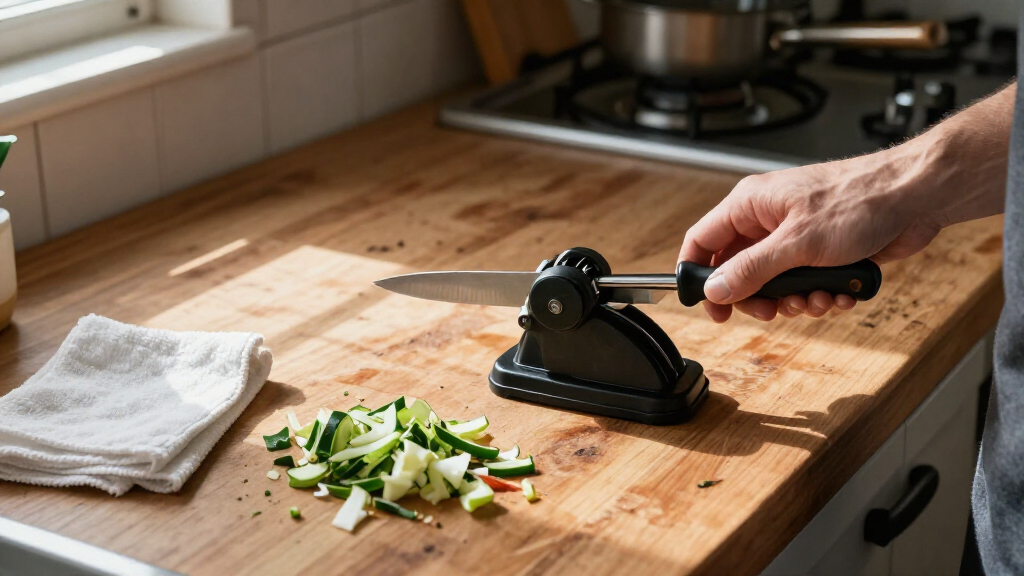
I compared these 15 handheld knife sharpeners by the factors that most affect a buying decision: ease of guiding a blade, sharpening-stage design, intended knife types, portability, and likely upkeep. I gave more weight to clear, practical use cases than to a long feature list. A sharpener that appears easy to use but lacks guidance for the buyer’s knife type cannot serve as a universal pick.
The ranking favors options with a distinct strength and a manageable learning curve, then accounts for tradeoffs such as narrow blade compatibility, limited angle control, or a design better suited to field use than kitchen routines. Multi-function features count only when they expand a buyer’s likely use; they do not automatically outrank a simpler tool that fits its main job well. Since the lineup includes different sharpening styles, buyers should match the tool to their blade and sharpening habits rather than treat every pull-through sharpener as interchangeable.
Factors to Consider When Choosing Handheld Knife Sharpeners
Choosing among handheld knife sharpeners starts with the knives you own and the results you expect, not the number of sharpening stages. I’d use these factors to narrow the field before focusing on a particular model.
Match the sharpener to your blade types
Make a list of the knives you plan to sharpen before choosing a tool. A kitchen set may include straight-edge chef’s knives, serrated bread knives, and kitchen shears, but one sharpener may not handle all three appropriately. A dedicated straight-edge sharpener can be simpler to use, while a combo design can reduce the need for separate tools if its slots suit your blades. Don’t assume a serrated setting works on every serration pattern or that a scissor slot fits every pair of shears. Check the manufacturer’s guidance for blade compatibility, especially for specialty or unusually shaped knives. If most of your blades share one style, a focused tool may be easier to use well than a multi-purpose model.
Choose between fixed guidance and more control
Fixed-angle slots lower the skill barrier by guiding the knife through a repeatable path, which is useful for routine maintenance. Adjustable-angle or guided systems give you more influence over the sharpening geometry, but demand closer attention to setup and technique. A common mistake is choosing more control without wanting to learn how to use it. Another is assuming every blade benefits from the same angle; the edge geometry and intended use can differ between knives. If you are unsure, prioritize clear guidance and compatibility information over the broadest set of adjustments. More control is a benefit only when you plan to use it.
Understand what the stages are for
Stage count alone does not tell you how well a sharpener fits your needs. Multiple stages may separate coarse edge repair from finer finishing, or add a slot for another blade type; those jobs are not interchangeable. For a knife that only needs regular upkeep, an elaborate process may add steps without adding much value. If a blade is very dull or damaged, a basic pull-through tool may not be the best match for the repair work required. Read what each stage is designed to do and follow the maker’s instructions rather than repeatedly pulling a knife through every slot. Pick by sharpening task, not by the largest stage number.
Balance kitchen stability with portability
A compact sharpener is easy to store or carry, but a small footprint can make it harder to hold steady during a stroke. For kitchen use, a secure grip and a stable working position matter as much as drawer-friendly size. Field-oriented designs prioritize packability and on-the-go maintenance, while larger kitchen tools may be more convenient for regular countertop routines. Consider where you will sharpen and whether you can keep the sharpener and blade controlled throughout each pass. Avoid choosing a travel model for everyday use solely because it takes up less space. Portability matters most when you will actually carry the tool.
Decide whether extra functions justify the compromise
Scissor, serrated-knife, and tool compatibility can make a sharpener more useful around a home or in a field kit. Those additions can also complicate the layout and make it harder to tell which slot belongs to which blade. If you only sharpen standard kitchen knives, extra functions may take up space without solving a real problem. If you do need them, confirm that the product names the blade types it supports and gives clear instructions for each. Avoid treating a combo tool as a substitute for every specialized sharpening method. Pay for added functions only when they match blades you own.
Set realistic expectations for maintenance sharpening
Handheld sharpeners are often chosen for convenience, but convenience does not mean every blade can be restored with a few quick strokes. Routine edge upkeep is different from repairing chips, changing an edge profile, or addressing a badly worn blade. Using a coarse stage too often can remove more material than regular maintenance calls for, while too little sharpening may leave a dull knife unchanged. Follow the product instructions, use light and controlled passes, and stop to check the edge instead of repeating strokes by habit. If your knives have a special finish or manufacturer-specific care guidance, check that before using an abrasive sharpener. A good match is a tool suited to the condition you expect to maintain.
Frequently Asked Questions
Can I use one handheld sharpener for all the knives in my kitchen?
Possibly, but you should verify each blade type against the sharpener’s instructions rather than infer compatibility from its name. Standard straight-edge knives are the most common match for pull-through designs, while serrated knives and scissors may need separate slots or a different sharpening method. Specialty edges, coated blades, and knives with unusual geometry deserve extra caution. If most of your set is straight-edge, a dedicated model may be simpler than a combo sharpener. Choose a multi-purpose option only when its added functions match blades you actually own.
Is an adjustable-angle sharpener a better choice than a fixed-angle model?
It is better for buyers who want to set or adapt the sharpening angle and are willing to follow the setup instructions closely. A fixed-angle sharpener can be a better fit for quick maintenance because it removes some of the technique decisions. Neither approach is automatically right for every knife: the blade’s edge geometry and intended use matter. If you do not know your knives’ angles, read their care guidance before changing them. Choose adjustable control for a reason, not simply because it sounds more advanced.
Will a handheld pull-through sharpener repair a chipped or badly dull knife?
Some sharpeners include a more aggressive stage, but a pull-through tool is not a guaranteed fix for chips, major edge damage, or a blade that needs reshaping. Repeated passes through a coarse slot can remove excess material without correcting the underlying problem well. For significant damage, a guided system or professional sharpening service may be a better route. For routine maintenance, use the sharpener as directed and check the edge as you work. Match the tool to the blade’s condition rather than expecting every sharpener to restore every edge.
Should I buy a compact field sharpener or a kitchen-focused model?
Choose based on where you expect to sharpen most often. A compact field model makes sense when portability and touch-ups away from home matter, while a kitchen-focused sharpener may be easier to handle during regular countertop use. Small size can make storage and carrying easier, but it does not automatically make a tool more comfortable or stable to use. If the sharpener will stay in one drawer, prioritize blade compatibility and ease of control over packability. If you need a field kit, confirm that its sharpening style suits the knives or tools you carry.
Do combo sharpeners make sense if I only own straight-edge knives?
They can, but added slots are useful only if they improve a task you actually perform. A combo model may take up more space or require you to identify the correct slot, while a focused sharpener can be simpler for one blade type. If you expect to buy scissors or serrated knives later, broader compatibility may be worthwhile after you verify the supported blade styles. Don’t choose a combo design just because it lists more functions. For a straight-edge-only kitchen, compare ease of use and sharpening control first.
Conclusion
For one adaptable pick, I’d choose the Work Sharp Guided Field Knife Sharpener as best overall, while the Smith’s CCKS 2-Step is the best value-minded choice for buyers who want a simpler two-step format. Beginners should look first at straightforward kitchen-focused options such as the Wüsthof Two-Stage or Henckels, choosing between them by fit and blade compatibility. For a premium kitchen-oriented choice, the Wüsthof is the clearest fit in this lineup; for angle-conscious users, the Sharp Pebble Adjustable Angle offers a different kind of control. Field-kit shoppers can compare the Smith’s DCS4 with the Work Sharp Pivot, while buyers sharpening scissors or serrated knives should focus on the compatible combo models. Pick the tool that matches your blades and routine rather than the one with the longest feature list.