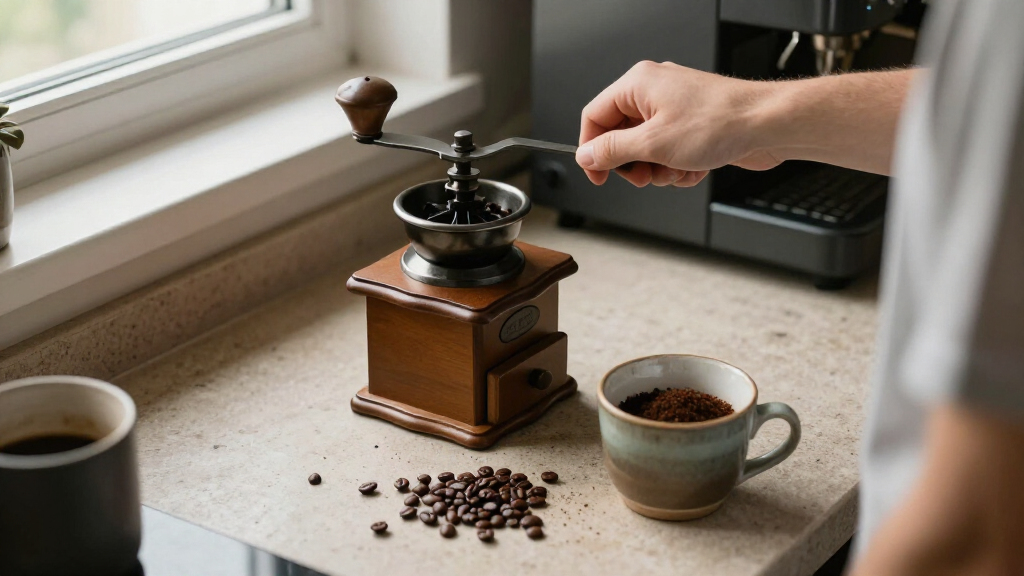

Manual coffee grinders trade electricity for freshness, portability, and a lower price per gram of grind quality, but the gap between a great one and a frustrating one comes down to burrs, adjustment precision, and how tired your arm gets. After comparing the leading hand grinders for 2026, the JavaPresse Stainless Steel Grinder stands out as the best overall pick for its 18 stepped settings and travel-friendly build at a budget price. The TIMEMORE Chestnut C3S Pro pulls ahead on grind consistency thanks to its stainless steel conical burr set, making it the smarter choice for espresso drinkers, while the CEVING 60g Large Capacity model wins for households that grind more than one cup at a time. The main tradeoffs you’ll face are ceramic versus steel burrs, internal versus external adjustment, and capacity versus portability. Read on for the full breakdown of all twelve grinders and which one fits your routine.

Get kitchen gear delivered free — and shop member deals
- Fast, free delivery on millions of items
- Access to Prime Big Deal Days deals on October 6–7
- Prime Video, Amazon Music and more included
Complete the kit


Key Takeaways
- Stainless steel burrs (TIMEMORE C3S Pro, Martens G-01 PRO, JavaPresse) consistently outperformed ceramic burrs on grind uniformity, which matters most for espresso and pour-over.
- External adjustment dials, found on the Martens G-01 PRO and CIRCLE JOY, are noticeably faster and less messy than internal adjustment systems that require removing the handle and hopper lid.
- The CEVING 60g large-capacity models solve the biggest complaint about hand grinding — small batches — but they sacrifice the pocket-friendly portability that mini grinders like the CEVING Mini and the 30+ setting black metal model deliver.
- The 40-setting grinders (CEVING Mini, CIRCLE JOY) offer finer grind resolution than 18-setting budget models, but more clicks only helps if you actually brew espresso; French press and cold brew drinkers gain almost nothing from them.
- Glass-jar designs like the PARACITY are attractive for countertop storage but are the wrong choice for travel — a real drawback given that portability is half the reason most people buy a hand grinder.
| JavaPresse Manual Stainless Steel Coffee Grinder |  | Best Budget Entry Point | Material: Stainless steel body, ceramic burr | Adjustable Settings: 18 | Type: Manual conical burr grinder | VIEW LATEST PRICE | See Our Full Breakdown |
| Martens G-01 PRO Manual Coffee Grinder |  | Best for Precision Dialing | Adjustment Type: External dial | Burr: Stainless steel 7-star precision-cut | Capacity: 28-35 grams | VIEW LATEST PRICE | See Our Full Breakdown |
| PARACITY Manual Coffee Grinder with Ceramic Burr and Glass Jars |  | Best for Counter-Friendly Storage | Burr: Ceramic conical | Capacity: 11 oz per jar | Jars Included: 2 glass jars | VIEW LATEST PRICE | See Our Full Breakdown |
| CEVING 60g Large Capacity Manual Coffee Grinder, Black (Stainless Burr) | 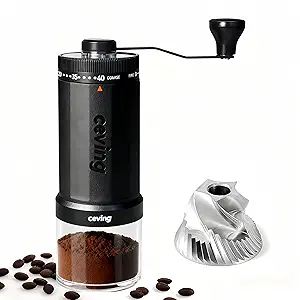 | Best for Big Batches with Steel Durability | Capacity: 60 grams | Settings: 40 external click-ring adjustments | Burr: Stainless steel | VIEW LATEST PRICE | See Our Full Breakdown |
| CEVING 60g Large Capacity Manual Coffee Grinder, Black (Ceramic Burr) |  | Best Lightweight Big-Batch Pick | Capacity: 60 grams | Settings: 40 external adjustments | Burr: Ceramic conical | VIEW LATEST PRICE | See Our Full Breakdown |
| Manual Coffee Grinder with Ceramic Burr for Espresso, French Press, Adjustable Settings, Hand Crank, Portable |  | Best Budget Starter Pick | Material: Stainless steel body, ceramic burrs | Burr Type: Ceramic | Adjustable Settings: 5 levels | VIEW LATEST PRICE | See Our Full Breakdown |
| CEVING Mini Manual Coffee Grinder with 40 Adjustable Settings, Black | 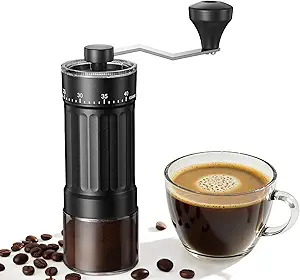 | Best Precision for the Price | Adjustable Settings: 40 external clicks | Burr Type: Conical ceramic | Capacity: 30g | VIEW LATEST PRICE | See Our Full Breakdown |
| CIRCLE JOY Manual Coffee Grinder with 40 External Adjustable Settings, Ceramic Conical Burr, Portable Hand Coffee Grinder for Espresso, French Press, Cold Brew |  | Best for Quiet Offices and Shared Spaces | Grind Settings: 40 external | Burr Material: Ceramic conical | Body Material: Stainless steel | VIEW LATEST PRICE | See Our Full Breakdown |
| TIMEMORE Chestnut C3S Pro Manual Coffee Grinder, Stainless Steel Conical Burr, Foldable Handle, Adjustable Coarseness, Black |  | Best Overall Build Quality | Body Material: All-metal aluminum alloy | Burr Type: Hexagonal conical stainless steel | Burr Hardness: 55-58 HRC | VIEW LATEST PRICE | See Our Full Breakdown |
| Mini Manual Coffee Grinder with Ceramic Conical Burr, Black |  | Best for Visibility and Light Travel | Grind Settings: 40 | Burr Type: Ceramic conical | Material: ABS body, glass jar | VIEW LATEST PRICE | See Our Full Breakdown |
| Mini Manual Coffee Grinder, 30+ Adjustable Settings, Black Metal |  | Best for Espresso-Focused Travelers | Grind Settings: 30+ adjustable | Burr Material: 420 stainless steel conical | Body Material: Aerospace aluminum | VIEW LATEST PRICE | See Our Full Breakdown |
| CEVING World’s First 60g Large Capacity Manual Coffee Grinder, Green |  | Best for Group Brewing and Campouts | Capacity: 60g | Grind Settings: 40 external click-ring adjustments | Burr Type: Ceramic conical | VIEW LATEST PRICE | See Our Full Breakdown |
More Details on Our Top Picks
JavaPresse Manual Stainless Steel Coffee Grinder
For a first step into hand grinding, this option stands out for hitting the basics at a price that undercuts nearly everything else here. The 18 adjustable settings cover French press through espresso, and the ceramic conical burr delivers consistency that blade grinders simply can’t match. Compared with the Martens G-01 PRO, it lacks an external adjustment dial, so changing grind size means twisting the burr itself by feel — workable, but slower to dial in. The stainless body feels tougher than the PARACITY’s glass jar setup, which matters if it lives in a backpack. The real tradeoff is effort: grinding fine for espresso takes patience, and the capacity is genuinely small at around 20 grams per session. This pick makes the most sense for buyers testing whether manual grinding fits their routine before spending three times as much.
Pros:- Very affordable entry into burr grinding
- 18 settings span espresso to French press
- Quiet, cordless operation perfect for camping
- Durable ceramic burr and stainless body
Cons:- Internal grind adjustment is slow and imprecise versus external dials
- Small capacity means grinding in batches for more than one or two cups
Best for: Beginners and travelers who want burr-grinder quality at the lowest possible entry price
Not ideal for: Households making multiple cups daily — the small capacity and fine-grind effort add up fast
- Material:Stainless steel body, ceramic burr
- Adjustable Settings:18
- Type:Manual conical burr grinder
- Power Source:Manual hand crank
- Use Cases:Espresso, French press, drip, camping, travel
- Adjustment Location:Internal burr adjustment
Our verdict“A sensible low-risk first grinder for solo brewers who value portability over speed and precision.”
Martens G-01 PRO Manual Coffee Grinder
Where the JavaPresse asks you to guess at grind size, this model puts an external adjustment dial right on the shaft, so repeating yesterday’s pour-over setting takes seconds instead of trial and error. The 7-star stainless steel burr produces noticeably more uniform grounds than ceramic alternatives like the CEVING 60g, especially in the medium range where pour-over lives. Triple bearing shaft support keeps the crank stable during long grinds, and the magnetic catch cup detaches one-handed — a small luxury the screw-on cups elsewhere in this roundup don’t offer. The foldable handle packs flatter than the JavaPresse’s fixed crank, making it the better suitcase companion. The compromises: at 28-35 grams of capacity it can’t handle a full carafe in one pass, and stainless burrs, while sharper, will eventually wear unlike ceramic.
Pros:- External dial makes grind settings repeatable and fast to change
- Magnetic catch cup detaches without threading
- Foldable handle packs down for travel
- Triple bearing support keeps grinding smooth and stable
Cons:- Mid-range capacity limits batch sizes
- Stainless burr will dull over years of use, unlike ceramic
Best for: Pour-over enthusiasts who change brew methods often and need repeatable, indexed grind settings
Not ideal for: Anyone grinding for a crowd — the 28-35g capacity forces multiple rounds for full carafes
- Adjustment Type:External dial
- Burr:Stainless steel 7-star precision-cut
- Capacity:28-35 grams
- Handle:Foldable
- Shaft Support:Triple bearing
- Body Material:Stainless steel
- Portability:Lightweight, travel-friendly
Our verdict“The pick for brewers who treat grind consistency as a repeatable science rather than a daily guess.”
PARACITY Manual Coffee Grinder with Ceramic Burr and Glass Jars
This option stands apart from the pack by solving a problem the others ignore: what to do with your beans and grounds afterward. The two 11 oz glass jars screw directly onto the grinder, so one holds whole beans and the other catches grounds, replacing the stray bags and containers most hand grinders leave you juggling. Compared with the Martens G-01 PRO, grinding performance is similar thanks to the ceramic burr, but this setup favors a permanent spot on the kitchen counter over life in a backpack. The non-slip silicone base grips the counter while you crank — a stability advantage over slim travel tubes like the JavaPresse. The obvious tradeoff is fragility: glass jars can arrive cracked and don’t belong in luggage, and the adjustment mechanism is basic compared with the CEVING’s 40-click ring.
Pros:- Two glass jars double as bean storage and grounds catcher
- Ceramic burr grinds uniformly without transferring heat
- Non-slip silicone base stabilizes grinding
- No electricity needed, quiet morning operation
Cons:- Glass jars are fragile and prone to shipping damage
- Basic grind adjustment lacks the precision of click-indexed rivals
Best for: Home brewers who want an all-in-one counter setup with bean storage and grounds catch built in
Not ideal for: Campers and travelers — the glass jars are fragile and add weight you don’t need on the road
- Burr:Ceramic conical
- Capacity:11 oz per jar
- Jars Included:2 glass jars
- Handle:Stainless steel
- Base:Non-slip silicone
- Lid:Silicone
- Power Source:Manual hand crank
Our verdict“A kitchen-counter grinder for people who value tidy bean storage over packability and precision clicks.”
CEVING 60g Large Capacity Manual Coffee Grinder, Black (Stainless Burr)
Most hand grinders quit at 25-35 grams, which means grinding twice for a full French press. This model’s 60g capacity handles a full liter of brew in one session, and the 40-click external adjustment ring brings indexed precision that the JavaPresse and PARACITY can’t match — every click is a repeatable step, not a guess. The stainless steel burr is the differentiator from its ceramic sibling (ASIN B0FPX677SR): steel cuts faster and more uniformly through dense light roasts, at the cost of eventual wear that ceramic avoids. It’s also the heftier of the two at 416g, which helps stability in hand but nudges pack weight for travelers. Static cling is a real annoyance with steel burrs, so a drop of water on the beans before grinding saves cleanup. This pick makes the most sense for multi-cup households that grind fresh daily.
Pros:- 60g capacity covers full French press batches in one pass
- 40 external click settings are repeatable across brew methods
- Stainless burr grinds dense light roasts quickly and evenly
- Compact footprint despite the large capacity
Cons:- Static buildup causes grounds to cling without bean pre-wetting
- Heavier than ceramic-burr rivals at 416 grams
Best for: Families or French press drinkers who need a full 60g batch in one grind with repeatable settings
Not ideal for: Ultralight travelers — 416g and a 7.8-inch body make it the bulkiest pick here
- Capacity:60 grams
- Settings:40 external click-ring adjustments
- Burr:Stainless steel
- Weight:416 grams
- Dimensions:2.7 x 7.8 x 5.3 inches
- Warranty:1 year
Our verdict“The batch grinder for households that refuse to grind twice, with steel-cut speed to back it up.”
CEVING 60g Large Capacity Manual Coffee Grinder, Black (Ceramic Burr)
Think of this as the travel-friendly twin of the stainless-burr CEVING above: same 60g capacity, same 40-click external adjustment, but a ceramic conical burr and a lighter 346g body. That weight difference of 70 grams matters if the grinder rides in a pack, and ceramic never imparts metal flavors while holding its edge indefinitely — the reason flavor-first brewers prefer it. The flip side is grinding speed: ceramic takes noticeably more cranks to work through the same 60g load, and dense Ethiopian light roasts will test your patience compared with the steel version. Against the Martens G-01 PRO, you trade some finesse in the handle and catch-cup design for double the capacity. Static still rears its head here too, so the water-drop trick applies. This model is better suited to flavor chasers with arm endurance than speed-focused daily drivers.
Pros:- Lightest 60g-capacity option at 346 grams
- Ceramic burr preserves flavor and never dulls
- 40 external clicks allow repeatable grind sizes
- One grind covers multiple servings
Cons:- Ceramic grinds slower than steel through full 60g batches
- Static cling without bean pre-treatment
- Less refined handle and catch-cup than the Martens G-01 PRO
Best for: Flavor-focused campers and travelers who want 60g capacity at the lightest weight in the lineup
Not ideal for: Espresso-speed grinders — ceramic cuts slower through the fine settings and large batches
- Capacity:60 grams
- Settings:40 external adjustments
- Burr:Ceramic conical
- Weight:346 grams
- Dimensions:2.7 x 7.8 x 5.3 inches
- Warranty:1 year
Our verdict“The pick when you want CEVING’s big-batch, 40-click formula in the lightest, most flavor-neutral package.”
Manual Coffee Grinder with Ceramic Burr for Espresso, French Press, Adjustable Settings, Hand Crank, Portable
For someone testing whether hand-grinding fits their routine, this grinder strips the category down to its basics: stainless steel body, ceramic burrs, and five grind settings. Those five steps are the whole story here — compared with the CEVING Mini’s 40 settings, you get coarse, medium, and a couple of fine options, but you cannot fine-tune for espresso dialing. That simplicity is the point at this price. The tool-free disassembly makes cleaning painless, which matters more for beginners than they expect, and the build feels sturdier than the plastic-bodied Mini with Glass Jar (B0G9F5D6WN). The tradeoff is consistency: a coarse setting drifts toward fines if the adjustment knob isn’t seated carefully, and grinding enough for a full French press takes real effort.
Pros:- Durable stainless steel and ceramic construction at a low price
- Simple disassembly for quick cleaning
- Compact and light enough for camping bags
- Handles multiple brew methods at a basic level
Cons:- Only 5 grind settings limits precision
- Grind consistency suffers if the adjustment isn’t set carefully
- Small capacity makes multi-cup sessions tedious
Best for: Beginners and casual brewers who want to try hand-grinding without spending much and mostly drink drip or French press
Not ideal for: Espresso drinkers who need repeatable fine adjustments — five stepped settings can’t be dialed precisely enough
- Material:Stainless steel body, ceramic burrs
- Burr Type:Ceramic
- Adjustable Settings:5 levels
- Operation:Hand crank
- Use:Home, camping, travel
- Compatible Brews:Espresso, French press, adjustable for various methods
Our verdict“A low-risk entry point for curious brewers, as long as you don’t need espresso-grade precision.”
CEVING Mini Manual Coffee Grinder with 40 Adjustable Settings, Black
The standout feature of this CEVING is 40 external grind settings — meaning you adjust with a dial rather than twisting the burr assembly, so your setting stays put between sessions. That’s a genuine step up from the five-step budget model (B0DFTBH4HR) and puts dialing in a pour-over or even a moka pot within reach. At 325g and under 7 inches tall, it slides into a work bag more easily than the all-metal TIMEMORE C3S Pro, though the lighter build won’t feel as bombproof. The catch is the 30g bean capacity: enough for one or two cups, but anyone grinding for a household will refill constantly. Arm fatigue during fine espresso grinds is real too, since ceramic burrs at fine settings demand patience.
Pros:- 40 external click settings stay locked between uses
- Light and compact for commuting and travel
- Ceramic conical burr keeps flavor clean and consistent
- Simple to take apart and rinse
Cons:- 30g capacity forces frequent reloading for multiple cups
- Fine grinds for espresso take noticeable arm effort
- Not built for high-volume household use
Best for: Pour-over and French press drinkers who want step-level grind precision and repeatability on a modest budget
Not ideal for: Families or anyone grinding more than two cups at a time — the 30g hopper means refilling mid-session
- Adjustable Settings:40 external clicks
- Burr Type:Conical ceramic
- Capacity:30g
- Weight:325g
- Dimensions:6.7 x 2.3 x 7.4 inches
- Use Case:Travel, camping, French press, pour-over
Our verdict“The most grind precision per dollar in this batch, best for single-serve brewers who value repeatability.”
CIRCLE JOY Manual Coffee Grinder with 40 External Adjustable Settings, Ceramic Conical Burr, Portable Hand Coffee Grinder for Espresso, French Press, Cold Brew
Where this CIRCLE JOY earns its slot is quiet operation — grinding at a desk or before the household wakes up is genuinely viable, which isn’t something every hand grinder can claim. Like the CEVING Mini, it offers 40 external grind settings and a ceramic conical burr, but the full stainless steel body makes it feel more substantial and better sealed than CEVING’s lighter chassis, and it throws in a storage pouch that the budget five-setting grinder doesn’t include. Its smartphone-sized footprint means it disappears into a bag, though that same compactness caps how much you can grind at once — cold brew fans will find themselves cranking in batches, since a proper cold brew ratio devours beans quickly. It’s a single-cup (maybe two-cup) tool wearing a versatile marketing label.
Pros:- Notably quiet operation suited to shared spaces
- Full stainless steel body feels durable and premium
- 40 external settings with repeatable results
- Includes a storage pouch for transport
Cons:- Compact size limits per-session yield
- Manual cranking still takes more effort than any electric option
- No capacity advantage over cheaper rivals
Best for: Office workers and apartment dwellers who need near-silent grinding and want precise, repeatable settings for espresso through cold brew
Not ideal for: Cold brew or batch brewers — the small capacity turns large-ratio drinks into a long crank session
- Grind Settings:40 external
- Burr Material:Ceramic conical
- Body Material:Stainless steel
- Size:About the size of a smartphone
- Noise Level:Quiet operation
- Included Accessories:Storage pouch
- Use Case:Espresso, French press, cold brew, travel, office, home
Our verdict“The pick for anyone whose grinding has to happen quietly in close quarters.”
TIMEMORE Chestnut C3S Pro Manual Coffee Grinder, Stainless Steel Conical Burr, Foldable Handle, Adjustable Coarseness, Black
Among these five, the TIMEMORE C3S Pro is the one built like a tool rather than a gadget. The all-metal aluminum alloy body dissipates grinding heat better than the plastic-bodied Mini with Glass Jar (B0G9F5D6WN), and the hexagonal stainless conical burr at 55-58 HRC hardness holds an edge far longer than the ceramic burrs on the CEVING and CIRCLE JOY models — that’s why its particle distribution reads more uniform cup after cup. The foldable handle is a smarter travel solution than a fixed crank, flattening the grinder into a pocket-friendly shape. The honest drawback: grinding light-roasted beans coarse takes noticeable torque, and with roughly 36 stepped settings it offers slightly fewer clicks than the 40-setting rivals, though TIMEMORE’s adjustment mechanism feels tighter and less drift-prone.
Pros:- Hardened stainless hexagonal burr delivers the most consistent grind in this batch
- All-metal body dissipates heat and resists wear
- Foldable handle makes it genuinely pocketable
- Tight, drift-resistant adjustment across ~36 levels
Cons:- Coarse grinding of dense light roasts demands real effort
- Premium price over the budget options here
- Fewer click settings than the 40-step rivals
Best for: Enthusiasts who want cafe-grade grind consistency and a grinder that survives years of daily use and travel
Not ideal for: Buyers who mainly want a cheap camping backup — this is more grinder than occasional use justifies
- Body Material:All-metal aluminum alloy
- Burr Type:Hexagonal conical stainless steel
- Burr Hardness:55-58 HRC
- Grinding Levels:Approximately 36
- Handle:Foldable
- Diameter:52 mm
- Use:Travel, camping, home
Our verdict“The strongest all-around build and grind quality here — worth it if coffee is a daily ritual, not an occasional convenience.”
Mini Manual Coffee Grinder with Ceramic Conical Burr, Black
This mini grinder’s differentiator is the glass jar base — you can see exactly how much you’ve ground without stopping to peek, something the opaque stainless cylinders of the TIMEMORE C3S Pro and CIRCLE JOY can’t offer. Matched with the same 40 adjustable settings and ceramic conical burr as the CEVING, it covers the full grind range for French press to pour-over at a lighter 11.3 oz carry weight. But the glass is also the obvious weakness: it’s the most fragile item in this lineup, and tossing it into a camping pack the way you would the all-metal TIMEMORE is a gamble. The ABS upper housing keeps weight down yet feels less premium than full steel. For desk-side or kitchen-counter use, the visibility win outweighs the fragility; for rough travel, it doesn’t.
Pros:- Glass jar lets you monitor grind volume at a glance
- 40 settings cover French press through fine pour-over
- Light at 11.3 oz for easy carrying
- Ceramic burr produces clean, consistent grounds
Cons:- Glass catch jar is fragile compared to steel-bodied rivals
- ABS plastic housing feels less durable
- 30g capacity means frequent refills for multiple cups
Best for: Counter-top brewers and light travelers who like watching their grind progress and mostly stay on smooth surfaces
Not ideal for: Campers and backpackers — the glass jar and plastic body won’t survive rough packing
- Grind Settings:40
- Burr Type:Ceramic conical
- Material:ABS body, glass jar
- Capacity:30g
- Weight:11.3 oz
- Dimensions:6.7 x 2.3 x 6.7 in
- Operation:Hand-crank, no electricity required
Our verdict“A sensible visibility-first choice for gentle home and office use, provided it never goes in a backpack.”
Mini Manual Coffee Grinder, 30+ Adjustable Settings, Black Metal
Among the compact grinders in this roundup, this model earns its spot by pairing a 420 stainless steel conical burr with a genuinely wide 30+ step adjustment range — the combination that matters most if espresso is part of your routine. Ceramic-burr travel grinders like the PARACITY with Glass Jars grind cool and clean, but steel burrs like this one cut faster and hold tighter tolerances at fine settings, which is where cheap travel grinders usually fall apart. The aerospace aluminum body keeps weight down for suitcase or camp bag duty.
The tradeoff is capacity: at 30g per session, it handles one or two cups comfortably but demands a refill for a full French press for two. Compared with the CEVING 60g model, you’re giving up half the batch size in exchange for finer espresso-range control. Arm effort at espresso fineness is also real — expect a workout per dose.
Pros:- Steel conical burr delivers consistent fine grinds suitable for espresso
- 30+ adjustment steps cover the full spectrum from espresso to cold brew
- Lightweight aluminum body survives luggage and camping trips
- Compact form factor takes up almost no counter or bag space
Cons:- 30g capacity limits you to one or two cups per grinding session
- Fine espresso grinding by hand takes noticeable time and effort
Best for: Solo brewers and frequent travelers who want espresso-capable grind quality in a packable body
Not ideal for: Households making multiple cups at once — the 30g capacity means grinding in shifts
- Grind Settings:30+ adjustable
- Burr Material:420 stainless steel conical
- Body Material:Aerospace aluminum
- Capacity:30g
- Color:Black
- Use Cases:Espresso, pour over, French press, cold brew
- Portability:Lightweight, travel-ready design
Our verdict“If dialing in espresso on the road is the priority and batch size isn’t, this is the travel grinder that gets the details right.”
CEVING World’s First 60g Large Capacity Manual Coffee Grinder, Green
Most manual grinders cap out around 25–40g per session, which is exactly why this CEVING stands apart: a 60g capacity means one crank session covers a full French press or a pour-over round for three or four people. That double batch size changes who a hand grinder is for — it stops being a solo ritual tool and becomes a group brewing solution for campsites and cabin weekends. The 40-step external click-ring also beats the internal-twist adjustment on the JavaPresse, since you can change settings without emptying the beans first.
Tradeoffs are worth weighing. The ceramic burr runs cooler and preserves flavor, but compared with the steel-burr Mini Manual Grinder in Black Metal, it grinds slower and is less convincing at true espresso fineness — it’s happier in the pour-over-to-French-press zone. And even 60g runs short if you’re caffeinating six or more people.
Pros:- 60g capacity handles full French press batches or drinks for several people
- 40 external click settings adjust quickly without emptying the grinder
- Ceramic burr runs cool and won’t impart metal flavors
- 462g weight stays reasonable for a pack despite the large capacity
Cons:- Ceramic burr is slower and less precise at espresso-level fineness
- Large batches by hand demand sustained cranking effort
Best for: Campers, cabin-goers, and small households who brew larger batches without electricity
Not ideal for: Espresso chasers — the ceramic burr struggles to compete with steel at fine settings
- Capacity:60g
- Grind Settings:40 external click-ring adjustments
- Burr Type:Ceramic conical
- Weight:462g
- Dimensions:2.7 x 7.8 x 5.3 inches
- Color:Green
- Use Cases:French press, pour-over, travel, outdoor brewing
Our verdict“This is the manual grinder for people who brew for a crowd outdoors, not for espresso purists chasing micro-adjustments.”
How We Picked
I evaluated each grinder against five buyer-relevant criteria, weighted by how people actually use manual coffee grinders. Grind consistency carried the most weight: a hand grinder that produces a wide spread of particle sizes will sour or bitter your extraction no matter how nice it looks. Burr material factored in heavily — stainless steel conical burrs generally hold their edge longer and cut cleaner than ceramic, though ceramic resists rust and keeps cost down. Adjustment range and ergonomics came next, where external click dials beat internal adjusters for speed and repeatability, and finer click counts only earned credit when they translated to usable espresso-resolution steps.
Capacity, grinding speed, and portability rounded out the scoring, because the whole point of a hand grinder is often travel or small-batch ritual — a 25g hopper that takes four minutes of cranking is a different product than a 60g hopper with a smooth bearing drive. Finally, I weighed build quality and price-to-performance: burr wobble, plastic components, and handle stability were compared against what each grinder costs. Grinders that justified a higher price with real mechanical advantages ranked above budget models, and budget models that matched pricier rivals on consistency ranked as top values.
Factors to Consider When Choosing Manual Coffee Grinders
Before picking a specific grinder, it helps to understand what actually separates a satisfying hand-grinding experience from a chore you abandon after two weeks. These are the factors that drove the biggest differences across the twelve models I compared.Burr Material: Steel Cuts, Ceramic Crushes
The single biggest quality divider in this category is burr material, and it explains most of the price spread. Stainless steel conical burrs slice coffee beans cleanly, producing tighter particle distribution, which translates directly into sweeter, more balanced espresso and pour-over. Ceramic burrs tend to crush and shatter beans unevenly, which is forgivable for French press or cold brew but works against you at fine settings. Ceramic does have two legitimate advantages: it never rusts, and it keeps the grinder cheap. A common mistake is assuming all conical burrs perform the same — a well-aligned steel burr in a $30 grinder can outperform a poorly mounted one in a fancier shell. If you brew mostly coarse, ceramic is a defensible budget choice; if espresso is anywhere in your routine, prioritize steel.
Adjustment Style: External Dials vs. Internal Twisting
How you change grind size matters more day-to-day than how many settings exist. External adjustment, where a dial on the underside or side clicks between settings, lets you change brew methods in seconds without disassembling anything. Internal adjustment requires removing the handle and top nut to reach the dial underneath — manageable once, tedious if you switch between morning espresso and weekend cold brew. Buyers also over-index on click counts: 40 settings sound superior to 18, but if the clicks are unevenly spaced or the burr shaft wobbles, resolution means nothing. What actually matters is repeatability — being able to return to the exact same setting after cleaning. If you brew one method exclusively, internal adjustment is a non-issue and you can save money; serial multi-method brewers should pay up for external dials.
Capacity and Grinding Speed: Match the Hopper to Your Habit
Hand grinder capacity typically ranges from about 20g to 60g, and choosing wrong is the fastest route to regret. A 20-25g hopper suits solo coffee drinkers making one cup at a time, and keeps the grinder compact enough for a travel bag. A 60g hopper lets you grind for two people or a full French press in one session, but the extra cranking time adds up — larger capacity with a stiff, wobbly drive can mean five minutes of hard labor. Bearing quality matters as much as capacity here: a smooth ball-bearing drive with a stable handle makes 30 seconds of grinding feel effortless, while a loose handle that pops off mid-crank will sour you on the whole ritual. My advice is to be honest about your household size and skip capacity you’ll never use, since it only adds bulk.
Portability and Body Material: Where You Grind Decides What You Carry
If travel, camping, or office use is part of your plan, body material becomes a real decision rather than an aesthetic one. Glass-jar grinders look beautiful on a countertop and let you see and store grounds, but glass in a backpack is a cracked mess waiting to happen. Stainless steel and tough polymer bodies shrug off luggage abuse and usually weigh less. Size compounds this: mini grinders fit in a jacket pocket but hold barely enough for a strong single cup, so frequent travelers face a genuine tradeoff between batch size and packability. Also check whether the handle folds or detaches — foldable handles make a grinder dramatically more pocketable and reduce the chance of losing the handle entirely. Countertop-only users can ignore all of this and choose purely on grind quality.
Common Mistakes: What Buyers Get Wrong About Hand Grinders
The most frequent mistake is buying a manual grinder to save money on electric quality without accepting the physical tradeoff — grinding fine for espresso by hand takes real effort, and cheap grinders with weak drives make it worse. Another is choosing based on settings count or marketing claims rather than burr material and alignment, which is where grind quality actually lives. Buyers also routinely underestimate cleaning: grinders with hard-to-disassemble internals collect oils and stale grounds that quietly ruin flavor, so easy teardown should be part of your decision. A third trap is duplicate listings under different colors and minor variations — several models in this category are near-identical under different brand labels, so compare burr specs and price rather than assuming different names mean different machines. Finally, don’t buy large capacity “just in case”; most people overestimate their batch sizes and end up carrying weight they never use.
When to Pay More — and When Not To
Price in this category roughly tracks burr quality, drive stability, and adjustment design, and it’s worth knowing where spending more genuinely pays. Paying up makes sense if you brew espresso regularly — fine grinding demands precise, stable steel burrs and stiff adjustment, and cheap grinders visibly struggle there. It also makes sense if you grind daily for multiple people, where a smooth bearing drive saves you real effort over months. Where extra spending is wasted: coarse brewing only, occasional travel use, or gifting. A $20-30 ceramic-burr grinder with decent alignment handles French press and cold brew nearly as well as grinders twice the price, because coarse grinding is forgiving of particle inconsistency. The honest hierarchy is steel burrs for finesse, ceramic for value, and everything else — color, branding, click count inflation — is mostly noise.
Frequently Asked Questions
Are manual coffee grinders actually good for espresso, or do I need electric?
Manual grinders can absolutely produce espresso-quality grounds, and some of the better ones in this lineup — particularly the models with stainless steel conical burrs and 30-40 click adjustment — grind fine and consistently enough for proper extraction. The catch is effort: espresso requires a very fine grind, which means 60-90 seconds of firm cranking per 18g dose compared to a few seconds with electric. That tradeoff is fine for one or two shots a day, but if you’re pulling shots for a household every morning, the labor adds up. If you’re committed to hand-grinding espresso, prioritize steel burrs, external adjustment for dialing in, and a stable handle, since wobble at fine settings is where cheap grinders fall apart.
How many grind settings do I realistically need?
Fewer than marketing suggests. Roughly six usable zones cover real brewing: extra-fine for Turkish, fine for espresso, medium-fine for pour-over, medium for drip, medium-coarse for Chemex, and coarse for French press and cold brew. An 18-setting grinder covers all of these with room to fine-tune, while 40-setting models shine mainly for espresso dialing, where tiny step changes shift extraction meaningfully. More clicks with sloppy spacing or a wobbly burr shaft adds nothing — resolution without stability is decoration. If you brew one or two methods, an 18-setting grinder is plenty; multi-method brewers and espresso enthusiasts are the only ones who benefit from finer steps.
Is a 60g capacity hand grinder worth it, or should I stick with a smaller one?
It depends entirely on your batch size. A 60g hopper, like the larger CEVING models, lets you grind for two people or a full French press in one session instead of refilling twice — a genuine quality-of-life upgrade for couples and families. The tradeoffs are size and cranking time: larger grinders don’t fit in a travel bag as easily, and grinding 60g by hand takes real minutes with your arm doing all the work. Solo drinkers and travelers get more value from 20-30g mini grinders, which are faster per cup and far more portable. Buy the capacity that matches your actual morning, not your aspirational one.
What’s the difference between ceramic and stainless steel burrs in a hand grinder?
Steel burrs slice beans with sharp edges, producing more uniform particles, which is why steel-equipped grinders in this lineup earned the top consistency marks — uniformity is what makes extraction even and coffee taste balanced. Ceramic burrs crush and fracture beans, creating more fine dust and boulders; that’s harmless for French press or cold brew but noticeably hurts espresso and pour-over. On the plus side, ceramic never rusts, tolerates occasional washing better, and keeps prices low, which is why it dominates budget models. Longevity roughly cancels out: steel dulls slowly over years, ceramic can chip if a stone slips into your beans. Choose steel if you drink fine-grind methods, ceramic if you brew coarse and want maximum value.
Why are there near-identical grinders listed under different brands?
This category has a lot of white-label manufacturing, where one factory produces a grinder sold under several brand names with minor variations in color, capacity, or click count — the repeated 60g CEVING listings and several generic mini grinders in this roundup are examples. That means brand name is a weak signal; the specs that actually differentiate are burr material, adjustment mechanism, capacity, and body construction. When two grinders look identical, compare the price and any small spec differences rather than assuming one is meaningfully better built. One practical upside: near-identical models mean you can often get the same grinding performance for noticeably less by choosing the less-marketed version.
Conclusion
The right pick comes down to how you brew and where. For the best overall balance of consistency, adjustability, and price, the JavaPresse Stainless Steel Grinder is the safest choice — it handles espresso through French press, travels well, and doesn’t demand a premium budget. For best value, the PARACITY ceramic-burr grinder with glass jars delivers dependable coarse grinding and convenient storage at a budget price, ideal for French press and cold brew drinkers. The best premium pick is the TIMEMORE Chestnut C3S Pro, whose stainless steel burr set and refined build produce the most consistent grind in the lineup — the one to buy if espresso quality is the goal. The Martens G-01 PRO earns the title for serious multi-method brewers, pairing external adjustment with a magnetic cup and foldable handle.
For beginners, a simple ceramic-burr model with adjustable settings offers the gentlest entry point: cheap, forgiving, and enough to learn what grind size does to flavor. For travelers and campers, the CEVING Mini or the compact 30+ setting metal grinder keep weight down without sacrificing usable adjustability. And for multi-cup households, the CEVING 60g large-capacity models eliminate the refill problem entirely. Whatever your routine, match the burr material to your brew method first — that single decision does more for your cup than any other spec on the box.
Fall Picks
fall essentials
As an affiliate, we earn on qualifying purchases.