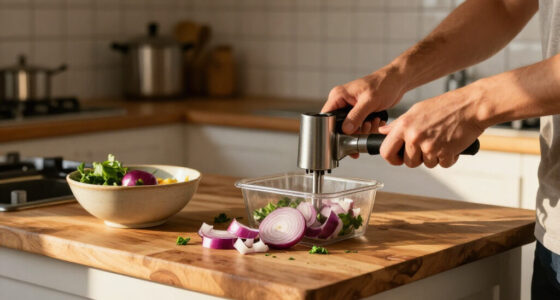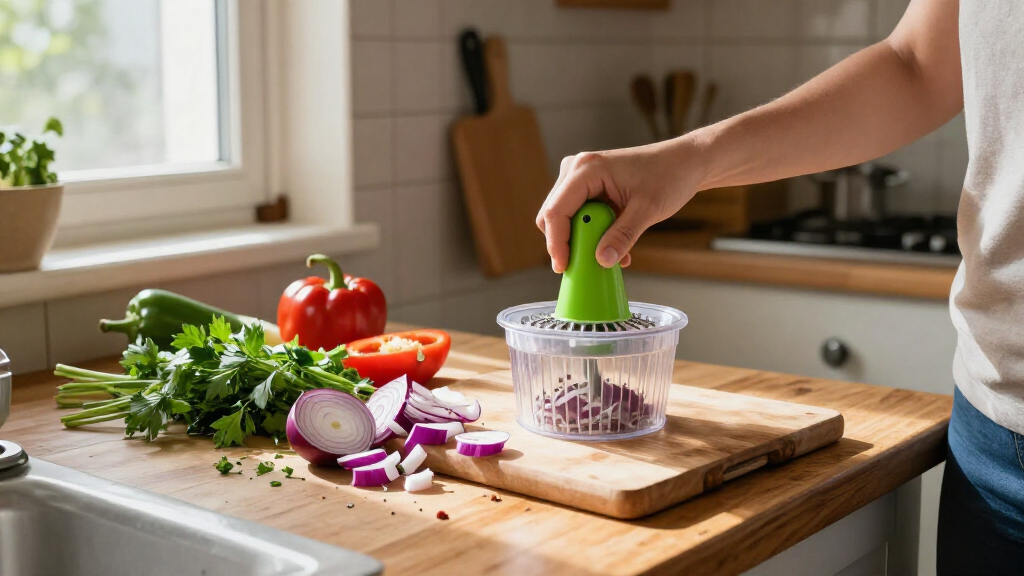

When choosing a manual food chopper, the main decision is how you want to supply the cutting motion. Pull-cord models use a handle and cord to spin a blade assembly inside a container; push-down models send a plunger or lid downward to chop as you press. Both can handle small batches without a powered appliance, but they feel different to use and suit different ingredients and routines.

Get kitchen gear delivered free with Prime
- Fast, free delivery on millions of items
- Prime Video, Amazon Music and more included
- Member-only deals all year

OXO Good Grips Vegetable Chopper with Easy-Grip Handle
- ✔ Brand: OXO
- ✔ Type: Manual vegetable chopper
- ✔ Blade material: Stainless steel

Ourokhome Manual Food Processor and Vegetable Chopper, 500 ml, Gray
- ✔ Brand: Ourokhome
- ✔ Capacity: 500 ml
- ✔ Operation: Manual pull-string

Mueller Pro Vegetable Chopper and Mandoline Slicer, 10-in-1
- ✔ Brand: Mueller Austria
- ✔ Model: MC-710 GG
- ✔ Recommended uses: Egg, vegetable
Pull-cord choppers are usually the better fit for repeated chopping, such as preparing onions, herbs, or vegetables for a meal. Their spinning action can produce a useful batch with several pulls, though the result depends on pull count and technique. Push-down models favor a direct, simple action and often take up less space, but each press contributes only a portion of the work. The comparison below focuses on effort, control, capacity, cleaning, durability, versatility, and value. Product designs vary, so check a specific model’s blade arrangement, usable capacity, and dishwasher guidance before buying.
At a Glance
| Criteria | Pull-cord manual food choppers | Push-down manual food choppers | Winner |
|---|---|---|---|
| Chopping speed | Repeated pulls spin the blades quickly for small batches. | Each press drives the blades; speed depends on how quickly and often you press. | A |
| Effort | Several pulls can do the work without repeated downward pressing. | Requires repeated downward pressure, which can tire the hand or wrist. | A |
| Cut-size control | More pulls usually mean finer results, but pieces can vary. | Press count offers some control, though results can be uneven. | Depends |
| Batch capacity | Often available with a larger lidded bowl; capacity varies by model. | Many are compact and suited to smaller quantities. | A |
| Cleaning | Bowl and blade may separate; corded lid can need careful wiping. | Simple parts can be easy to rinse, but lids may trap food. | Depends |
| Storage and durability | Compact, but the cord and retraction mechanism add moving parts. | Often has a straightforward mechanism; plunger or hinge quality matters. | B |
| Value | Worth paying a modest premium if frequent batch prep saves effort. | Can be a good low-cost choice for occasional, small jobs. | Depends |
OXO Good Grips Vegetable Chopper with Easy-Grip Handle
The OXO Good Grips Vegetable Chopper is our strongest match for cooks who want a dedicated manual tool for chopping vegetables, herbs, and nuts. Each press turns a rotating stainless steel blade, so the mechanism is built around repeating a simple motion rather than pulling a cord or swapping cutting plates. Compared with the Ourokhome, it gives us a catcher cup with measurement markings, which can make it easier to portion ingredients as we prep. The easy-grip handle also gives the pressing action a clear ergonomic focus.That single-purpose design is also its main boundary. We still supply the effort with each press, and the product is described for chopping rather than broader food processing. Unlike the Mueller, it does not claim to slice, julienne, grate, or shred. Its advantage is a more direct path from ingredient to chopped pieces, with a cup that catches the results and a body that disassembles for dishwasher-safe cleanup. We would choose it for regular, modest prep when chopping is the priority; cooks looking for a compact travel tool or multiple cut styles should look elsewhere.
Pros:
- Rotating stainless steel blade chops with each press.
- Catcher cup has measurement markings for gauging prepared ingredients.
- Easy-grip handle is designed for comfortable pressing.
- Disassembles for dishwasher-safe cleanup.
Cons:
- Requires repeated manual pressing to chop.
- Focused on chopping rather than the broader processing tasks associated with a food processor.
Best for: Home cooks who regularly chop vegetables, herbs, or nuts and value a marked catcher cup and a press-style mechanism.
Not ideal for: Buyers who want a pull-string portable chopper, broad slicing and shredding functions, or food-processor-style processing.
Bottom line: For a dedicated manual chopper that pairs a press action with a useful marked cup, the OXO is the most balanced choice in this lineup.
“For a dedicated manual chopper that pairs a press action with a useful marked cup, the OXO is the most balanced choice in this lineup.”
Ourokhome Manual Food Processor and Vegetable Chopper, 500 ml, Gray
For a small kitchen, campsite, or grill station, the Ourokhome Manual Food Processor makes a different compromise from the OXO: it trades a press handle and marked cup for a compact bowl operated by a pull string. Its three stainless steel blades sit at different heights and directions, and the stated uses include vegetables, fruit, nuts, herbs, and meat. Pulling the string more times lets us adjust the chopping texture, giving this model a straightforward way to move from a coarse chop toward a finer mince.The 500 ml capacity is the key limit. It suits a small batch and is more packable than a larger prep setup, but a bigger recipe may need several rounds. The OXO is a better fit if we want measurement markings and a pressing action; Ourokhome instead prioritizes portability and texture adjustment. It still takes manual work, this time through repeated pulls, and the product details do not specify a catcher cup with measurement marks. Dishwasher-safe care and a one-year warranty are listed, but buyers who want broader slicing options should consider the Mueller instead.
Pros:
- Three stainless steel blades are arranged at different heights and directions.
- Pull count provides a simple way to adjust chopping texture.
- Compact design is portable and needs no electricity.
- Dishwasher-safe care is listed.
Cons:
- The 500 ml capacity can require multiple rounds for larger recipes.
- Operation depends on manually pulling the string.
Best for: Cooks who need a compact, electricity-free chopper for small batches at home, while traveling, camping, or grilling.
Not ideal for: Anyone preparing large quantities in one go or seeking a press-style handle, marked measuring cup, or interchangeable slicing tools.
Bottom line: Choose Ourokhome when compact storage and adjustable small-batch chopping matter more than capacity or a marked catcher cup.
“Choose Ourokhome when compact storage and adjustable small-batch chopping matter more than capacity or a marked catcher cup.”
Mueller Pro Vegetable Chopper and Mandoline Slicer, 10-in-1
The Mueller Pro Vegetable Chopper and Mandoline Slicer is the pick for cooks who want one manual setup to do more than chop. Its interchangeable stainless steel blades are described for chopping, slicing, dicing, julienning, grating, and shredding, while a built-in container catches prepared food. That makes it more capable across different prep tasks than either the OXO or Ourokhome, both of which are presented primarily as choppers. A food holder helps control smaller ingredients during slicing, and the included cleaning fork is intended to help with cleanup.For a buyer focused strictly on chopped vegetables, that extra range may not justify the added pieces. The OXO keeps the task simpler with a rotating blade and marked cup, while Ourokhome is easier to position as a compact pull-string option. Mueller’s product details say some parts are dishwasher safe but do not identify which ones, and they do not specify materials for the container or other non-blade parts. We should expect to consult the product’s care instructions and manage interchangeable components. It makes the most sense when we will actually use its variety of cuts; for a quick, dedicated chopping routine, one of the simpler mechanisms is a clearer fit.
Pros:
- Interchangeable blades support several prep styles beyond chopping.
- Built-in container catches prepared ingredients.
- Food holder helps control small items while slicing.
- A cleaning fork and dishwasher-safe parts are included among the cleanup supports.
Cons:
- The available details do not specify the material of the container or other non-blade parts.
- The product information does not clarify which individual parts are dishwasher safe.
- Interchangeable blades mean more components to set up and manage than the dedicated choppers.
Best for: Meal preppers who want a manual tool for chopping plus slicing, dicing, julienning, grating, and shredding.
Not ideal for: Buyers who want a compact, single-purpose chopper with clearly specified care instructions for every part.
Bottom line: Mueller is the better choice when we will use its multiple cutting styles, but its added versatility is less compelling for chopping alone.
“Mueller is the better choice when we will use its multiple cutting styles, but its added versatility is less compelling for chopping alone.”
As an Amazon Associate we earn from qualifying purchases.
Key Differences
The motion changes the workload. A pull-cord model lets a short hand movement spin the blades, so a few pulls can process a small bowl of ingredients with less repetitive pressing. That tends to make it more comfortable for regular prep. A push-down chopper is mechanically straightforward: press the top and the blades move. It can be easy to understand and store, but the user supplies the force on every stroke.
Neither design guarantees uniform pieces. With either type, ingredients need to be cut to fit and the container should not be overloaded. Pulling or pressing more often generally makes the contents finer, but soft and firm ingredients can break down at different rates. Pull-cord models have an advantage for larger batches and repeated chopping; push-down versions make sense for occasional small amounts when simplicity, low cost, or compact storage matters more than speed.
Value follows usage. If a manual chopper will be used several times a week, paying somewhat more for a sturdy pull-cord model can be justified by reduced repetitive effort and faster prep. For a drawer-bound gadget used now and then, a basic push-down model is often the more sensible purchase. In either case, prioritize a stable base, a lid that stays secure, accessible blade assembly, and replacement-part availability where offered.
Detailed Comparison
Chopping speed (Pull-cord manual food choppers wins — moderate)
Pull-cord wins by a moderate margin. Each pull spins the blade assembly, so multiple cuts happen during one motion. A few pulls can take care of a small amount of onion or herbs faster than repeated presses. Push-down models chop incrementally as the user works the plunger, making them slower for a full bowl. For a single garlic clove, the difference is minor; for ingredients across a meal, it becomes noticeable.
Effort and comfort (Pull-cord manual food choppers wins — moderate)
Pull-cord wins for most repeated prep, with a moderate gap. Pulling a cord still takes hand strength and the grip can matter, but it avoids repeatedly pressing down on the lid. Push-down units ask for a firm stroke each time, which may be tiring for people with wrist discomfort or limited hand strength. A small task may feel easy on either; longer prep favors the pull mechanism.
Cut-size control (minor difference)
This depends on the user’s preferred rhythm. Both types can usually produce coarser or finer results by changing the number of pulls or presses, and neither replaces a knife when uniform dice matter. Pull-cord blades spin rapidly, so ingredients may move from chopped to pulsed very fine quickly. Push-down gives a clear stop between strokes, but that does not guarantee even pieces. The difference is minor and model-dependent.
Batch capacity (Pull-cord manual food choppers wins — moderate)
Pull-cord models often win by a moderate margin. Many use a bowl designed to contain a batch while the blades rotate, which is convenient for multiple servings. Push-down choppers tend to emphasize compactness and smaller quantities. Capacity differs widely, so compare usable bowl volume rather than exterior size. Overfilling either design reduces movement and can leave large pieces untouched.
Cleaning and maintenance (minor difference)
No universal winner. Push-down designs may have fewer moving parts to maintain, a minor advantage for simple rinsing. However, food can lodge around a plunger or under a lid. Pull-cord bowls and blades are often removable, while the corded lid must generally be kept out of water unless the maker explicitly permits washing. Check dishwasher instructions and whether the blade assembly comes apart safely; these details matter more than the category.
Storage and durability (Push-down manual food choppers wins — minor)
Push-down has a slight simplicity advantage, but durability depends on construction. A compact press design can fit easily in a drawer and has no retracting cord mechanism. A pull-cord model remains compact too, but its cord, spring, and lid add parts that can fail with rough use. On either type, a secure lid, sturdy pull or plunger, and replaceable blade assembly matter more than a low advertised price.
Value for money (moderate difference)
It depends on frequency of use. A lower-priced push-down chopper is often better value for occasional small tasks, because paying extra for a pull mechanism brings little benefit if it rarely leaves the drawer. For regular meal preparation, the pull-cord premium can be worthwhile: it reduces repetitive pressing and processes batches faster. Compare build quality and warranty alongside price; the cheapest option is poor value if its mechanism fails early.
Pull-cord manual food choppers: Pros and Cons
Pros:
- Processes small batches quickly with repeated blade rotation.
- Requires less repeated downward pressure than a push-down design.
- Often suited to meal-prep quantities and ingredients such as onion, herbs, and vegetables.
Cons:
- Cord and retraction mechanism add parts that may wear or jam.
- Pull count and ingredient type affect consistency.
- The lid mechanism may need careful cleaning and cannot always be immersed.
Push-down manual food choppers: Pros and Cons
Pros:
- Direct press action is simple to understand.
- Often compact and suitable for small, occasional jobs.
- Fewer moving parts can make the mechanism straightforward.
Cons:
- Repeated pressing can take longer and tire the hand.
- Small capacity on many models limits batch use.
- A plunger or lid can trap food and require detailed cleaning.
Who Should Choose What
Choose Pull-cord manual food choppers if:
- You regularly chop onions, herbs, or vegetables for several servings.
- You want a faster manual process and prefer pulling to repeated downward pressing.
- You value a contained bowl and can maintain a cord mechanism according to its care instructions.
Choose Push-down manual food choppers if:
- You chop small quantities only occasionally.
- You prefer a direct press action and a compact, mechanically simple gadget.
- Your budget is tight and speed or larger batch capacity is not a priority.
Skip both if: You need consistently uniform dice, large-volume prep, or frequent processing of hard ingredients. A knife, a larger manual processor, or an electric food processor will be a better fit.
Value for Money
Paying more for a pull-cord chopper makes sense when it will be used regularly: the faster spinning action can reduce time and repeated hand pressure across many small prep jobs. The premium is less compelling if the chopper is only for occasional garlic or a small garnish. In that case, a basic push-down unit can deliver better value, provided it feels stable and its parts are easy to clean. Judge value by usable capacity, blade access, lid security, warranty, and likely frequency of use, not by the number of advertised functions.
Final Verdict
For most people who plan to use a manual chopper often, choose a pull-cord model. It is generally faster for small batches and asks for less repetitive pressing, making it the stronger everyday prep tool. Choose a push-down model if you only need occasional small portions, want a compact and simple mechanism, and would rather keep the purchase price low. The deciding factor is frequency: regular prep can justify paying more for the pull-cord action; sporadic use usually cannot. Skip both if precise, even cuts or high-volume processing are the priority.
Frequently Asked Questions
Are pull-cord or push-down manual choppers better for onions?
For a small bowl of onion, a pull-cord chopper is usually faster because each pull spins the blades repeatedly. Use short pulls and check the pieces between them; too many can turn onion into a wet, uneven mince. A push-down model can handle a small amount too, but repeated presses take longer.
Can either type make evenly diced vegetables?
Neither is a reliable substitute for knife work when uniform dice matter. Pieces vary with ingredient firmness, how full the bowl is, blade arrangement, and the number of pulls or presses. Both are better for rough chopping than precise cuts.
Which manual food chopper is easier to clean?
That depends on the specific design. A removable bowl and blade assembly help with either type. Push-down models may have a simpler mechanism, while pull-cord lids often need wiping without soaking. Follow the maker’s washing instructions and handle exposed blades carefully.
Is a more expensive pull-cord chopper worth it?
It can be worth the extra cost if you prepare ingredients often or tend to chop more than a token amount at once. The faster action and reduced repetitive pressing can make routine prep easier. For occasional small jobs, a well-made push-down chopper is usually better value.