
TL;DR

Get kitchen gear delivered free — and shop member deals
- Fast, free delivery on millions of items
- Access to Prime Big Deal Days deals on October 6–7
- Prime Video, Amazon Music and more included
A Good Housekeeping report draws on two registered dietitians to identify eight fiber-rich foods that pair well with cottage cheese, including beans, avocados, baked potatoes, oat flour, chickpeas, fruit, protein pasta, and chia jam. The pairings address cottage cheese’s main nutritional gap: it is high in protein but contains virtually no fiber.
A new Good Housekeeping report outlines the eight best foods to pair with cottage cheese for added fiber, drawing on recommendations from two registered dietitians. The list — bean chili, avocado, baked potatoes, oat flour, chickpeas, fruit, protein pasta, and chia seed jam — offers specific serving ideas and fiber estimates for readers looking to close a nutritional gap: cottage cheese is protein-rich but contains almost no fiber on its own.
The recommendations come from Lauren Zenker and Luciana Soares, DCN, RDN, LDN, a professor and department director of nutrition and dietetics at Johnson & Wales University. Their suggestions are aimed at practical meal applications rather than supplements or specialty products.
Topping bean chili with cottage cheese instead of shredded cheese or sour cream is the first recommendation. Zenker notes that beans supply roughly 15 grams of fiber per cup, and a chili combining black beans, kidney beans, lentils, and chickpeas could deliver 10 to 20 grams of fiber per serving, according to her estimates. The cottage cheese adds protein while remaining lower in saturated fat than the alternatives.
Other pairings include an avocado-cottage cheese dip served with sweet-potato chips — one avocado contains about 9 grams of fiber — and baked russet or sweet potatoes topped with cottage cheese, where keeping the skin on matters most since the fiber is concentrated there. A medium potato has about 2 grams of fiber, a medium sweet potato about 4 grams, and pumpkin seeds sprinkled on top add roughly 5 grams per ounce, per the report.
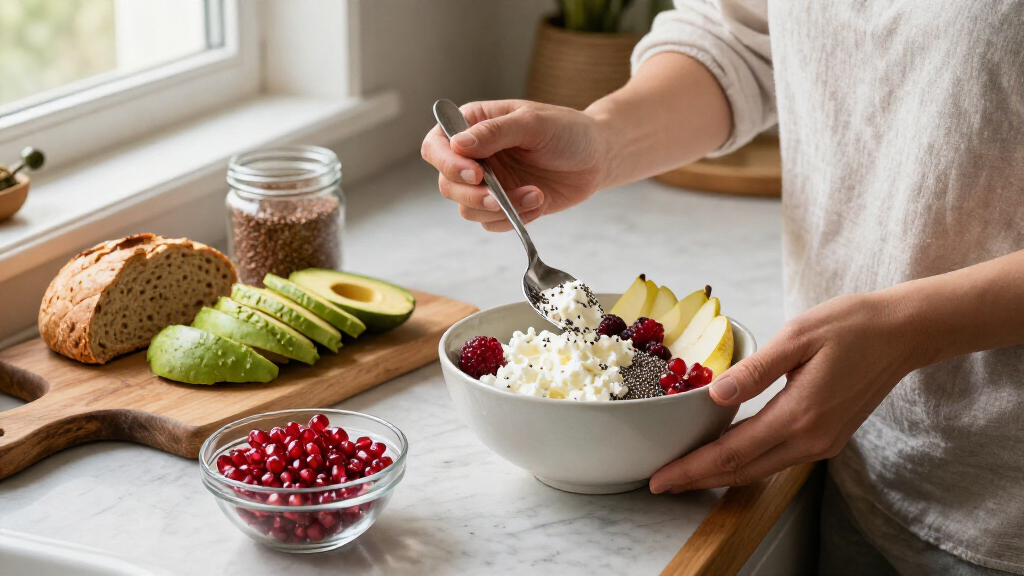
Soares also outlines an oat flour pancake recipe combining 1 cup of 2% cottage cheese, four eggs, and 1 cup of oat flour, which she says provides about 7 grams of fiber and 30 grams of protein per serving. A chickpea-and-vegetable bowl over cottage cheese supplies about 8 grams of fiber, and a fruit bowl with peach, blueberries, strawberries, chia seeds, and cinnamon provides 7 grams per serving. Homemade chia seed jam rounds out the list: “Depending on how you make it, chia jam can provide 4 to 8 grams of fiber per 2 tablespoons,” Zenker says.
Why the Fiber Gap Matters
Cottage cheese has surged in popularity as a high-protein, relatively low-fat food, but on its own it supplies negligible fiber. Most adults fall short of recommended fiber intake — generally cited as at least 25 to 38 grams per day — and low fiber intake is associated with digestive issues and other health risks. The report’s value is in showing how a trendy protein food can be converted into a complete meal or snack with simple, widely available additions, rather than requiring separate fiber sources or supplements.
Cottage Cheese’s Rise as a Protein Staple
Cottage cheese has become a fixture in high-protein diets in recent years, appearing in everything from breakfast bowls to viral dessert recipes. Dietitians have generally praised its protein content while pointing out its lack of fiber. The Good Housekeeping guide follows a familiar format in nutrition coverage: registered dietitians suggest whole-food pairings with quantified fiber estimates, along with preparation methods such as Soares’s twice-baked sweet potato with cottage cheese, pumpkin seeds, cinnamon, and maple syrup, and her blended cottage cheese sauce for protein pasta with zucchini, spinach, and cherry tomatoes.
Estimates, Not Clinical Findings
The fiber figures in the report are dietitian estimates that vary with portion sizes, specific ingredients, and preparation methods — for example, Zenker’s bean chili estimate spans a wide 10-to-20-gram range. The piece is a consumer nutrition guide, not peer-reviewed research, and it does not claim clinical outcomes from these pairings. Individual fiber needs also differ by age, sex, and activity level, which the report does not address in detail.
Trying the Pairings at Home
Readers can test the suggested combinations using the report’s recipes, most of which use common pantry ingredients and standard kitchen equipment such as a blender or nonstick skillet. Anyone with specific dietary goals or digestive conditions may want to consult a registered dietitian about their individual fiber targets before making large increases to intake, since fiber should generally be raised gradually.
Key Questions
Why does cottage cheese need fiber pairings?
Cottage cheese is high in protein but contains virtually no fiber, so pairing it with foods like beans, fruit, or chia seeds turns it into a more balanced, filling meal.
Which pairing provides the most fiber?
According to Zenker, a bean chili made with several legume varieties and topped with cottage cheese could contain more than 10 to 20 grams of fiber per serving, the highest estimate in the report.
Is homemade chia jam better than store-bought?
Zenker says homemade chia jam can provide 4 to 8 grams of fiber per 2 tablespoons depending on how it is made, compared with about 4 grams per tablespoon for some store-bought versions.
Are these recommendations based on research?
No. They are practical suggestions from two registered dietitians published by Good Housekeeping, with fiber estimates that vary by ingredients and portions, not findings from clinical studies.
Source: rss
Fall Picks
fall essentials
As an affiliate, we earn on qualifying purchases.